



Episode 12: Marfan Syndrome — Why Does a Single FBN1 Variant Cause Systemic Disease?
What Is Marfan Syndrome?
Marfan syndrome (MFS) is an autosomal dominant connective tissue disorder caused by pathogenic variants in the FBN1 (Fibrillin-1) gene.
Prevalence is estimated at approximately 1 in 5,000–10,000, with no significant difference by race or sex.
The three organ systems most characteristically affected are:
- Cardiovascular system
- Skeletal system
- Ocular system
All three share a common feature: they are rich in fibrillin-based connective tissue.
Most people first picture tall stature and long limbs, but the most clinically critical concern is aortic dissection. Without timely diagnosis, life-threatening cardiovascular complications can occur at a young age — making early diagnosis especially important for Marfan syndrome.
Characteristic Physical Findings in Marfan Syndrome
Marfan syndrome presents with a relatively distinctive physical appearance:
- Tall, slender build
- Long limbs (dolichostenomelia)
- Long, slender fingers (arachnodactyly)
- Wrist sign / Thumb sign
- Pectus excavatum / Pectus carinatum
- Scoliosis
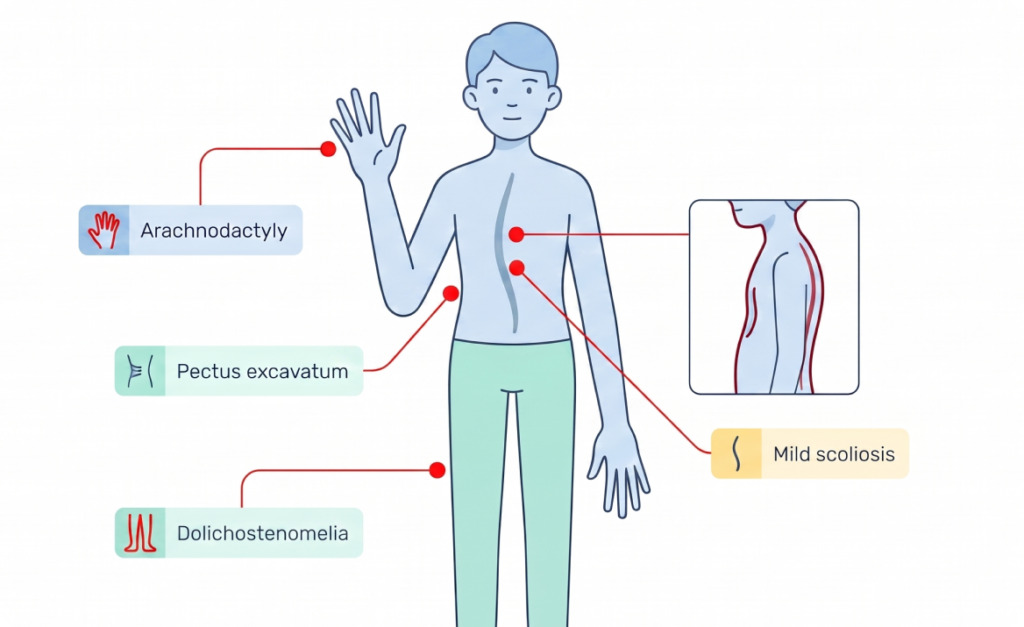
However, these physical features alone cannot confirm a diagnosis. Diagnosis is actually based on the Revised Ghent Nosology, which evaluates clinical findings — including aortic root dilatation and ectopia lentis — together with genetic testing results.
What Kind of Gene Is FBN1?
FBN1 encodes Fibrillin-1, a large extracellular matrix protein made up of approximately 2,871 amino acids.
Fibrillin-1 is not elastic fiber itself, but rather serves as the core scaffold of the microfibril. In other words, it provides the external structural support that allows elastin to be properly organized and tissue elasticity to be maintained.
These microfibrils are especially abundant in:
- The aortic wall
- The ciliary zonules that support the lens
- Ligaments
- Skin
- Lungs
Two Mechanisms Underlying Marfan Syndrome
FBN1 variants do more than simply weaken structural integrity. Two major pathophysiological mechanisms are currently recognized.
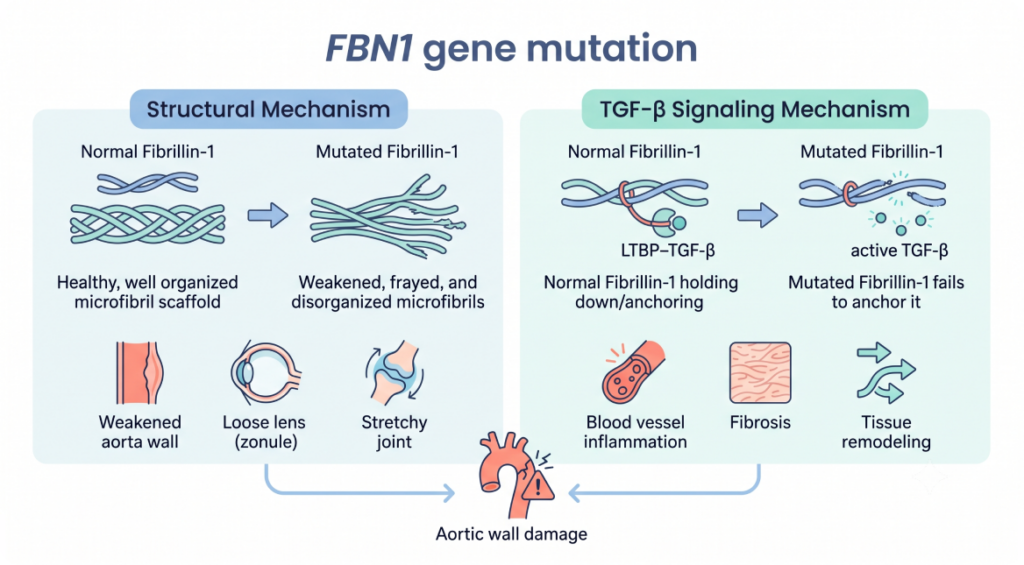
1. Structural Mechanism
This is the most intuitive mechanism. Normal fibrillin-1 forms microfibrils that maintain the mechanical strength of tissue. Depending on the type of variant, pathogenic FBN1 variants impair microfibril formation and function through either a dominant-negative effect or haploinsufficiency, reducing both microfibril formation and stability.
As a result:
- The aortic wall weakens
- The zonules supporting the lens rupture
- Ligaments and skeletal structures become excessively lax
2. TGF-β Signaling Mechanism
This mechanism has received growing attention in recent research. Fibrillin is not merely a structural protein — under normal conditions, it also anchors LTBP (Latent TGF-β Binding Protein) to microfibrils, keeping TGF-β from becoming activated beyond what is needed.
When FBN1 is mutated, the latent TGF-β complex fails to remain properly anchored, leading to increased active TGF-β signaling. This drives vascular remodeling, fibrosis, ECM degradation, and inflammatory responses — further worsening aortic pathology.
In short, Marfan syndrome is now understood as a disease driven by both structural failure and dysregulated signaling acting together.
Same FBN1, Different Diseases — Why?
Interestingly, not all FBN1 variants cause Marfan syndrome. Depending on where the variant occurs, a range of distinct disorders can result:
- Isolated ectopia lentis
- Neonatal Marfan syndrome
- Weill-Marchesani syndrome
- Acromicric dysplasia
- Geleophysic dysplasia
- Stiff Skin Syndrome
Variants in exons 24–32 are strongly associated with severe Neonatal Marfan syndrome. In contrast, some variants within the 8-cysteine (TB) domains are more closely associated with Acromicric dysplasia or Geleophysic dysplasia. Variants at the RGD site within the 8-cysteine domain 4 (TB4) are linked to Stiff Skin Syndrome, and variants in the C-terminal region of FBN1 are known to cause Progeroid Fibrillinopathy.
In other words, simply having “an FBN1 variant” matters far less than which domain the variant occurs in and what type of variant it is.
Major Clinical Features of Marfan Syndrome
1. Cardiovascular
- Aortic root dilatation
- Aortic aneurysm
- Aortic dissection
- Mitral valve prolapse
This is the single most important determinant of patient prognosis.
2. Ocular
The hallmark feature is ectopia lentis (lens dislocation), which occurs when the fibrillin-rich zonules supporting the lens weaken.
Patients are also at increased risk for high myopia, retinal detachment, early cataracts, and glaucoma.
3. Skeletal
Tall stature, arachnodactyly, scoliosis, pectus deformity, and joint hypermobility are commonly observed.
How Is Marfan Syndrome Diagnosed?
The Revised Ghent Nosology (2010) is the most widely used diagnostic framework today. In the absence of a family history, a diagnosis can be made if any one of the following is satisfied:
- Aortic root enlargement + Ectopia lentis
- Aortic root enlargement + Pathogenic FBN1 variant
- Aortic root enlargement + Systemic score ≥7
- Ectopia lentis + a pathogenic FBN1 variant associated with aortic disease
In other words, diagnosis is not based on genetic test results alone — interpreting them together with clinical findings is essential.
How Does Clinical Genetics Interpret FBN1 Variants?
FBN1 is a very large gene composed of 65 exons, and pathogenic variants are not confined to a single hotspot. This makes full-gene analysis essential.
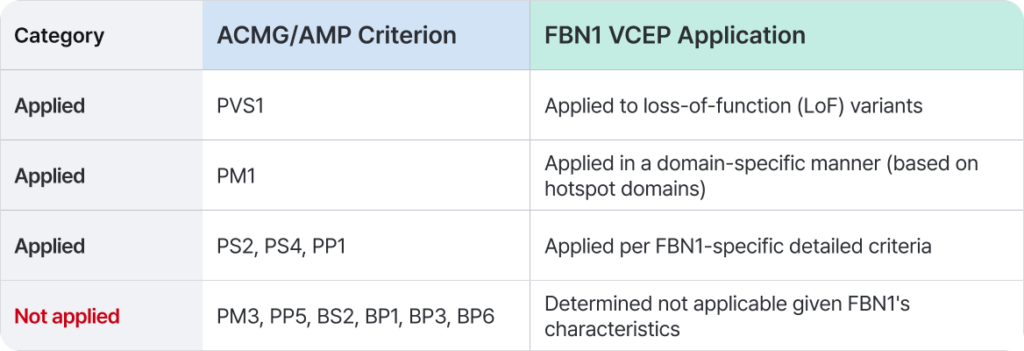
Clinical genetics laboratories currently apply FBN1-specific ACMG/AMP criteria issued by the ClinGen FBN1 Variant Curation Expert Panel (VCEP). These criteria adapt the general ACMG guidelines to the specific characteristics of FBN1, and include:
- Application of PVS1 for loss-of-function variants
- Domain-specific PM1 criteria
- Various FBN1-specific rule applications, including PS2, PS4, and PP1
- Decisions to not apply PM3, PP5, BS2, BP1, BP3, and BP6
Pilot studies applying these disease-specific rules reported a reduction in VUS classifications and an increase in (Likely) Pathogenic and Benign classifications, improving the consistency and accuracy of variant interpretation.
Conclusion
Marfan syndrome is not simply about being tall — it is a systemic disease in which both the structural stability of connective tissue and TGF-β signal regulation break down simultaneously.
Because FBN1 functions both as a structural protein and as a regulator of growth factor signaling, a single gene defect can affect the cardiovascular, ocular, and skeletal systems all at once.
Furthermore, depending on its location and functional impact, the same FBN1 variant can cause not only Marfan syndrome but also a range of other fibrillinopathies — making it essential in clinical practice to interpret variants in light of both their position and their underlying mechanism.
See How GEBRA Supports FBN1 Variant Interpretation
Genes like FBN1, where clinical significance shifts by domain and mechanism, are difficult to interpret consistently without standardized curation criteria. See how GEBRA supports the variant interpretation workflow firsthand.
FAQ
Q. Is Marfan syndrome inherited?
A. Marfan syndrome is inherited in an autosomal dominant pattern. If one parent carries the variant, there is a 50% chance of passing it to each child; the condition can also arise from a new (de novo) variant with no family history.
Q. If someone has an FBN1 variant, does that always mean Marfan syndrome?
A. No. Depending on the location and type of the FBN1 variant, other distinct disorders can occur instead, including Weill-Marchesani syndrome, Acromicric dysplasia, and Geleophysic dysplasia.
Q. What is the most dangerous complication of Marfan syndrome?
A. Aortic dissection. It results from progressive weakening of the aortic wall, and early diagnosis along with regular cardiovascular monitoring is the single most important factor in determining prognosis.
Q. What criteria are used to diagnose Marfan syndrome?
A. Diagnosis follows the Revised Ghent Nosology (2010), which integrates aortic root dilatation, ectopia lentis, presence of a pathogenic FBN1 variant, and systemic score. Genetic test results alone are not used for diagnosis — they are interpreted together with clinical findings.
References
- Sakai LY, Keene DR, Renard M, De Backer J. FBN1: The Disease-Causing Gene for Marfan Syndrome and Other Genetic Disorders. Gene. 2016.
- Dietz H. FBN1-Related Marfan Syndrome. GeneReviews®. 2022.
- Loeys BL, Dietz HC, Braverman AC, et al. The revised Ghent nosology for the Marfan syndrome. J Med Genet. 2010.
- Habashi JP, Judge DP, Holm TM, et al. Losartan, an AT1 antagonist, prevents aortic aneurysm in a mouse model of Marfan syndrome. Science. 2006.
- Faivre L, Collod-Béroud G, Loeys BL, et al. Effect of mutation type and location on clinical outcome in 1,013 probands with Marfan syndrome. Am J Hum Genet. 2007.
- Baudhuin LM, Kotzer KE, Lagerstedt SA. Increased frequency of FBN1 truncating and splicing variants in Marfan syndrome patients with aortic events. Genet Med. 2015.
Full series
View all

3billion Inc.
3billion is dedicated to creating a world where patients with rare diseases are not neglected in diagnosis and treatment.