


[Interpretation Notes #2] ROH vs. UPD: Similar Genomic Patterns, Different Biological Meanings
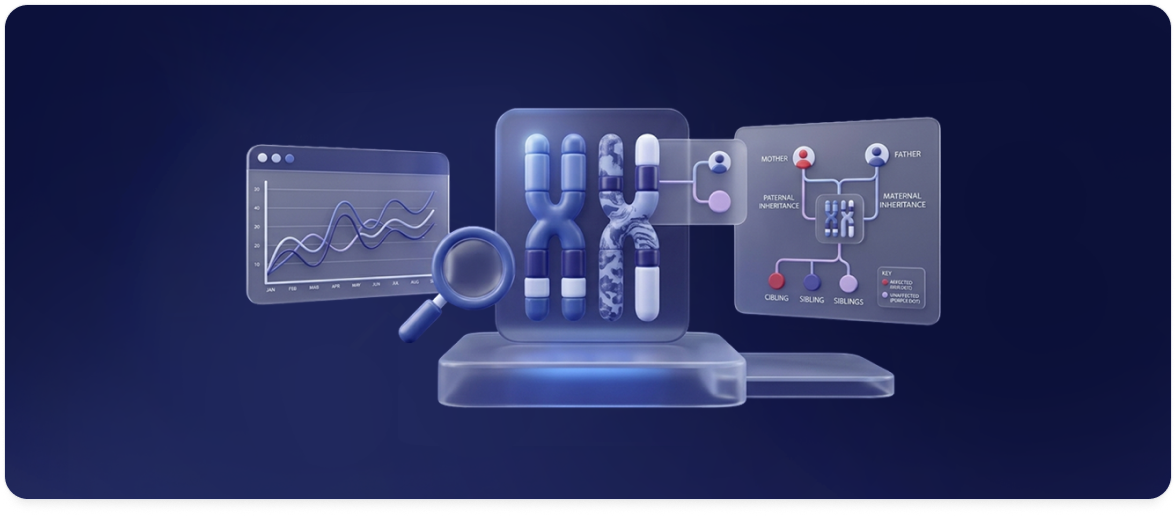
Genomic sequencing can reveal long stretches of the genome in which the variants are predominantly homozygous. These regions of homozygosity (ROH) can provide important clues about an individual’s inheritance pattern and may help identify clinically relevant genetic mechanisms.
One mechanism that can produce a large ROH is uniparental disomy (UPD). However, an ROH does not necessarily indicate UPD, and UPD itself does not always produce an ROH. Understanding this distinction is important when interpreting ROH detected from genomic data.
Frequently Asked Questions (FAQ)
Q1. If a large ROH is detected, does that confirm UPD?
A. No. An ROH is a genomic observation rather than a diagnosis. Large ROHs can also arise through identity by descent (IBD), where both parents transmit the same ancestral chromosomal segment, or through consanguinity more broadly. That said, a very large ROH confined to a single chromosome is a reason to consider UPD — particularly isodisomy — as a leading candidate mechanism.
Q2. Can ROH analysis detect every form of UPD?
A. Not reliably. Isodisomy is comparatively straightforward to detect, because both copies derive from the same parental homolog and produce a clear ROH. Pure heterodisomy, however, may retain heterozygosity and therefore may not be identifiable by ROH detection alone.
Q3. If an ROH raises suspicion for UPD, what additional testing is needed?
A. ROH alone cannot establish parental origin. Parental genotyping or parent-of-origin analysis is the primary next step. Where appropriate — for example, when a known imprinting disorder region is involved — methylation testing may also be required to establish whether UPD is actually present and to determine its parental origin.
1. What is a region of homozygosity (ROH)?
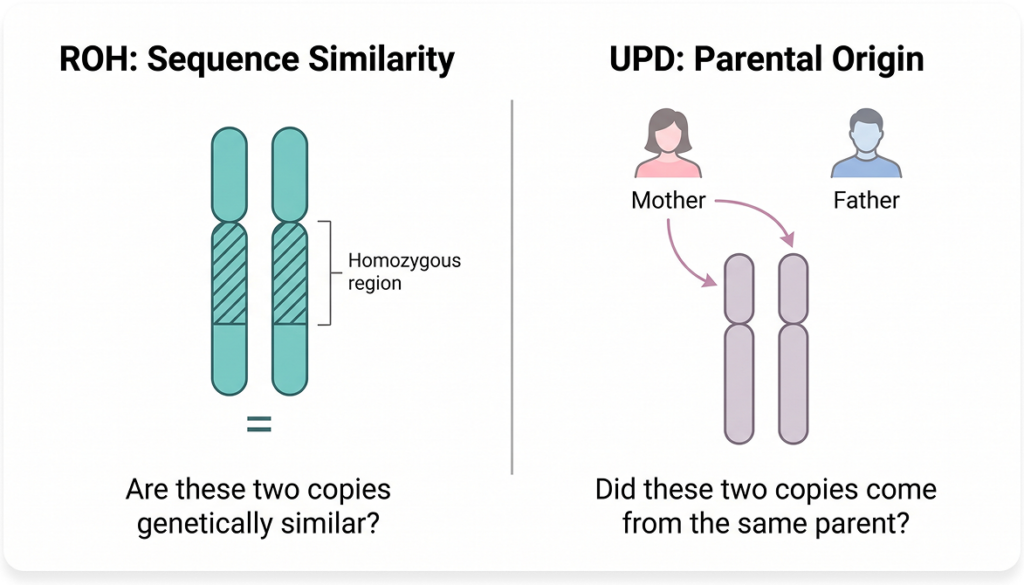
A region of homozygosity (ROH) is a continuous genomic segment containing many homozygous variants with little or no heterozygosity. In other words, the two chromosomal copies within this region contain highly similar sequences.
ROHs can arise through several mechanisms. One common explanation is identity by descent (IBD), in which both parents inherited the same ancestral chromosomal segment and transmitted it to their child. For this reason, the number, size, and chromosomal distribution of ROHs can provide information about parental relatedness.
- Multiple large ROHs distributed across several chromosomes are more suggestive of parental relatedness or shared ancestry.
- A very large ROH restricted to a single chromosome may raise suspicion for other mechanisms, including uniparental isodisomy.
Importantly, an ROH is primarily a genomic observation rather than a diagnosis. Its clinical significance depends on where the ROH occurs and what genes or regulatory regions are contained within it.
What the ACMG technical standard notes Genomic testing — including SNP-based chromosomal microarray, exome sequencing, and genome sequencing — can identify large regions of homozygosity, and the distribution of these regions can provide clues to consanguinity or possible UPD. (Gonzales PR, et al., ACMG technical standard, Genet Med 2022)
A note on terminology. The literature uses several overlapping terms for this observation: ROH, AOH (absence of heterozygosity), LOH (loss of heterozygosity, more common in the somatic/oncology context), and LCSH (long contiguous stretches of homozygosity). In constitutional genomic analysis these largely describe the same finding. This article uses ROH throughout.
2. What is uniparental disomy (UPD)?
Uniparental disomy describes a different concept. Normally, an individual inherits one copy of each autosomal chromosome from the mother and one from the father. In UPD, both homologous chromosomes — or, in segmental UPD, both copies of a chromosomal region — originate from the same parent.
So while ROH describes sequence similarity between the two copies, UPD describes their parental origin.
This distinction matters because UPD occurs in two major forms.
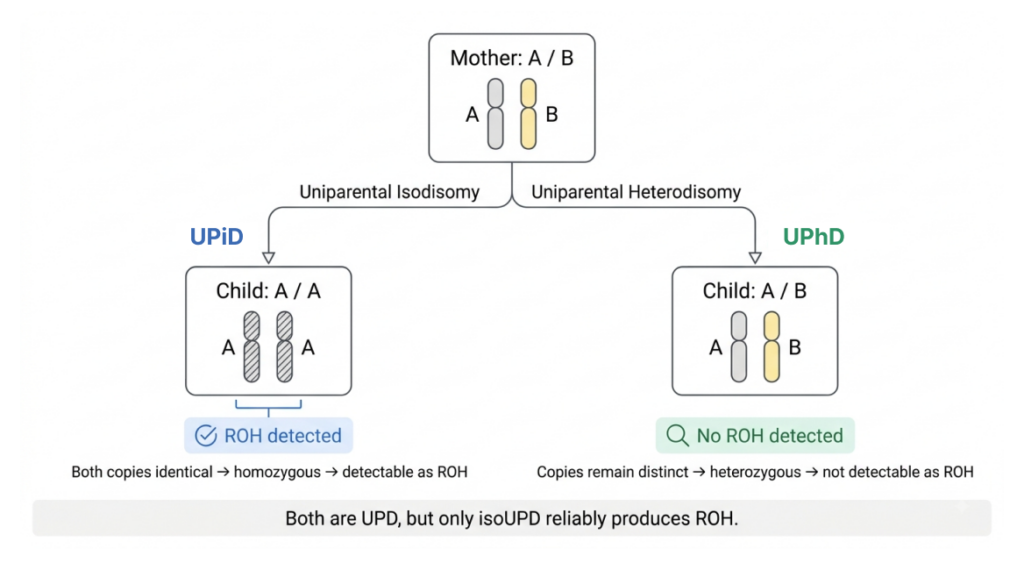
Uniparental isodisomy (UPiD)
In isodisomy, two copies of the same parental chromosome or chromosomal segment are present.
Mother: A / B → Child: A / A
Because the two copies derive from the same parental homolog, the affected region becomes homozygous.
→ UPiD typically produces an ROH.
This also explains a clinically important consequence of isodisomy: a pathogenic recessive allele carried by only one parent can become homozygous in the child, potentially causing an autosomal recessive disorder.
Uniparental heterodisomy (UPhD)
In heterodisomy, the child inherits both different homologous chromosomes from the same parent.
Mother: A / B → Child: A / B
The chromosomes have the same parental origin, but they are not identical.
→ UPhD may not produce a detectable ROH.
This is one of the most important distinctions between ROH and UPD. A method that detects UPD primarily by identifying homozygous regions is naturally more sensitive to isodisomy than to pure heterodisomy.
3. ROH and UPD overlap — but they are not interchangeable
The two concepts intersect clinically, but they are not substitutes for one another. ROH describes sequence similarity; UPD describes parental origin.
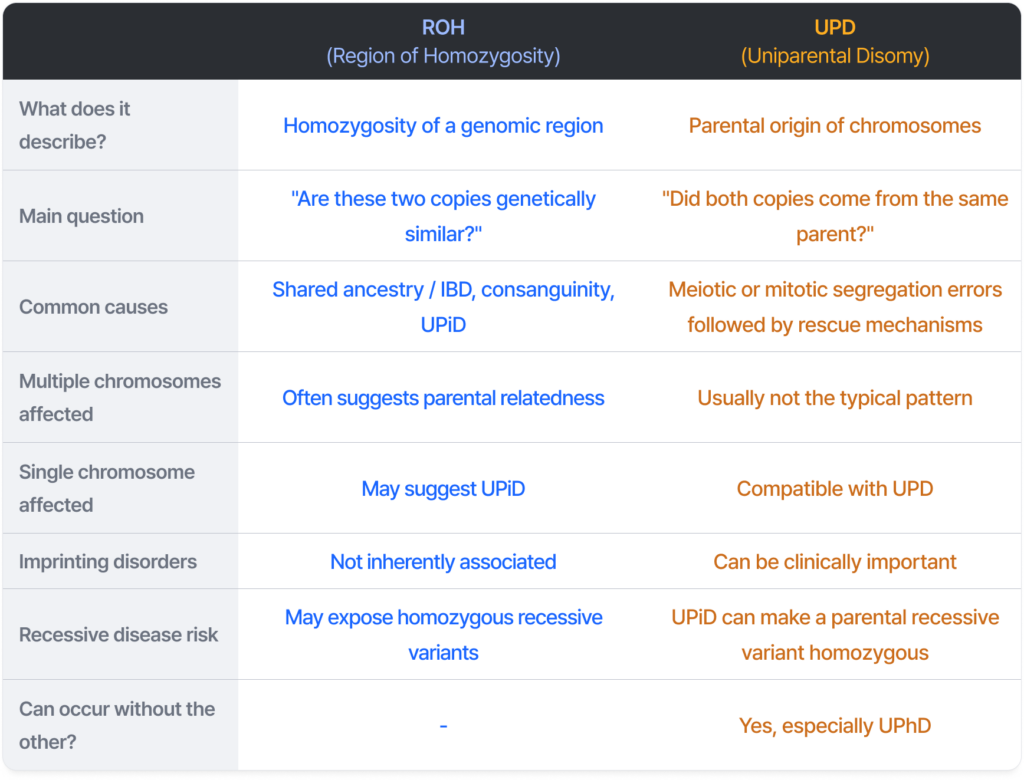
The relationship should therefore not be read as ROH = UPD. A more accurate framing is:
ROH (genomic observation)
↓ evaluate distribution and location
Possible UPD candidate
4. Why does the distinction matter clinically?
UPD can cause disease through two major mechanisms.
4-1. Genomic imprinting
For most autosomal genes, whether an allele originates from the mother or the father does not determine its expression. Certain genes, however, are imprinted, meaning their expression depends on parental origin. Inheriting both copies of an imprinted region from the same parent can therefore disrupt the normal balance of parent-of-origin-specific gene expression.
This mechanism is associated with well-established imprinting disorders involving several chromosomes, including chromosomes 6, 7, 11, 14, 15, and 20. UPD of chromosome 15, for example, can contribute to Prader-Willi syndrome or Angelman syndrome depending on the parental origin of the chromosomes.
4-2. Unmasking an autosomal recessive variant
Consider a parent carrying a pathogenic recessive allele:
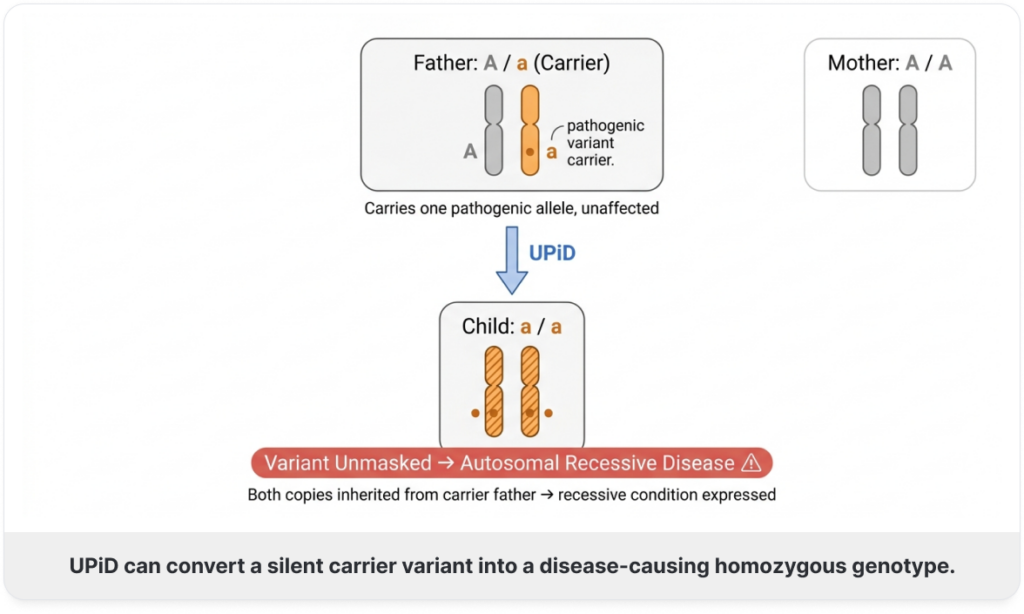
Parent: A / a (a = pathogenic recessive allele)
↓ UPiD
Child: a / a
Through isodisomy, the child can inherit two pathogenic copies even though the other parent does not carry the variant.
An apparently homozygous pathogenic variant — particularly when located within a large single-chromosome ROH — may therefore warrant evaluation of UPD as a possible underlying mechanism.
5. From ROH detection to UPD interpretation
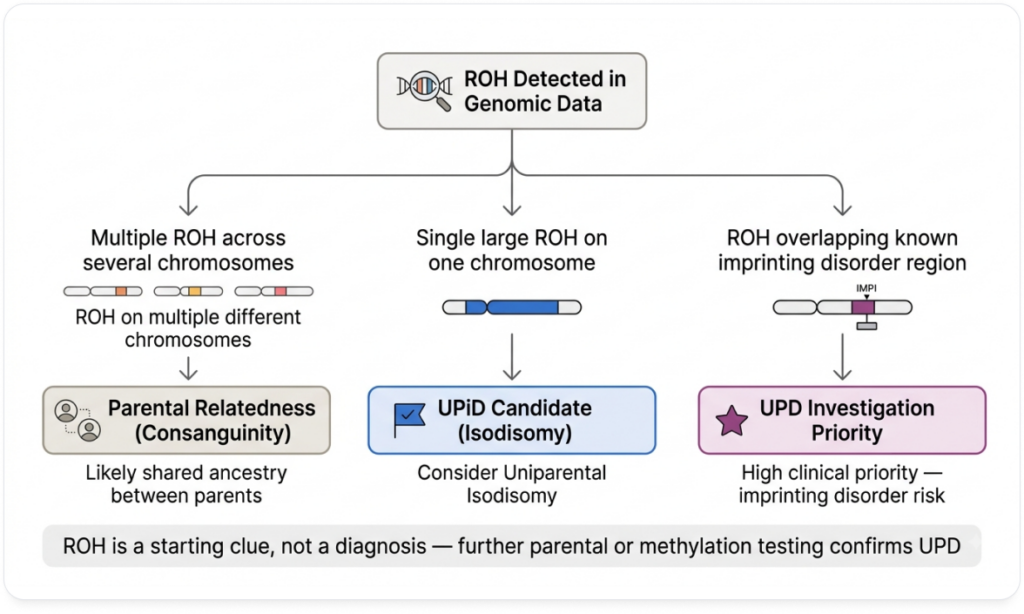
A large ROH does not by itself prove that UPD has occurred. Its size, chromosomal distribution, genomic location, and overlap with clinically relevant regions should all be evaluated.
In practice, three patterns guide interpretation:
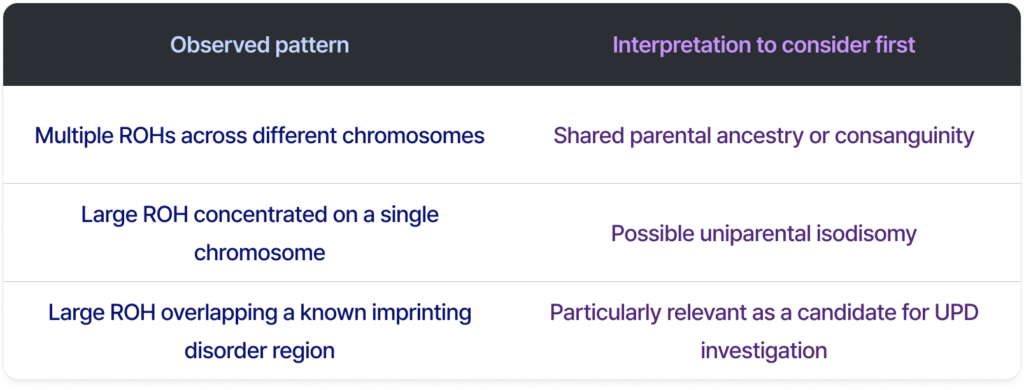
Because ROH is a genomic observation, establishing parental origin requires additional testing. Parental genotyping or parent-of-origin analysis is the primary next step; where appropriate, methylation testing may also be required to establish whether UPD is actually present and to determine its parental origin.
6. How GEBRA handles ROH and UPD
GEBRA separates the detection of homozygous genomic regions from their potential clinical interpretation.
- ROH detection and initial review. The ROH section presents regions of homozygosity identified in the patient, allowing users to examine their size and genomic distribution — including whether they are spread across multiple chromosomes or concentrated on one.
- UPD candidate listing. When an ROH overlaps a known imprinting disorder region and exceeds the predefined threshold, the region is additionally listed as a candidate in the UPD variant tab.
The workflow can therefore be understood as:
ROH detection
↓
Evaluation of size and genomic location
↓
Overlap with a known imprinting disorder region
↓
Listed as a potential UPD candidate
This structure reflects the point above: an ROH is evidence that may raise suspicion for UPD, rather than definitive evidence of UPD itself.
One limitation is worth stating explicitly. ROH-based analysis primarily captures the isodisomic component of UPD. Pure heterodisomy may retain heterozygosity and therefore may not be identifiable through ROH detection alone — results should be interpreted with that constraint in mind.
Key takeaway
Although ROH and UPD are closely related concepts, they describe fundamentally different genomic phenomena.
ROH tells us how similar the two chromosomal copies are. UPD tells us where those two copies came from.
A large ROH may result from shared ancestry or from uniparental isodisomy, while heterodisomic UPD can occur without producing a large ROH. Identifying an ROH — especially one involving a single chromosome or overlapping an imprinting disorder region — should therefore be viewed as a starting point for UPD evaluation rather than confirmation of UPD.
In clinical practice, these genomic clues are followed up with parental genotyping or methylation testing to establish whether UPD is actually present and to determine its parental origin.
💡 See how this looks in your own cases
GEBRA presents ROH size and chromosomal distribution, and lists regions that overlap known imprinting disorder loci as UPD candidates.
References
- Gonzales PR, et al. Interpretation and reporting of large regions of homozygosity and suspected consanguinity/uniparental disomy, 2021 revision: A technical standard of the American College of Medical Genetics and Genomics (ACMG). Genetics in Medicine. 2022;24:255–261.
- Benn P. Uniparental disomy: Origin, frequency, and clinical significance. Prenatal Diagnosis. 2021;41:564–572.
- Kawashima S, et al. Uniparental disomy as a cause of pediatric endocrine disorders. Clinical Pediatric Endocrinology. 2018.
- Liehr T. Cytogenetic contribution to uniparental disomy (UPD). Molecular Cytogenetics. 2010.
Full series
View all
- [Interpretation Notes #1] 3bCNV: WES vs. Panel Detection Criteria
- [Interpretation Notes #2] ROH vs. UPD: Similar Genomic Patterns, Different Biological Meanings
- [Interpretation Notes #3] Why IGV Read Counts Differ from GATK HaplotypeCaller Allelic Depth (AD)

3billion Inc.
3billion is dedicated to creating a world where patients with rare diseases are not neglected in diagnosis and treatment.