



[Interpretation Notes #1] 3bCNV: WES vs. Panel Detection Criteria
Frequently Asked Questions (FAQ)
Q1. Why doesn’t 3bCNV detect a 1-exon deletion in WES?
A. At WES’s average depth of ~100x, it’s difficult to distinguish whether a decrease in read depth at a single exon reflects a true variant or simple sequencing fluctuation (noise). (The exception is homozygous deletion, where reads are entirely absent — this can still be detected.)
Q2. Can 3bCNV determine the exact breakpoint (base-pair position)?
A. No. Because the method infers regions based on changes in Depth of Coverage, it cannot pinpoint exact base-level start and end positions, and variants smaller than 1 kb are excluded by default.
1. Two Technical Approaches to CNV Detection
Technical methods for detecting Copy Number Variants (CNVs) in NGS data broadly fall into two categories, depending on what is being analyzed.
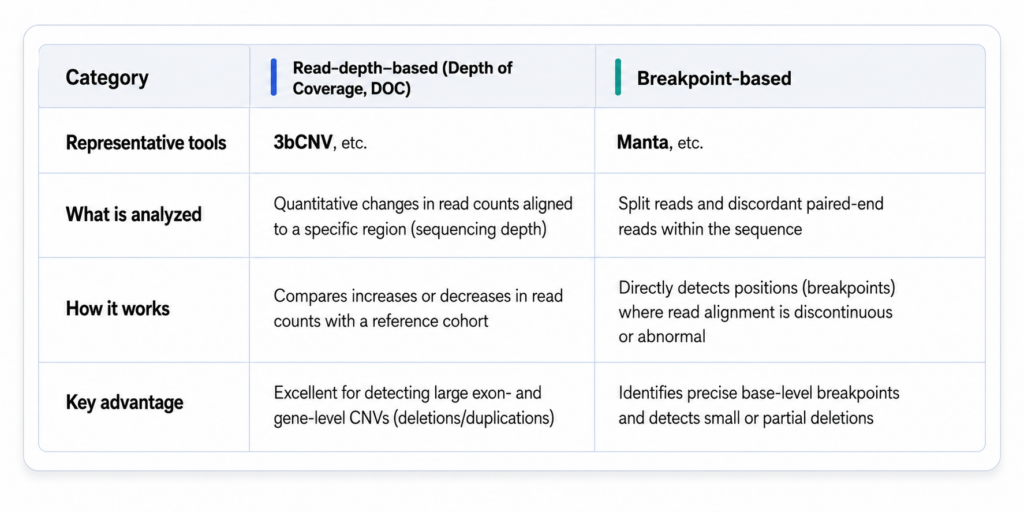
CNV detection principles vary by algorithm. Some algorithms directly detect breakpoints using split reads and discordant paired-end reads (e.g., Manta), while 3bCNV does not use breakpoint information at all — it is a read-depth based algorithm that analyzes relative changes in sequencing depth.
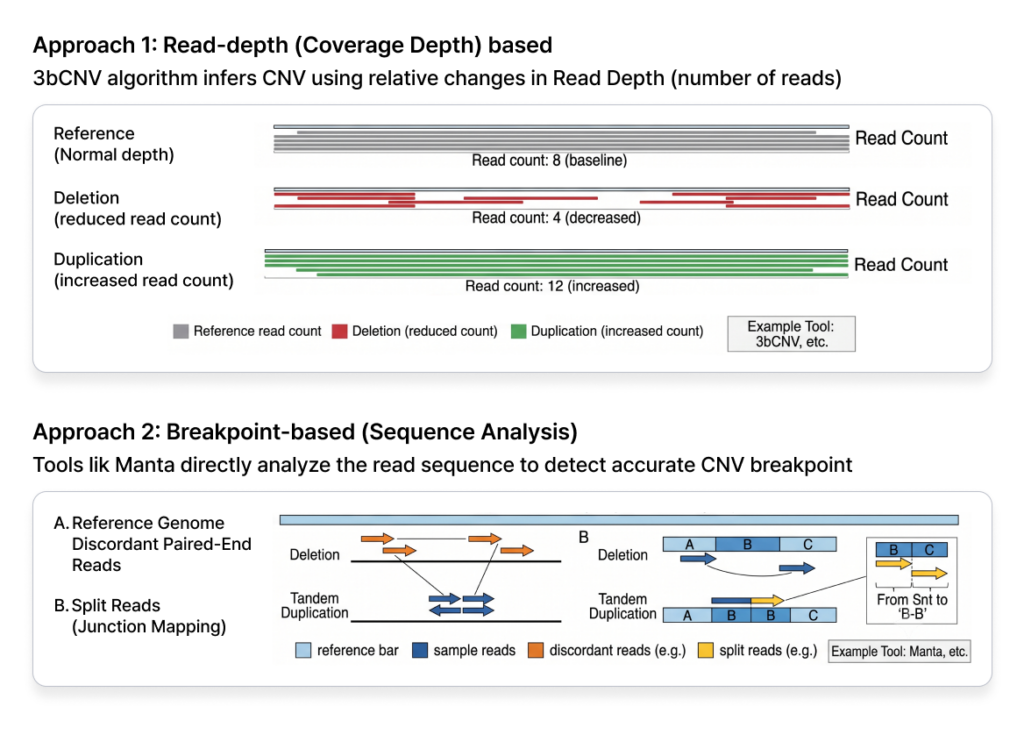
2. How 3bCNV Works (Read-Depth Based)
3bCNV adopts a read-depth approach and detects variants through the following process:
- Depth comparison and normalization: It calculates the average coverage depth per exon across a reference sample cohort, then normalizes each individual sample’s coverage values to minimize sample-to-sample and run-to-run variability.
- Variant inference: If the read count is quantitatively lower than normal, it’s called a deletion; if higher, a duplication.
3. Why Isn’t Coverage Always Consistent?
One of the most important things to keep in mind when analyzing NGS data is that coverage is not uniform across all exons.
In read-depth based algorithms, the key challenge is distinguishing depth variation caused by technical limitations and biological factors from actual noise:
- Regions with excessively high GC content
- Regions with poor capture efficiency
- Presence of repetitive sequences in the genome
- Regions that are difficult to map with short reads
For this reason, even if a Z-score decrease is observed at a single exon, it may simply be technical fluctuation — so a careful, conservative threshold is required.
4. Why WES Uses a ≥3 Consecutive Exon Criterion
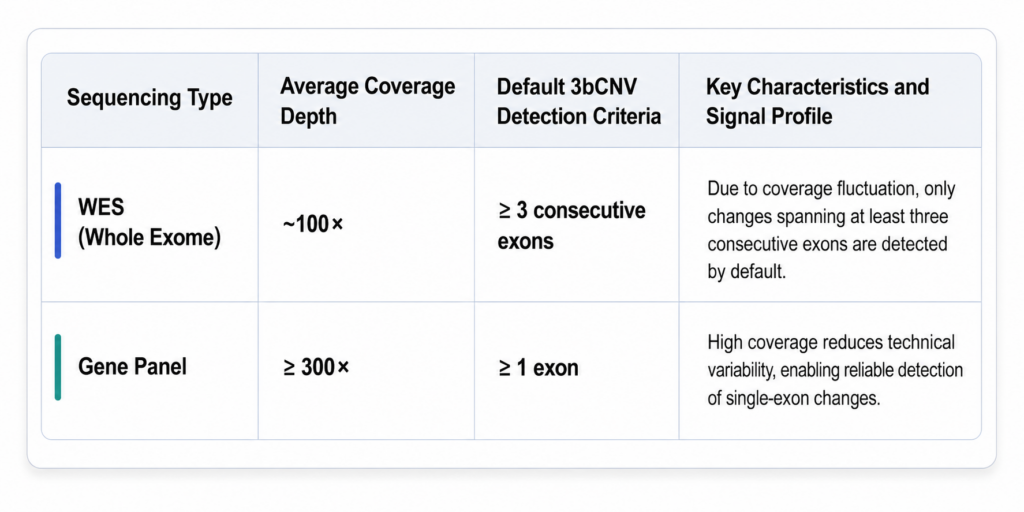
WES (Whole Exome Sequencing) typically has an average depth of about 100x. At this depth, DOC-based algorithms may lack sufficient statistical confidence to determine, from a decrease in read count at a single exon alone, whether it represents a true heterozygous deletion or simple sequencing noise.
To address this, 3bCNV checks for a consecutive pattern:
[Example noise pattern]
Exon 8 (normal) → Exon 9 (low) → Exon 10 (normal)
=> Likely simple capture variation (noise)
[Example true CNV pattern]
Exon 8 (normal) → Exon 9 (low) → Exon 10 (low) → Exon 11 (low) → Exon 12 (normal)
=> 3+ consecutive decreases increase the likelihood of a true deletion variant
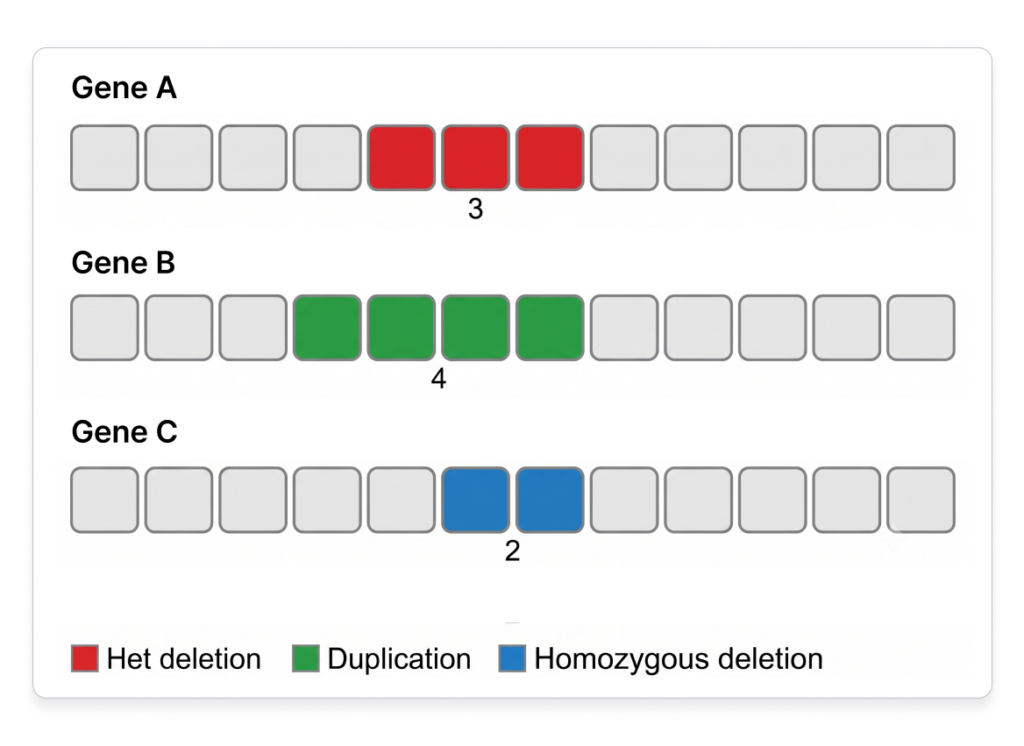
Even at the cost of some sensitivity, 3bCNV applies a ≥3 consecutive exons criterion in WES analysis to substantially reduce false positives and ensure reliable data interpretation.
5. Quantitative CNV Determination Using Z-Scores
3bCNV doesn’t simply look at whether read depth in a given region appears visually high or low. It statistically quantifies how far the normalized read depth deviates from the average distribution of normal (reference) samples, using a Z-score.
The Z-score indicates how many standard deviations (SD) a given exon’s normalized read depth is from the mean of normal samples — a precise metric
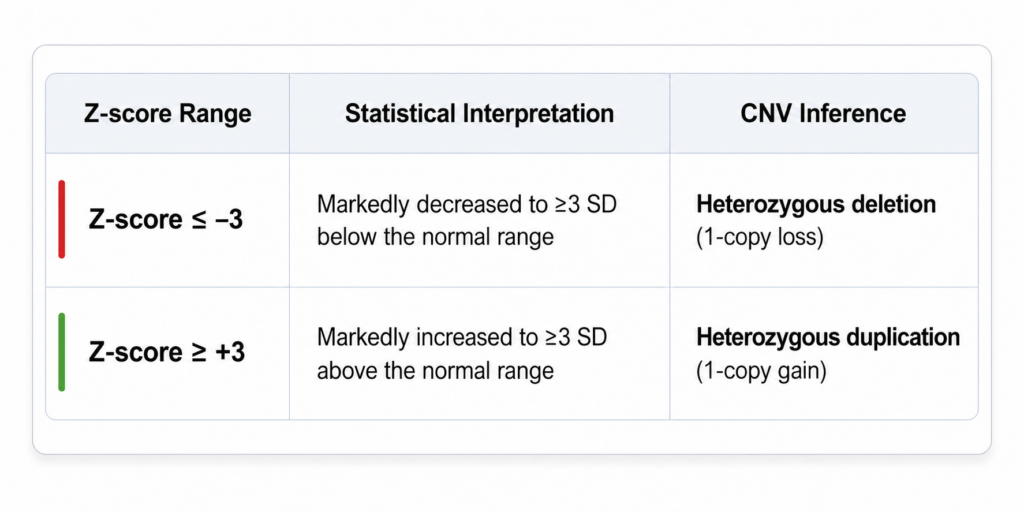
In other words, the more sharply negative the Z-score, the more clearly the read depth at that exon falls below the normal baseline, raising the likelihood of a deletion. Conversely, a strongly positive Z-score indicates elevated read depth, providing solid statistical evidence of a duplication signal.
6. WES vs. Gene Panel: Comparing CNV Analysis Resolution
Gene Panel analysis is a very different environment. It’s sequenced much more deeply, with an average coverage of 300x or higher.
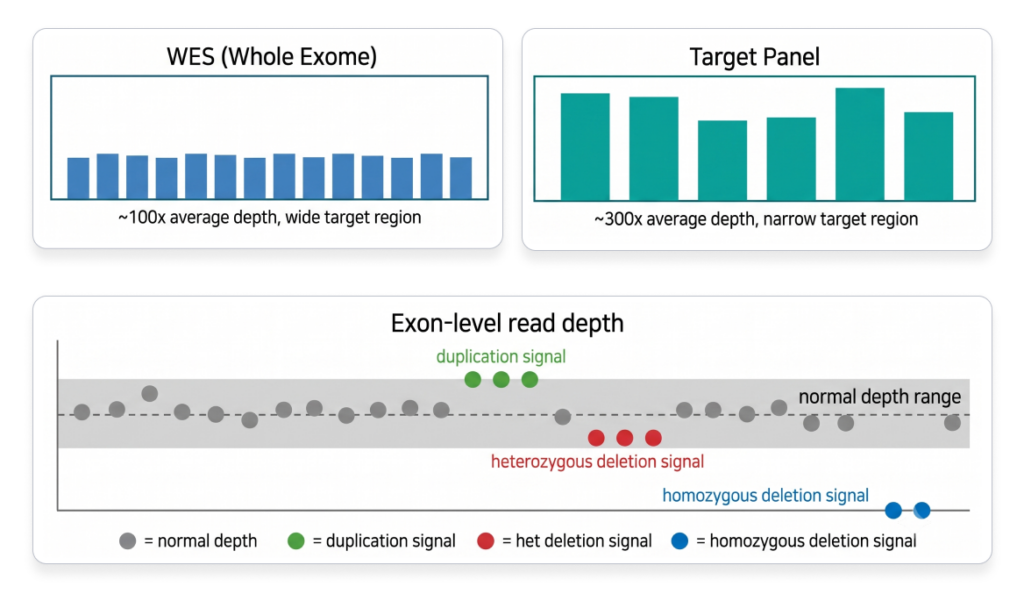
Even within read-depth based analysis, when depth increases substantially, the variability caused by technical noise shrinks, and true deletion/duplication signals become much clearer. As a result, Gene Panel environments can detect single-exon CNVs with high confidence.
7. Limitations of Read-Depth Based Algorithms
Because of its Depth of Coverage-based approach, the 3bCNV algorithm has the following technical limitations:
Filters out very small CNVs: Deletions smaller than 1 kb, deletions smaller than a single exon, and very small duplications are difficult to distinguish from simple noise and cannot be assigned precise breakpoints, so they are excluded from analysis by default.
Cannot determine exact breakpoints: Since it doesn’t directly read base-level discontinuities, it cannot pinpoint precise start and end positions like chr1:123456-123987 — it can only estimate a range based on where coverage changes.
Accurate CNV Interpretation Requires Understanding the Data’s Characteristics
3bCNV’s use of a ≥3 consecutive exon criterion (instead of single-exon detection) in WES, combined with precise statistical thresholds of Z-score ≤ -3 / ≥ +3, isn’t a technical limitation — it’s a deliberate strategic choice to maximize the reliability and accuracy of diagnostic data.
On the other hand, in Gene Panel environments with sufficient sequencing depth, or in cases of homozygous deletion where reads are completely absent, 3bCNV can detect variants down to the single-exon level.
Understanding the analytical principles of read-depth based algorithms — and how depth characteristics differ by data type — enables far more valid and reliable interpretation of CNV results in clinical and research settings.
💡 “From WES to Gene Panel, see the reliability of CNV interpretation for yourself.”
Spend less time worrying about complex variant interpretation, and start faster, more accurate clinical decision-making with the GEBRA platform.
Full series
View all
- [Interpretation Notes #1] 3bCNV: WES vs. Panel Detection Criteria
- [Interpretation Notes #2] ROH vs. UPD: Similar Genomic Patterns, Different Biological Meanings
- [Interpretation Notes #3] Why IGV Read Counts Differ from GATK HaplotypeCaller Allelic Depth (AD)

3billion Inc.
3billion is dedicated to creating a world where patients with rare diseases are not neglected in diagnosis and treatment.