



Unlocking the “Unmappable” D4Z4 Repeat: How 3billion Mastered FSHD Diagnosis with Long-Read Sequencing

Sookjin Lee
Chief Business Officer (CBO) | Ph.D.
A business expert leading innovation in precision medicine and genomics for 20 years. Accelerating the commercialization of innovative technologies with academic expertise and market insight.
Summary
- Overcoming D4Z4 Bottlenecks: Short-read NGS struggled with D4Z4 due to extreme repeats and 99% sequence identity between Chromosomes 4 and 10.
- Long-Read + Kivvi Pipeline: 3billion integrated PacBio Long-Read sequencing with the Kivvi tool to resolve repeat counts and haplotype origins accurately.
- Proven Clinical Value: Going beyond theoretical validation, 3billion successfully diagnosed 6 real FSHD patients, setting a new standard for rare disease testing.
Despite rapid advances in genomics, certain regions of the human genome have remained “black boxes.”
At the forefront of these challenges is the D4Z4 repeat region. Recently, 3billion successfully introduced advanced, dedicated D4Z4 analysis tools alongside Long-Read sequencing, turning technical theory into real-world patient diagnoses.
Here is how we overcame one of the most notoriously difficult bottlenecks in genomic medicine.
1. D4Z4 Repeats and FSHD Diagnosis
The D4Z4 repeat is a ~3.3 kb unit located at the distal end of chromosome 4 (4q35).
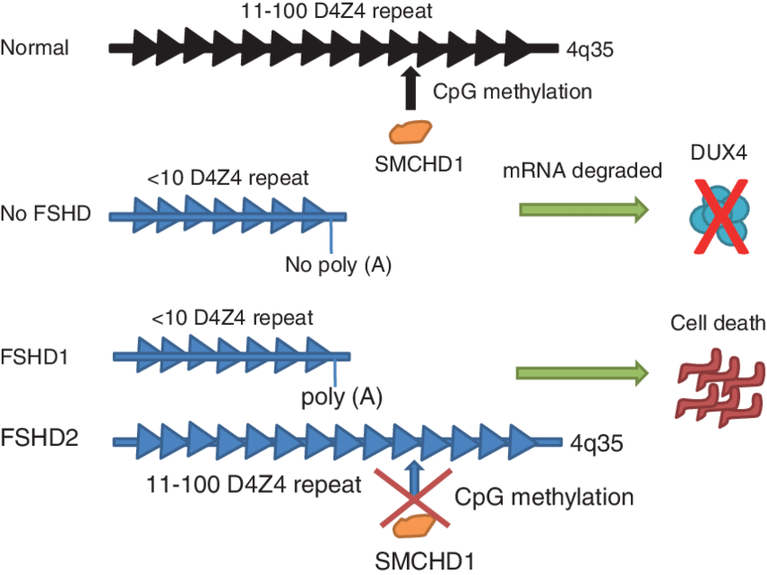
- Healthy Individuals: 11 to 100+ D4Z4 repeat units
- FSHD Patients: Reduced (contracted) to 1–10 units
Accurately counting these repeats is the primary criterion for diagnosing Facioscapulohumeral Muscular Dystrophy (FSHD).
2. Why is D4Z4 Analysis So Difficult?
D4Z4 is widely regarded as one of the hardest genomic regions to solve because it requires resolving multiple genetic and epigenetic layers simultaneously.
- Extremely Repetitive Structure: Dozens of 3.3 kb units repeat consecutively, making it impossible for Short-Read NGS to map or count them accurately.
- 99% Sequence Identity (Chr 4 vs. Chr 10): Chromosome 10 (10q26) harbors a D4Z4 region nearly identical (>99%) to Chromosome 4. Distinguishing reads originating from Chromosome 4 is critical.
- Haplotype Differentiation (4qA vs. 4qB): Disease occurs only when D4Z4 contraction exists alongside a 4qA haplotype (Permissive), which provides a Poly(A) signal to stabilize DUX4 mRNA. Contractions on 4qB do not cause disease.
- Epigenetic Methylation: Patients with normal repeat counts (11–100) can still develop FSHD2 if hypomethylation occurs. Measuring CpG methylation levels is essential.
💡 In Short:
D4Z4 analysis requires solving four challenges in a single workflow: ① Chr 4/10 Separation + ② Repeat Count + ③ Haplotype Calling + ④ Methylation Profiling.
3. Limitations of Traditional Southern Blotting
For decades, Southern Blotting was the gold standard for D4Z4 analysis. However, it presented major clinical drawbacks:
- Operator Dependency: High variability and error rates based on technician skill.
- Hazardous Materials: Requires radioactive isotopes and hazardous chemicals.
- Long Turnaround Time: Takes several days to weeks to yield results.
Traditional Southern Blotting simply could not match the speed, safety, and scalability of modern digital genomics. Furthermore, separate additional tests are required to analyze haplotypes and methylation states, adding significantly to the experimental burden.
4. The Promise of Long-Read Sequencing
Long-Read sequencing technologies (e.g., PacBio) changed the game by reading thousands of base pairs in a single continuous pass, spanning full repeat units.
In theory, generating Long-Read data seemed like the ultimate fix for D4Z4.
5. Data Generation Is Only Half the Battle
In practice, raw sequencing reads alone do not guarantee a diagnostic answer.
- Error Correction: Without precise error handling, raw reads can easily lead to miscounting.
- Noise Filtering: Disentangling the 99% identical Chromosome 10 reads requires specialized alignment algorithms.
3billion went beyond simply generating Long-Read data. We implemented and optimized a dedicated D4Z4 analysis pipeline, validating its accuracy on real clinical samples.
“Generating Long-Read data” and “Delivering an accurate D4Z4 clinical diagnosis” are two completely different achievements.
6. Insights from Our Team
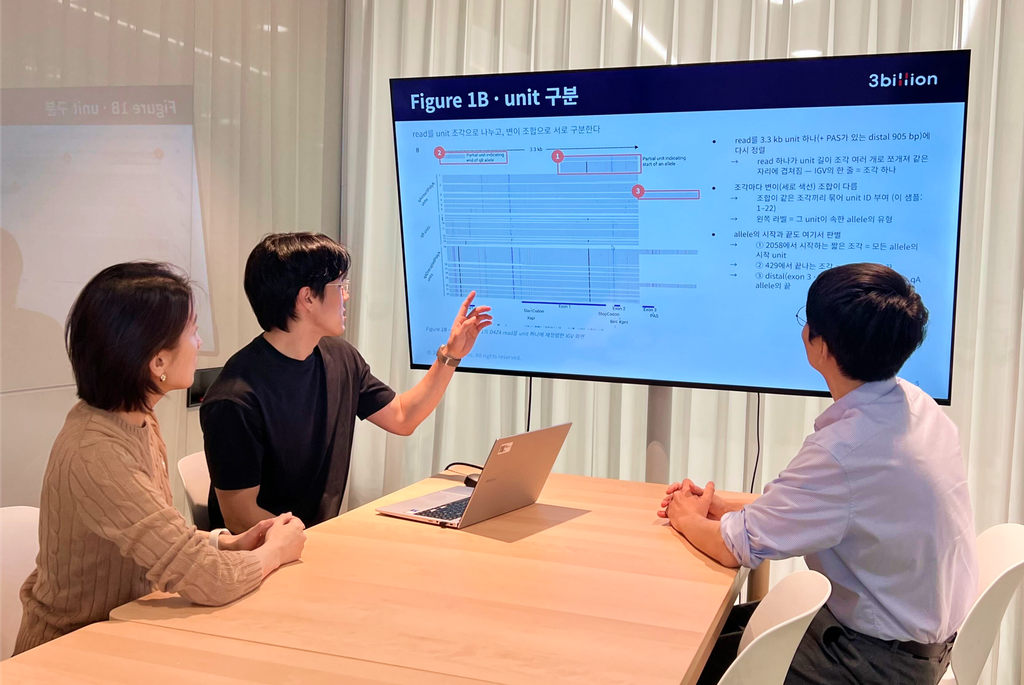
Q. What was the biggest challenge in building the D4Z4 pipeline?
Seongyun Kim (Bioinformatics Engineer):
“Disentangling Chromosome 4 from Chromosome 10 was the toughest hurdle. Because their sequences are over 99% identical, looking at the repeat region alone isn’t enough.
We adopted PacBio’s Kivvi tool, which traces chromosome origins by phasing the flanking regions outside the repeat array. In our testing, almost all assembled alleles received clear chromosomal assignments. Since raw tool outputs list repeats from both chromosomes together, we refined our pipeline to clearly separate and report counts by individual chromosome.”
Q. What does achieving real clinical diagnoses mean for patients and clinicians?
Dr. Seung-Woo Ryu (Clinical Geneticist):
“Although FSHD is relatively common among rare diseases, its molecular mechanism differs from typical monogenic disorders, making diagnosis exceptionally difficult. Short-read NGS was simply inadequate, often leaving us no choice but to mark these cases as ‘untestable.’
By introducing Long-Read sequencing alongside Kivvi, we unlocked clear D4Z4 interpretation and successfully diagnosed 6 real FSHD patients. This consolidates a historically multi-step process into a single, streamlined genomic test—dramatically reducing costs, shortening turnaround times, and improving diagnostic access.”
Q. What’s next for 3billion?
Dr. Seung-Woo Ryu:
“Starting with D4Z4, we plan to expand our Long-Read pipeline to other previously ‘unsolvable’ repeat expansion disorders, such as SCA and Fragile X syndrome. We will stay at the forefront of translating Long-Read potential into true clinical value.”
Closing Thoughts
Bridging the gap between raw technology and real clinical answers is the essence of genomic innovation. If you’d like to learn more about our D4Z4 analysis or Long-Read diagnostic services, feel free to reach out to us!
Want to learn more about
3billion's genetic testing?
We'll reply within 1 business day.
Frequently Asked Questions (FAQ)
Q1. Does Long-Read sequencing automatically solve D4Z4 analysis?
A. No. Producing raw Long-Read data is not enough. You need specialized mapping pipelines (like Kivvi) to filter out Chromosome 10 noise, correct read errors, and phase haplotypes correctly.
Q2. Does a reduced D4Z4 repeat count always mean FSHD?
A. No. Even with fewer than 10 repeats, the disease develops only if the 4qA haplotype (which includes a Poly(A) signal) is present. Contractions on 4qB do not cause disease, making concurrent haplotype calling mandatory.
Q3. How does this compare to traditional Southern Blotting?
A. Southern Blotting is labor-intensive, uses radioactive materials, and takes weeks. Long-Read sequencing digitizes and automates the process, significantly improving accuracy, turnaround time, and safety.