


Meet the Clinician ① From Ugly Duckling to True Partner

Sookjin Lee
Chief Business Officer (CBO) | Ph.D.
A business expert leading innovation in precision medicine and genomics for 20 years. Accelerating the commercialization of innovative technologies with academic expertise and market insight.
A conversation with Professor Junhwa Lee, Department of Pediatric Neurology, Samsung Changwon Hospital
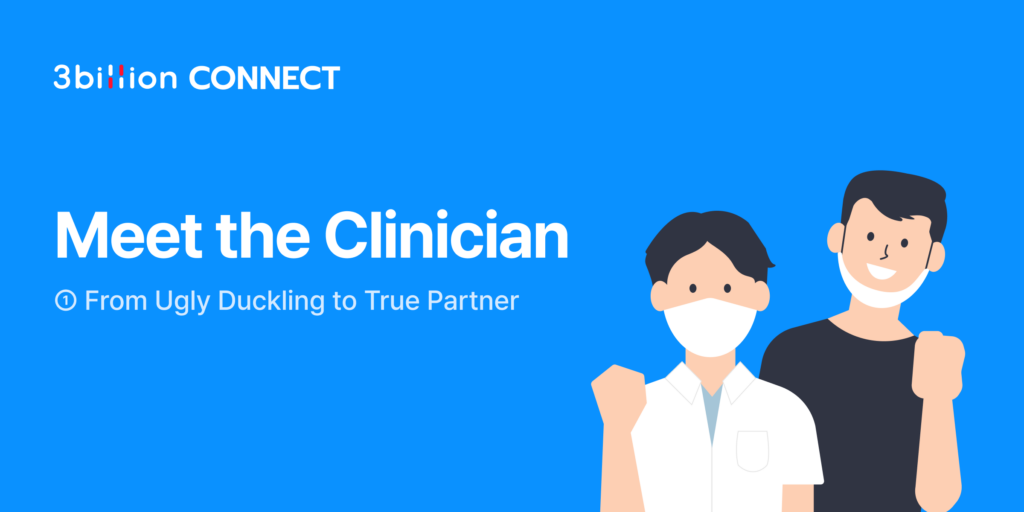
Five years ago we met over Zoom for the first time. I still remember how it went.
“I watched your webinar. I’d like to use the service — how do I order it?”
I explained the process. His first reply: “That won’t work for us.”
Unlike the tests already built into hospital systems, WES/WGS-based analysis belonged nowhere. It had no code, no slot, no established path. Ordering it meant asking a physician to do far too much.
So I said: “Then send it however works for you. We’ll handle the rest.”
Looking back, the one thing I’d credit us with is this — we didn’t defend our own process. We listened to what the clinic actually needed. We didn’t solve everything, but with his patience, we started. Over the years that followed, we worked through many patients together.
He acknowledges our work, and he tells us plainly when something isn’t working. In July I traveled to see him. What follows is not a formal interview but an edited version of a long, easy conversation.
Professor Junhwa Lee is a pediatric neurologist at Samsung Changwon Hospital, caring for children with neurological and rare genetic disease. He has worked with 3billion since 2021 and has diagnosed more than 200 patients. He also participates in national and foundation-funded rare disease diagnostic programs.

What first made you consider 3billion?

It started with a webinar. In rare disease care, the hardest problem has always been getting to an accurate diagnosis quickly. Pediatric presentations are broad and often progressive, so panels only take you so far. Many of these children need WES or WGS. But results took a long time to come back, and families spent months — sometimes longer — in uncertainty with no clear answer.
For children, timing is everything. Every delay risks losing a treatment window that won’t come back. Fast turnaround was what caught my attention.
But adopting it in practice was another matter. What was holding you back?
“That won’t work for us.” — the adoption barrier
The value of the service was clear enough. Access was the problem. Ordering meant logging into a separate system, and that was the real hurdle. During clinic, opening a browser simply isn’t possible. Explaining the test to a family already takes time; entering phenotype details one by one, then arranging sample shipping, was more than the visit could absorb.
3billion took that on early. I check boxes on a paper form during clinic, and a nurse sends the sample out. Instead of insisting I adopt their system, they lowered the barrier first. That’s why I was able to try it at all.
I’ve since gotten used to the platform and I see its advantages. But without nursing colleagues who help, it still wouldn’t be easy. If a physician only had to check a requisition form and everything downstream moved on its own, I think clinicians starting out would order these tests far more readily.
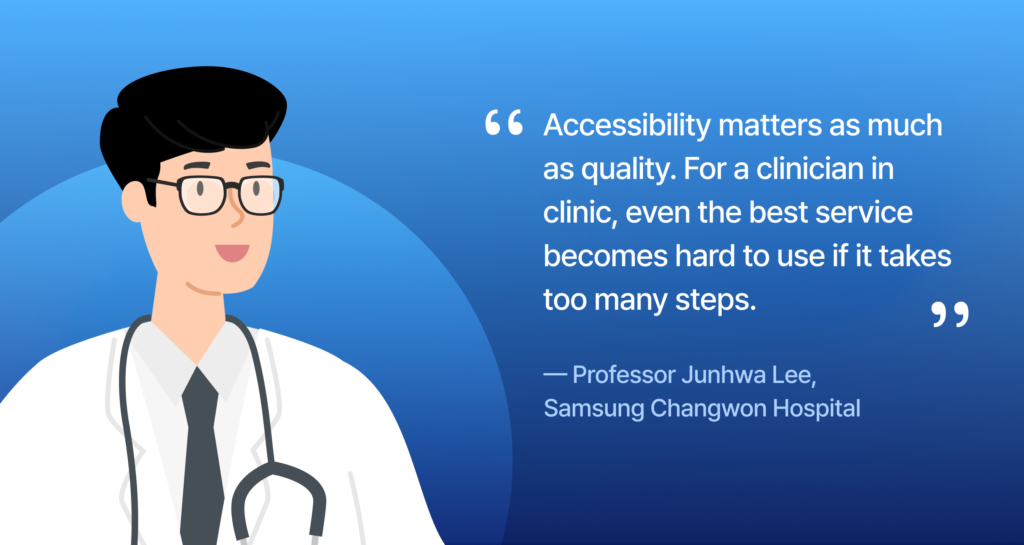
That’s a fair point. We’ll keep looking for ways to absorb more of that burden on our side. Still — compared with other laboratories, what stands out to you?
Beyond turnaround, the clearest strength is direct access to interpretation. When I have a question about a result, I can reach the clinical genetics team easily. That matters most with variants of uncertain significance, or when a variant needs to be weighed against the clinical picture. Being able to ask for a second opinion is genuinely practical in daily practice.
Blood draws are also difficult in neonates and infants, who often need multiple tests at once. Being able to use a buccal swab instead of blood has helped patients and families considerably.
And 3billion keeps re-examining data from undiagnosed patients. That’s an enormous advantage. No clinician has time to track new publications or reinterpret variants case by case. Someone is carrying that work forward on our behalf.
You’ve built up experience over the years. Which patients do you send for genetic testing, and how do you decide?
Where does the gut feeling come from?
There’s no formula, and I can’t give you precise criteria. But after seeing enough patients, something registers while you’re taking the history. A sense that something is there. A sense that this child shouldn’t just be sent home. Experience teaches you to catch those signals in a way textbooks don’t. My own interest in genetic disease came from the patients I couldn’t solve.
One case has stayed with me. 23 years ago, a third-grader came to clinic with a high fever and a skin rash. Something felt wrong, so I admitted her. Within hours she was unconscious, and we diagnosed meningococcal meningitis. The disease is rare, and her older brother had a similar history — that combination didn’t sit right. After extensive workup, we confirmed complement C7 deficiency. The management is straightforward: a third-generation cephalosporin, given immediately when symptoms begin. Her brother died at another hospital because antibiotics were started too late. My patient came close several times, but she is in her thirties now, married, and still comes in for scheduled vaccinations.
Another patient had refractory epilepsy and global developmental delay, and her family had spent years without an explanation. During a fellowship in the United States, a panel test identified beta-ureidopropionase deficiency — at that time, thirteen patients had been diagnosed worldwide. I could finally give the family a name for it.
Gaucher disease, Fabry disease, mucopolysaccharidoses, spinal muscular atrophy — after enough of these patients, the instinct sharpens. In my own practice, I consider genetic testing essential for refractory epilepsy of unknown cause, global developmental delay, isolated gross motor delay, and multiple congenital anomalies.
Some patients can be diagnosed but not treated. How do you answer families who ask whether testing is worth it?
Why diagnose when there is no treatment?
Families ask this constantly, and it’s a fair question. As I understand it, only about 5% of genetically diagnosed conditions currently have an approved therapy. So here is what I tell parents.
Don’t you want to know what your child has? Don’t you want to know why?
- WGS resolves at most about 50% of cases with today’s medicine. But we used to be under 10%, so the field has moved a great deal. Only around 5% have a drug so far, and development is accelerating — but a child can only receive a new therapy if we know what they have.
- Even without a treatment, knowing the cause lets us predict what may come next. We can begin cardiac, renal, or metabolic surveillance before symptoms appear, and prevent complications.
- If the parents want another child, genetic testing is essential. A diagnosis gives us recurrence risk. And if the condition is eligible for preimplantation genetic testing (PGT-M), they can have a healthy child.
- If the patient grows up and marries, we can give them their own transmission risk, and plan ahead.
One recent case is still vivid. An infant of migrant workers was in intensive care with multiple anomalies and respiratory failure, essentially brain dead. The family’s finances were desperate — they couldn’t afford testing at all. I asked 3billion to support the case, and we confirmed autosomal recessive asparagine synthetase deficiency. I was able to discuss with the clinical team how the result mapped onto her presentation, and ask what to consider next.
Further treatment would have been futile, so we brought the whole family together, explained everything, and let her go. It was a profound loss at the time. But afterward the parents understood why, and they were able to begin to make peace with it. Then, wanting a healthy child, they underwent carrier testing. Both were carriers, and they moved forward with IVF.
I remember that day. He wrote to tell us the family was grateful, that they had decided not to prolong her suffering, and that she had become a star in the sky that morning. Moments like that are why I shared it with everyone at the company — we aren’t delivering a service, we’re doing something that has to be done properly.
And a diagnosis doesn’t have to solve anything to matter. Being able to tell someone, or a family, what comes next is a value of its own.
Do you face particular difficulties working outside a major academic center?
Certainly. Staffing, awareness of rare disease, hospital infrastructure — all of it is harder. But if the will to solve the patient is there, I believe it can be done with what you already have. This testing takes only a little practice, and then it’s entirely feasible outside the large centers. Patients with the least time and money don’t have to travel to a tertiary hospital in the capital. We can finish it here. That, honestly, is the most rewarding part.
One test that began as an ugly duckling ended up, five years later, sitting with a family at the end of one life and the beginning of the next. In part two, we follow that instinct into a specific disease — Fabry disease.
Full series
View all
- Meet the Clinician ① From Ugly Duckling to True Partner
- Meet the Clinician ② Not Missing It — Five Fabry Patients in One Family