


Episode 13: CADASIL vs. CARASIL: What Differs in Genetic Interpretation?
When recurrent stroke and extensive white matter changes are observed together with findings that suggest a genetic cause — such as a family history or relatively early onset — hereditary cerebral small vessel disease (CSVD) should be considered. CADASIL and CARASIL are the representative conditions in this group.
The two conditions are clinically quite similar, but they differ in important ways: the genes involved, the inheritance pattern, and how variants should be interpreted.
FAQs
Q.If a NOTCH3 missense variant is found, can it be considered CADASIL?
A. Confirming that it is a rare missense variant is not sufficient on its own. The typical CADASIL-associated variant is a missense variant that changes the number of cysteines in an EGF-like repeat (EGFr) domain. The EGFr domain in which the variant is located may also relate to phenotype, so the domain position should be checked as well.
Q. If only one HTRA1 variant is found, should it be interpreted as carrier status?
A. No. In HTRA1, autosomal dominant HTRA1-related CSVD caused by a heterozygous variant is also recognized. Thinking of HTRA1 disease as a recessive disease only may lead to missing some patients.
Q. Can CADASIL and CARASIL be distinguished by age of onset alone?
A. It is difficult. Both conditions present mainly in adulthood, and their age-of-onset ranges are wide and overlapping. That said, presentation of the typical disease before age 10 is very rare.
Q. If there is no family history, can hereditary CSVD be excluded?
A. It should not be excluded. Family history is an important clue, but the absence of a family history alone is not grounds for excluding hereditary CSVD.
Q. If CADASIL is suspected, is testing NOTCH3 alone enough?
A. Evaluating both genes together is important. Testing only NOTCH3 when CADASIL is suspected, or only HTRA1 when CARASIL is suspected, risks missing cases because of the substantial clinical overlap between the two conditions.
1. What are CADASIL and CARASIL?
CADASIL (Cerebral Autosomal Dominant Arteriopathy with Subcortical Infarcts and Leukoencephalopathy) is a representative hereditary cerebral small vessel disease and is associated with pathogenic variants in the NOTCH3 gene.
CARASIL (Cerebral Autosomal Recessive Arteriopathy with Subcortical Infarcts and Leukoencephalopathy) is caused primarily by biallelic pathogenic variants in HTRA1.
However, autosomal dominant HTRA1-related CSVD caused by a heterozygous variant is also recognized in HTRA1. A single HTRA1 variant should therefore not automatically be interpreted as carrier status alone.
2. What symptoms do the two conditions show?
Both CADASIL and CARASIL may present with the following clinical findings:
Recurrent stroke · Migraine · Cognitive impairment · Epilepsy · Brain MRI abnormalities
As the disease progresses, repeated cerebrovascular injury accumulates, and some patients eventually develop vascular dementia.
When to actively consider hereditary CSVD
- Stroke occurring at a relatively early age, or recurrent stroke — although onset at an older age is also possible
- White matter abnormalities that are extensive for the patient’s age, or that show a characteristic distribution
- Progressive cognitive decline or vascular dementia
- Cerebral small vessel disease that is difficult to explain by conventional vascular risk factors alone
- A family history of stroke, early cognitive decline, or similar neurological disease
- Clinical or MRI findings suggestive of a specific hereditary CSVD
Family history is an important clue, but the absence of a family history alone is not grounds for excluding hereditary CSVD.
3. In NOTCH3, cysteine is what matters
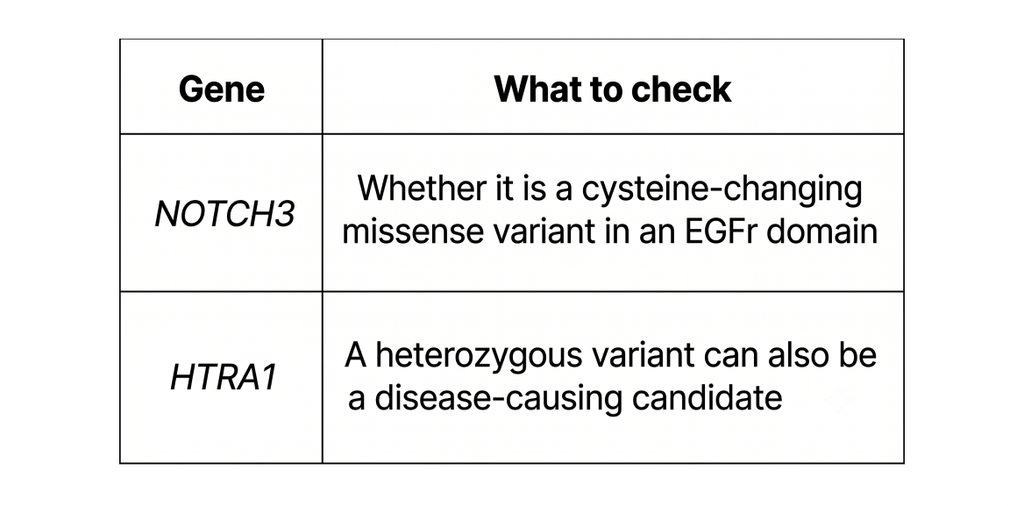
For NOTCH3, the gene responsible for CADASIL, confirming that a variant is a rare missense variant is not sufficient on its own.
The typical CADASIL-associated variant is a missense variant that changes the number of cysteines in an EGF-like repeat (EGFr) domain
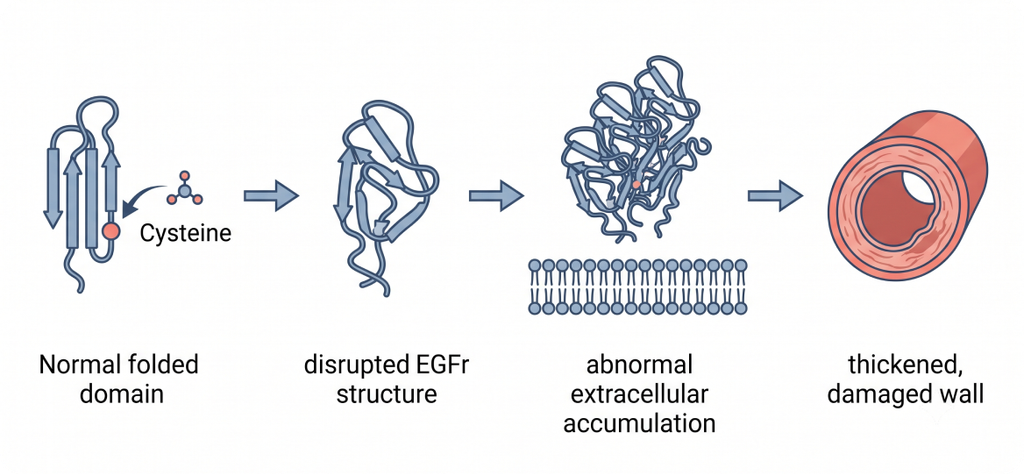
This sequence plays an important role in disease development.
EGFr domain position matters too
The EGFr domain in which the variant is located may also relate to phenotype.
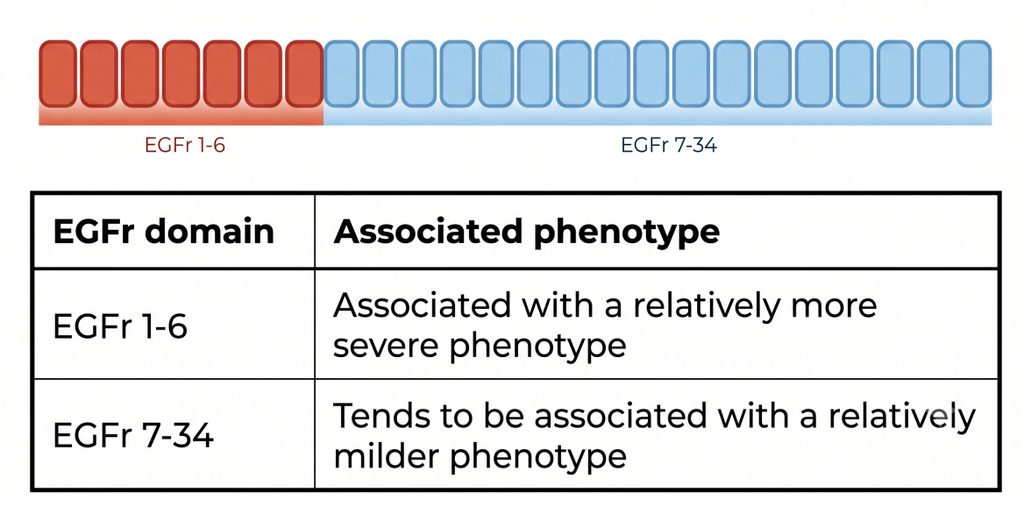
When interpreting a NOTCH3 missense variant, it is therefore important to check both of the following:
- “Is this a Cys-changing variant?”
- “Which EGFr domain is it located in?”
4. HTRA1 should not be thought of as recessive only
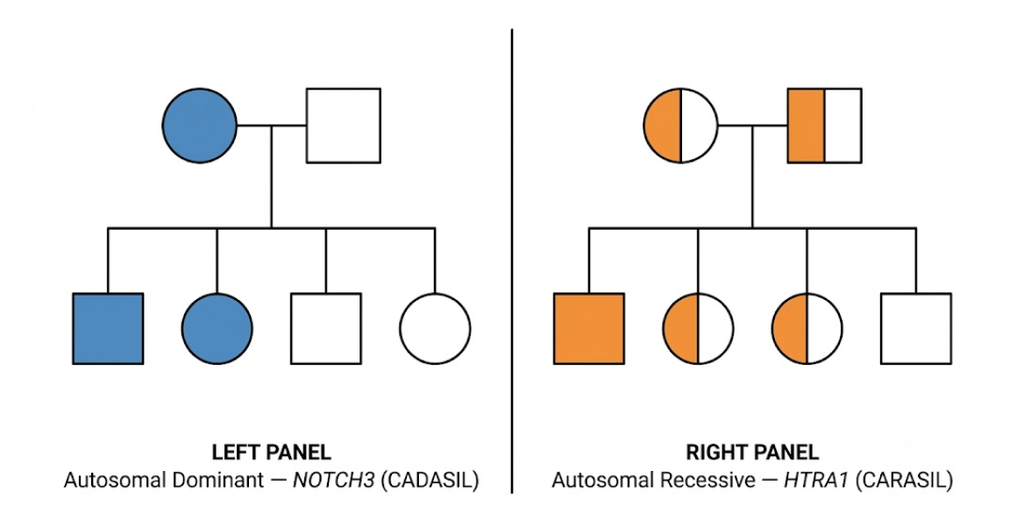
Classic CARASIL is caused by biallelic pathogenic variants in HTRA1, and these variants result in a marked reduction or loss of HTRA1 protease activity. However, thinking of HTRA1 disease as a recessive disease only may lead to missing some patients — because a heterozygous pathogenic variant in HTRA1 can also cause autosomal dominant cerebral small vessel disease.
In particular, for some heterozygous missense variants, a dominant-negative effect — in which mutant HTRA1 interferes with the function of normal HTRA1 — has been proposed as the disease mechanism.
For HTRA1, both of the following should therefore be considered:
5. Age of onset is also an important clue
Both conditions present mainly in adulthood, but the age of onset varies considerably.
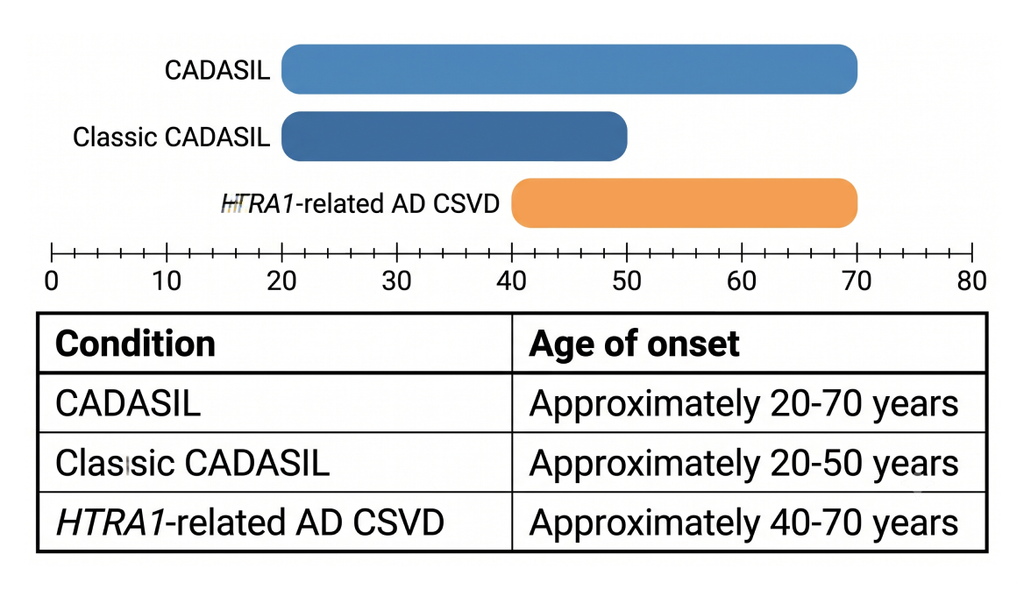
Age of onset alone is therefore not enough to clearly distinguish CADASIL from CARASIL.
On the other hand, presentation of the typical disease before age 10 is very rare, and onset in the late teens or early twenties can be regarded as quite early for this group of conditions.
6. What features can help distinguish CADASIL from CARASIL?
Because most of the neurological phenotype overlaps, certain additional features may help in the differential.
- CADASIL — Granular osmiophilic material (GOM) deposits may be identified on skin biopsy. However, this finding alone does not fully establish the diagnosis.
- Classic CARASIL — Alopecia and spondylosis are relatively characteristic accompanying features.
By contrast, heterozygous HTRA1-related CSVD generally may show a milder phenotype than classic CARASIL, and so may appear clinically even more similar to CADASIL.
At a glance
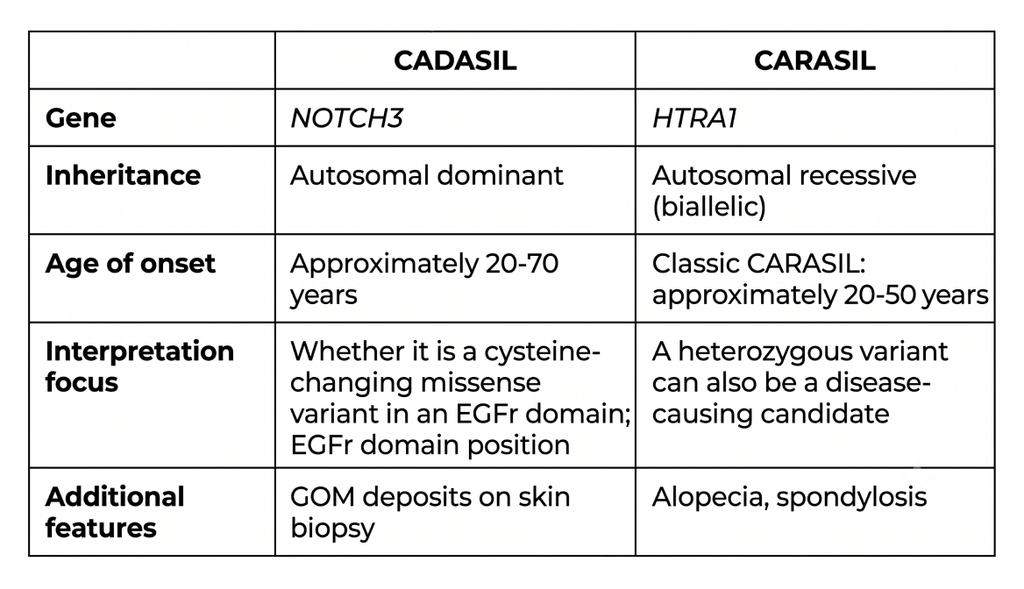
Autosomal dominant HTRA1-related CSVD caused by a heterozygous HTRA1 variant (age of onset approximately 40–70 years) should be understood separately from the CARASIL column above. It may show a milder phenotype and can therefore appear clinically more similar to CADASIL.
7. 3 things to remember in genetic interpretation
1. When to actively consider a genetic cause
If a patient has recurrent stroke, characteristic brain MRI abnormalities, and vascular cognitive impairment — particularly with onset before age 60, or when the picture is difficult to explain by conventional hypertensive CSVD alone — a genetic cause should be actively considered.
2. Do not look at one gene only
Rather than testing only NOTCH3 when CADASIL is suspected, or only HTRA1 when CARASIL is suspected, it is important to evaluate both genes together, because the two conditions overlap substantially in their clinical presentation.
3. Two axes of variant interpretation
Closing
The two conditions may look alike, but understanding these genetic characteristics allows a patient’s clinical information and genetic variants to be connected more accurately.
References
1. Rutten JW, Van Eijsden BJ, Duering M, et al. The Effect of NOTCH3 Pathogenic Variant Position on CADASIL Disease Severity: NOTCH3 EGFr 1–6 Pathogenic Variants Are Associated with a More Severe Phenotype and Lower Survival Compared with EGFr 7–34 Pathogenic Variants. Genetics in Medicine. 2019.
2. Zhao Y, Lu Y, Wang F, et al. Mechanistic Advances in Factors Influencing Phenotypic Variability in Cerebral Autosomal Dominant Arteriopathy with Subcortical Infarcts and Leukoencephalopathy: A Review. Frontiers in Neurology. 2025.
3. Wang W, Ren Z, Shi Y, Zhang J. A Novel Mutation Outside of the EGFr Encoding Exons of NOTCH3 Gene in a Chinese with CADASIL. Journal of Stroke and Cerebrovascular Diseases. 2020.
4. Rosochowicz MA, Kulcenty K, Suchorska WM. Exploring the Role of HtrA Family Genes in Cancer: A Systematic Review. Molecular Diagnosis & Therapy. 2024.
5. Nozaki H, Kato T, Nihonmatsu M, et al. Distinct Molecular Mechanisms of HTRA1 Mutants in Manifesting Heterozygotes with CARASIL. Neurology. 2016.
6. Hack RJ, Rutten J, Lesnik Oberstein SAJ. CADASIL. GeneReviews®. 2019.
7. Onodera O, Nozaki H, Fukutake T. HTRA1 Disorder. GeneReviews®. 2019.
Full series
View all

3billion Inc.
3billion is dedicated to creating a world where patients with rare diseases are not neglected in diagnosis and treatment.