



What 10,808 Newborns Taught Us About Genomic Newborn Screening
In 2025, four studies reported at once
Genomic newborn screening (gNBS) has been studied in pilot programs for years — the International Consortium on Newborn Sequencing now counts over 80 projects across more than 50 countries. What made 2025 different is that four large studies in the US, Belgium, and Australia published initial results within the same year, covering 10,808 newborns in total. Because they ran concurrently in different healthcare systems, their results can be read against each other.
- GUARDIAN — New York State, USA; 3,982 newborns
- BabyDetect — Liège, Belgium; 3,847 newborns
- Early Check — North Carolina, USA; 1,979 newborns
- BabyScreen+ — Victoria, Australia; 1,000 newborns
All four used prospective observational cohort designs, and all ran in parallel with standard newborn screening (stdNBS) — meaning the same infants were screened both ways, allowing direct comparison. A 2026 perspective paper in the American Journal of Human Genetics places the four side by side.

What held up: the technical case
Dried blood spots worked. All four studies successfully extracted and sequenced DNA from DBS cards, using three to eight 3-mm punches. Sample-related failure rates ran from 0.5% to 6.1% and fell as teams gained experience.
Three of the four used the same dried blood spots already collected for standard screening; BabyDetect used a second, dedicated card. The authors note that reusing standard screening cards leverages existing collection infrastructure, though extracting sufficient high-quality DNA from them can be challenging. Where samples failed, re-punching the existing card usually worked, but some cases required a new card or a fresh blood draw.
Screen-positive rates ranged from 1.6% to 3.7%. Pooled, that came to 284 screen-positive results across 10,808 newborns, or 2.6%. Excluding 29 false positives and 12 off-target findings, the true positive rate was 2.2%.
Median turnaround ranged from 13 to 51 days — 13 days for BabyScreen+, 32.5 for GUARDIAN, 35–38 for Early Check, and 51 for BabyDetect.
What didn’t line up: the panels
The sharpest divergence was over what to screen for.
The number of genes screened varied fourfold, from 149 to 605. Pooled, the four studies covered 736 unique genes — and only 80 were included by all four.
What makes this striking is that the four studies used broadly similar selection criteria. All focused on conditions with early onset, significant severity, and a meaningful benefit from early intervention. The divergence came from elsewhere: different methods for assembling the initial candidate list, subjective and inconsistent application of concepts like “severity” and “actionability,” thin data on penetrance and age of onset, and regional differences in treatment availability.
And here is the most practical finding in the paper. Screen-positive rate did not correlate with the number of genes screened. BabyScreen+ screened the most genes (605) and had the lowest positive rate (1.6%); GUARDIAN screened the fewest (149) and had the highest (3.7%). The authors attribute the difference not to panel size but, most likely, to how each study filtered and reported variants.
The G6PD variable
Of the 284 pooled screen-positive results, 145 — fully 51% — were G6PD deficiency.
G6PD deficiency is X-linked and extremely common, affecting over 400 million people worldwide. It predisposes to hemolytic crises triggered by certain foods such as fava beans, by medications such as antimalarials, or by infection. Its most serious complication is kernicterus following neonatal jaundice.
The operational implication is direct. In these four cohorts, a single condition accounted for half of all positive results, and any program including G6PD should expect it to make up a substantial share of its own — how large will depend on the population screened and on the reporting threshold applied. The authors recommend that such programs establish standardized reporting and management pathways in advance: enough to help families and primary care physicians avoid triggers lifelong, without over-medicalizing a common finding.
Excluding G6PD and conditions already covered by standard screening (such as cystic fibrosis), the most common groups of conditions identified newly through genomic screening were metabolic, endocrine, and hematologic disorders. These three specialties are the most likely to see increased downstream demand.
Notably, high-cost intervention was required in only two of the 10,808 newborns — both severe immunodeficiencies requiring bone marrow transplant.
Genomic screening does not replace standard screening
This deserves emphasis.
Standard newborn screening, running concurrently, identified 72 screen-positive results. Genomic screening missed four of them — a false negative rate of 5.6%.
The misses were not technical failures but a matter of biological scope. Some conditions — certain forms of hypothyroidism and deafness among them — are not necessarily monogenic in origin, and some variants do not meet reporting criteria (variants of uncertain significance, for instance).
The authors are explicit that standard screening retains an ongoing role. The two approaches catch different things.
Turnaround time is the next frontier
Standard newborn screening returns results in three to five days. The authors judge that genomic screening is unlikely to reach that at scale, and argue it is not clinically necessary — gNBS is not intended to replace diagnostic testing for infants with severe neonatal presentations.
But their position on the target is clear: two to four weeks is already achievable, and reducing turnaround to under two weeks — closer to standard screening — is both desirable and feasible, since many of the included conditions call for prompt treatment.
Among the four studies, only BabyScreen+ (median 13 days) currently meets that mark.
Where 3B-NEO fits
This paper offers a useful reference point for how genomic newborn screening is being designed in practice. Measured against it, here is where 3B-NEO, 3billion’s genomic newborn screening test, stands.
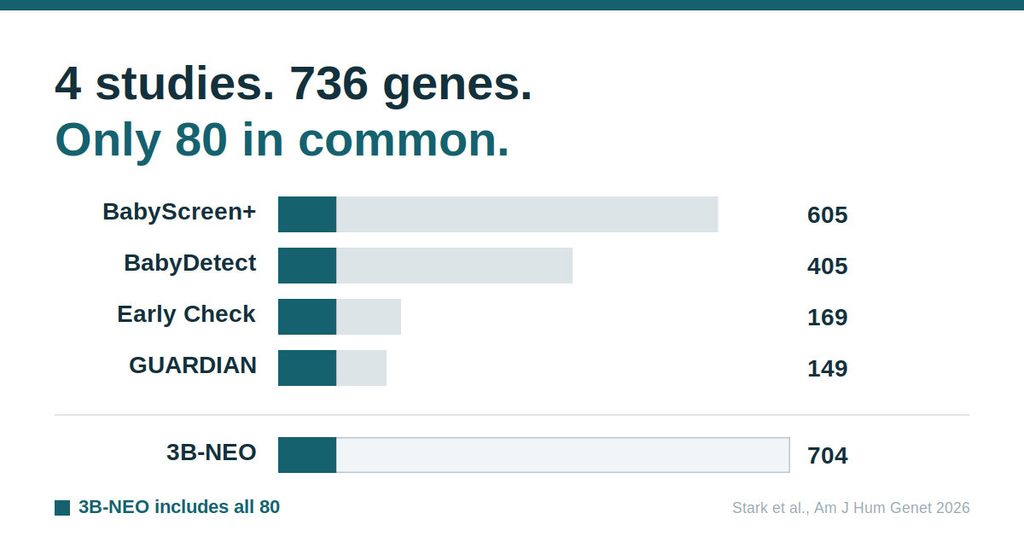
It covers 100% of the consensus core. We compared 3B-NEO’s 704 genes against the list of 80 genes shared by all four studies, published in the paper’s supplementary material. All 80 are included. This matters not because 704 is a large number — the paper itself shows panel size doesn’t predict yield — but because those 80 genes mark the narrow ground where four studies, working in four different healthcare systems with separate expert review processes, all arrived at the same answer. (👉See the genes covered by 3B-NEO)
It is designed to a two-week turnaround. 3B-NEO is specified to the target the authors identify as both desirable and feasible.
It uses the sample type all four studies validated. 3B-NEO runs on a dried blood spot card for newborns and can be ordered from the prenatal period through 90 days after birth.
It handles the steps around the test. Consent, sample collection, and return of results are among the stages the paper identifies as necessary for gNBS to work at scale. With 3B-NEO, parents initiate the request themselves, the physician confirms with a single click, 3billion handles kit delivery and sample pickup end to end, and results are returned through the system in a form ready to share with families.
3B-NEO includes G6PD. As noted above, any program including this gene should design its reporting pathway in advance.
Learn more about 3billion gNBS (3B-NEO)
Reference
Stark Z, Lunke S, Boemer F, Cope HL, Scharfe C, Servais L, Chung WK. International experiences of genomic newborn screening: Lessons from over 10,800 newborns. The American Journal of Human Genetics. 2026;113. doi:10.1016/j.ajhg.2026.09.002. https://www.cell.com/ajhg/fulltext/S0002-9297(26)00343-5#fig1

Soo-jung Baek
Marketing Manager
I strive to empower the rare disease community by sharing meaningful insights backed by our company’s expertise.