



X-Linked Inheritance: Transmission Risks and Pedigree Clues
*This article has been reviewed by a clinical geneticist at 3billion.
Variants in genes on the X chromosome are passed to children differently from autosomal variants. One simple fact — males have a single X chromosome, females two — determines whether a condition is expressed, the probability of transmission, and the entire pattern that appears in a pedigree. This article covers the basic principles of X-linked inheritance, the transmission probabilities for recessive and dominant forms, the clues that identify X-linked inheritance in a pedigree, and recurrence risk counseling in clinical practice.

1. The basic principle of X-linked inheritance
Human sex chromosomes are XX in females and XY in males. For a gene on the X chromosome, a female carries two alleles while a male carries only one. A male who carries just one allele at a given locus in this way is described as hemizygous.
This difference is the crux. A male with a single pathogenic variant in an X-linked gene has no normal allele to offset it, so the condition can generally be expressed. A female with a variant on one X chromosome, by contrast, usually has the normal allele on the other X to compensate for function, and is often a carrier. Every transmission probability described below follows from this structure.
2. X-linked recessive inheritance
In X-linked recessive conditions, a single variant is enough to cause expression in hemizygous males. Females are usually heterozygous carriers, but some show clinical symptoms, and those with pathogenic variants on both X chromosomes may be affected.
Transmission probabilities depend on the status of the parents.
With a carrier mother and an unaffected father, each son has a 50% chance of being affected, and each daughter has a 50% chance of inheriting the variant and becoming heterozygous. Most heterozygous daughters are asymptomatic or mildly affected, although clinical symptoms may appear depending on the condition.
With an affected father and a non-carrier mother, every daughter becomes a carrier — she necessarily inherits the father’s variant X — and no son inherits the variant, because a father passes a Y, not an X, to his sons.
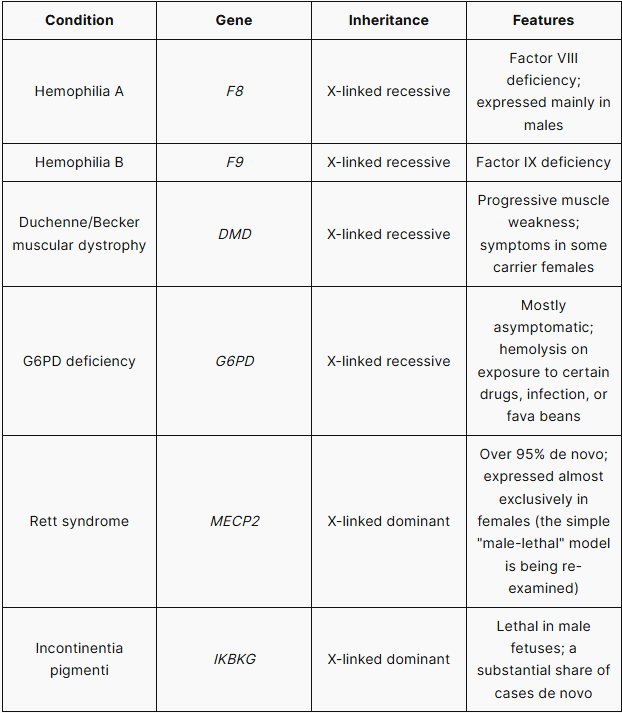
Representative conditions include hemophilia A (F8), hemophilia B (F9), Duchenne/Becker muscular dystrophy (DMD), and G6PD deficiency (G6PD).
3. X-linked dominant inheritance
X-linked dominant conditions are expressed with a variant on just one X chromosome, so heterozygous females are symptomatic as well. The most distinctive transmission pattern appears with an affected father.
With an affected father and an unaffected mother, every daughter is affected and no son is affected, because the father passes his variant X to his daughters and his Y to his sons. With an affected (heterozygous) mother, each child has a 50% chance of inheriting the variant, regardless of sex.
Some X-linked dominant conditions are lethal in male fetuses, and in these the great majority of liveborn patients are female. This point calls for careful, condition-by-condition interpretation, however. Rett syndrome (MECP2), for example, is a well-known condition associated with the X chromosome, yet the X-linked dominant rules above cannot be applied to it directly. Most patients are female, and most cases arise from a new (de novo) variant rather than being inherited from a family member. MECP2 variants also occur in males, though often with a different presentation and severity than in females, and males with classic Rett syndrome have been reported on rare occasions. As this illustrates, in real X-linked conditions, variants in the same gene can behave differently from expectation depending on sex and on how the variant arose.
Incontinentia pigmenti (IKBKG) is an X-linked condition that is typically lethal in male fetuses, and most patients are female. Surviving males have nonetheless been reported, including those with a 47,XXY karyotype or somatic mosaicism.
4. Identifying X-linked inheritance from a pedigree
In pedigree analysis, a few characteristic clues distinguish X-linked inheritance from autosomal inheritance.
The strongest clue is the absence of male-to-male transmission. In X-linked inheritance, a father does not transmit the causative variant to his son (no father-to-son transmission), because what he passes to a son is the Y chromosome. If direct father-to-son transmission is observed in a pedigree, X-linked inheritance becomes less likely.
In X-linked recessive inheritance, the condition appears mainly in males and is carried forward through carrier mothers, giving the appearance of skipping generations. Every daughter of an affected male is an obligate carrier. In X-linked dominant inheritance, both sexes are affected, but the asymmetry is the decisive clue: all daughters of an affected male are affected, while none of his sons are.
One caveat is worth noting. Female carriers of X-linked recessive conditions are not always asymptomatic. When X-chromosome inactivation (lyonization) is skewed toward one X, a carrier female can show mild to moderate symptoms. This phenomenon is an exception to the “asymptomatic carrier” assumption and should be kept in mind during differentiation.
[Table] Representative X-linked conditions
5. Clinical application: recurrence risk counseling and follow-up testing
The principles of X-linked transmission provide an important reference point for understanding recurrence risk in a family. If a mother is confirmed to carry a pathogenic variant associated with an X-linked recessive condition, for example, each son has a 50% chance of inheriting that variant.
The inheritance pattern visible in a pedigree is rarely enough on its own, however, to confirm the actual cause or the genetic risk within a family. A condition can arise from a de novo variant even with no family history, and the presence and severity of symptoms can differ among family members who carry the same variant.
When a genetic condition is suspected but the cause remains unidentified, genetic testing such as WES or WGS can be used to search for the causative variant. Trio testing, which analyzes the patient together with both parents, can help clarify the origin of a variant and whether it is de novo.
When the causative variant has already been identified within the family, or when there is a family history of a specific genetic condition, the purpose of testing may differ. Testing of asymptomatic family members can be considered on the basis of family history and clinical information (Family insight), or testing to confirm whether a known specific variant is present (3B-Variant) may be used.
Which genetic test is needed therefore depends on whether symptoms are currently present, whether there is a family history, and whether the causative variant in the family has already been identified. See below to find the genetic test that fits the situation.
Find the testing solution that's right for you.
References
- Amir RE, et al. Rett syndrome is caused by mutations in X-linked MECP2, encoding methyl-CpG-binding protein 2. Nat Genet. 1999;23(2):185-8. https://doi.org/10.1038/13810
- Meloni I, et al. A mutation in the Rett syndrome gene, MECP2, causes X-linked mental retardation and progressive spasticity in males. Am J Hum Genet. 2000;67(4):982-5. https://doi.org/10.1086/303078

Soo-jung Baek
Marketing Manager
I strive to empower the rare disease community by sharing meaningful insights backed by our company’s expertise.