



Standardizing UPD Analysis with GEBRA™
In genomic analysis, Uniparental Disomy (UPD) is a critical element for diagnosing rare diseases and identifying imprinting disorders. However, in traditional workflows, UPD has often been treated as a “special case” requiring manual intervention rather than a standardized reporting item.
The Problem: Fragmented Data and Manual Hurdles
- Lack of Standardized Documentation
Without a dedicated variant category, analysts had to “borrow” other categories or rely on manual text entries. This lack of structured data hindered post-management and the continuity of statistical analysis. - Analysis Delays Due to Data Fragmentation
Diagnostic evidence, such as ROH (Run of Homozygosity) data, had to be extracted and cross-referenced outside the system. This disconnected workflow created bottlenecks and increased overall lead time.
Standardizing and Automating UPD Analysis
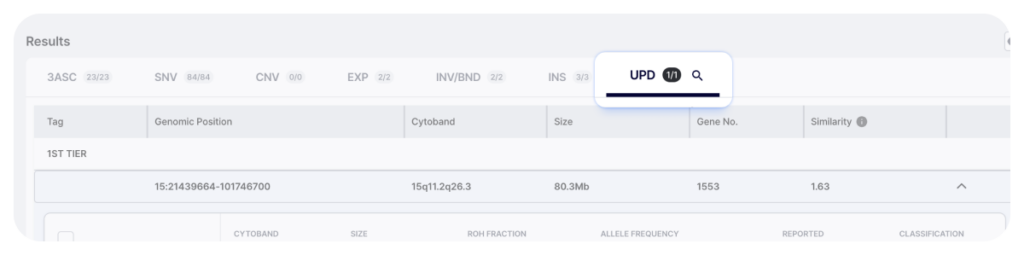
GEBRA™ has addressed these issues by integrating UPD as a Dedicated Variant Type. UPD is now fully incorporated into the GEBRA™ standard workflow, allowing for intuitive and structured analysis just like any other variant. Analysts no longer need to rely on external tools or manual records.
- Dedicated UPD Variant Tab
Provides a specialized interface for UPD analysis to enhance focus and efficiency. - Direct Selection & Reporting
Select UPD directly within the system; essential reporting phrases are now generated automatically. - Integrated Variant Card
View related variants, genomic positions, and the number of associated genes within a single, unified card. - Filtering & DB Integration
UPD is integrated into the global filtering system. Every event is automatically recorded in the In-house DB, facilitating internal statistics and cumulative case management (Reported Case Statistics).
More Accurate, More Consistent Diagnosis
Beyond adding a new feature, this update elevates the overall quality of genomic services:
- Structured Data Management
Manage UPD using standardized data formats rather than informal, unstructured memos. - Maximum Analysis Efficiency
By centralizing all necessary reporting information, we have completely eliminated manual conversion processes. - Guaranteed Reporting Consistency
Ensure high-reliability reports by maintaining consistent standards and processes, regardless of the individual analyst’s experience level.
GEBRA™ is realizing faster, more accurate diagnosis by standardizing every step of genomic analysis. Experience the new UPD functionality in GEBRA™ today.

3billion Inc.
3billion is dedicated to creating a world where patients with rare diseases are not neglected in diagnosis and treatment.