Is Metabolomic Testing Enough for IEMs? Why Genomics Matters in the NICU

Sookjin Lee
Chief Business Officer (CBO) | Ph.D.
A business expert leading innovation in precision medicine and genomics for 20 years. Accelerating the commercialization of innovative technologies with academic expertise and market insight.
In neonatal intensive care units (NICUs), clinicians frequently encounter two critical dilemmas regarding inborn errors of metabolism (IEMs):
- “If standard newborn metabolomic screening (MS/MS) returns normal, is genomic sequencing still necessary?”
- “If metabolomic testing flags an abnormality but genomic sequencing is negative, does that represent an analytical sequencing failure?”
A retrospective study published in npj Genomic Medicine (2026), titled “Exploring the technical possibilities of metabolomic versus genomic tests for diagnosis of inborn errors of metabolism in NICU”, provides direct clinical evidence to resolve these questions.
1. Clinical Cohort: MS/MS vs. tNGS in 1,003 Neonates
The investigators evaluated 1,003 full-term infants in the NICU, applying both MS/MS metabolomic testing and tNGS genomic sequencing from identical dried blood spots (DBS).
- Metabolomic testing (MS/MS): 15 suspected cases (1.50%)
- Genomic sequencing (tNGS): 156 suspected cases (15.55%)
- Confirmed IEM cases: 7 patients
Genomic testing captured a tenfold higher volume of suspected cases largely because its scope extended beyond standard metabolic panels, capturing non-metabolic genetic conditions (e.g., congenital hearing loss) and common genetic modifiers of neonatal jaundice (such as UGT1A1 variants in Gilbert syndrome and G6PD deficiency).
2. Misconception 1: “Is Genomics Redundant When Metabolomics Is Normal?”
Reality: Genetic defects can remain biochemically latent at birth, while metabolomics solves genomic VUS challenges.
Certain genetic disorders do not present with immediate biomarker elevations in early life. In this cohort, patients carrying pathogenic variants in genes such as PRODH and ACSF3 displayed no discernible biochemical abnormalities during the initial neonatal period. Relying solely on metabolomic screening risks missing these later-onset conditions.
Furthermore, among the 7 confirmed IEM patients, 4 cases (57.1%) carried Variants of Uncertain Significance (VUS) on genomic sequencing alone. Crucially, the presence of distinct metabolic perturbations provided the necessary ACMG phenotypic evidence (PP4) to upgrade these variants to diagnostic status.
3. Misconception 2: “Metabolic Abnormality with Negative Genetics Means a Missed Mutation?”
Reality: Over half of biochemical abnormalities in the NICU represent transient, non-genetic perturbations.
Of the 15 neonates flagged with abnormal metabolic profiles, 8 infants (53.3%) were genetically negative or carried only carrier-state heterozygous variants unrelated to an autosomal recessive diagnosis.
A systematic 2-year clinical follow-up revealed that all infants with isolated metabolic deviations maintained normal physical growth and neurodevelopment without disease relapse. In the NICU setting, total parenteral nutrition (TPN), antibiotic administration, liver immaturity, and acute systemic hypoxia frequently produce false-positive biochemical spikes. A negative genetic test in this context often rules out lifelong monogenic disorders, preventing unnecessary lifelong treatment.
4. Diagnostic Modality Comparison
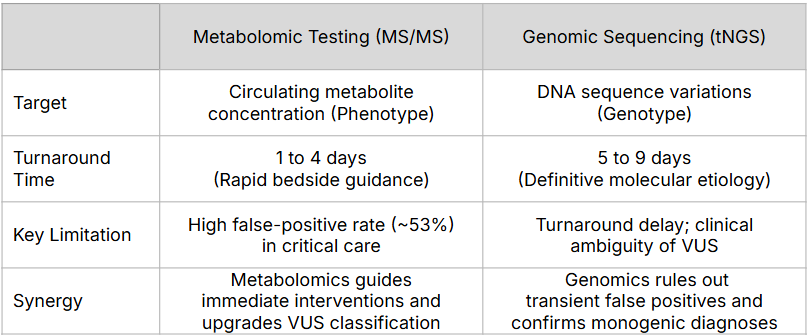
Frequently Asked Questions (FAQ)
Q1. Can tandem mass spectrometry (MS/MS) alone definitively diagnose IEMs in the NICU?
No. While MS/MS is indispensable for detecting active biochemical crises within 1 to 4 days, acute physiological stress and parenteral nutrition frequently induce transient false positives. Molecular confirmation via genomic testing is essential to confirm or rule out true genetic disease.
Q2. Why do some infants exhibit metabolic abnormalities but test negative on genetic sequencing?
In intensive care settings, premature organ systems, specialized nutritional support (TPN), and severe medical stress frequently distort circulating metabolite concentrations. In this cohort, over 53% of metabolic anomalies resolved without genetic etiology, demonstrating normal 2-year neurodevelopment.
Q3. How does metabolomic testing assist in resolving Variants of Uncertain Significance (VUS)?
Metabolomics offers critical phenotypic evidence under ACMG/AMP guidelines (criterion PP4). When a novel or uncharacterized variant aligns precisely with an abnormal biochemical biomarker profile, the VUS can be confidently reclassified as pathogenic or likely pathogenic.
Q4. What is the clinical strategy for combining metabolomics and NGS in critically ill newborns?
An integrated dual-testing workflow is recommended: utilize rapid MS/MS metabolomics to direct immediate resuscitation and stabilization, followed by targeted NGS to achieve definitive etiologic confirmation, decipher VUS results, and establish long-term management plans.
Want to learn more about
3billion's genetic testing?
We'll reply within 1 business day.