


[Clinical Insight] “Rarely Diagnosed, Not Rare” – An Interview with Dr. Dmytro Tokariev

Sookjin Lee
Chief Business Officer (CBO) | Ph.D.
A business expert leading innovation in precision medicine and genomics for 20 years. Accelerating the commercialization of innovative technologies with academic expertise and market insight.
We are thrilled to share a very special interview with Dr. Dmytro Tokariev, a dedicated pediatric genetic diagnostic expert who has not only been a loyal user of 3billion’s services but has also built a wonderful relationship with us as a regular reader of my weekly letters!
Working on the front lines of pediatrics and palliative care every day, Dr. Tokariev shares his profound clinical insights and raw, firsthand experiences with rare diseases. In this interview, he reveals the inspiring philosophy behind his self-developed “Phenotype Assessment Scale”—which allows clinicians to screen for genetic conditions using just a pen, paper, and their own eyes—as well as the definitive patient case that led him to transition completely from panel sequencing to WES/WGS.
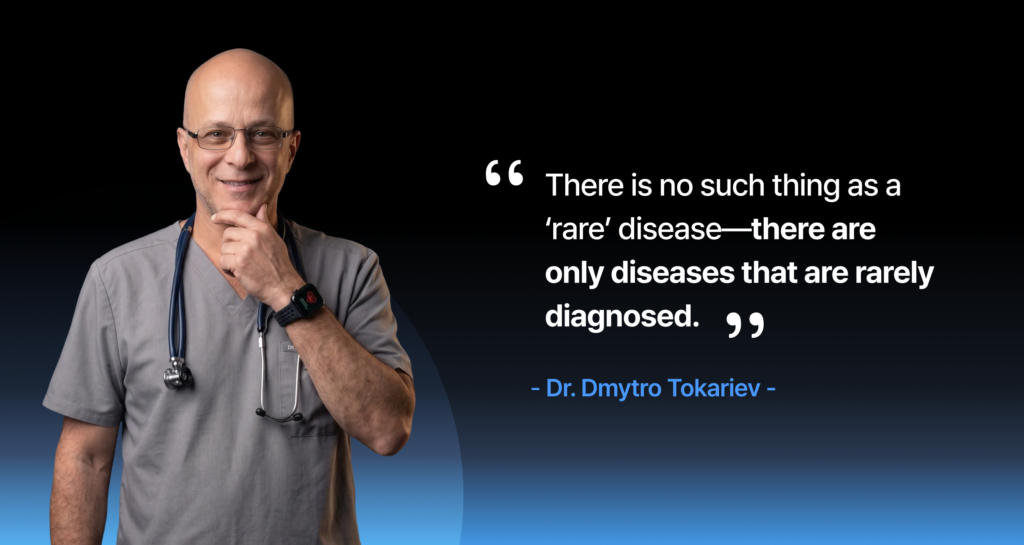
“There is no such thing as a ‘rare’ disease—there are only diseases that are rarely diagnosed.” Driven by this powerful belief, Dr. Tokariev emphasizes that the journey of diagnosing rare diseases should be embraced as a thrilling joy. Dive into his inspiring story and deep clinical wisdom below!
👤 Sector 1. Meet Dr. Dmytro Tokariev
Q1. Could you briefly introduce yourself, your role in the paediatric department, and the types of precious patients you care for every day?
A1. My name is Dmytro Tokarev, and I am the head of the Department of Pediatrics and Palliative Care at the Communal Non-Profit Enterprise City Multidisciplinary Clinical Hospital for Mothers and Children Named After Prof. M. F. Rudnev of the Dnipro City Council (KNP MBKLMD RUDNEVA DMR). I am a pediatrician and neonatologist, and I have been practicing medicine since 2002. I have served as department head since 2021.
Every day, we treat children from birth through age 18. We treat children with various serious illnesses—severe pneumonia, respiratory distress syndrome (including severe bronchiolitis), neuroinfections (including meningitis, excluding meningococcemia), multisystem inflammatory syndrome, Kawasaki disease, and many others. We also provide initial treatment with propranolol for children with infantile hemangiomas. We have some experience in the emergency treatment of children with type I glutaric aciduria in a state of metabolic crisis.
I also specialize in the diagnosis of genetically determined diseases in children. I conduct screening tests for the early diagnosis of storage diseases—Gaucher disease, mucopolysaccharidoses, and Fabry disease. I also give lectures to physicians on storage diseases, particularly Gaucher disease.
🎯 Sector 2. The Art of Suspecting a Rare Genetic Condition
Q2. Many clinicians find it incredibly challenging to know when to suspect a rare genetic disease. What are your personal trigger points or red flags when looking at a child?
A2. In my practice, I use a phenotype assessment scale that I have personally developed, which enables me to examine the phenotype in detail and calculate a score. Depending on the score, I then assess the risk of a genetically determined disease.
- 17–8 points – highly likely
- 7–5 points – moderately likely
- less than 5 points – unlikely
- The total score is the red flag itself
Q3. We were absolutely fascinated by your self-developed Phenotype Assessment Scale! Could you share the core philosophy or principles behind how it works?
A3. The main idea behind the scale is a sheet of paper, a pen and the eyes of a doctor who has no specialist training in clinical genetics. The systematisation and counting of dysmorphic features.
💡 Dr. Lee’s Note
It is truly fascinating that any clinician, even without specialized training in genetics, can screen for rare diseases using just their eyes, a pen, and a sheet of paper. While the exact criteria of the scale weren’t fully disclosed in this interview, I am already so curious! Next time, I will definitely ask Dr. Tokariev if he could share more details on “the systematization and counting of dysmorphic features” so we can share this invaluable knowledge with our global medical community. Stay tuned for a potential follow-up!
🧬 Sector 3. Your Evolving Diagnostic Algorithm
Q4. In your workflow, you prefer standard Karyotyping over CMA as a first-tier test if gross malformations are present. We would love to hear your clinical reasoning behind this choice.
A4. In most cases, we begin our diagnostic process with karyotyping. However, in each individual case, I try to take a personalized approach, carefully analysing the patient’s medical history and clinical and laboratory data. For example, there are patients with phenotypic features of Cornelia de Lange syndrome and Waardenburg syndrome. For these patients, I plan to carry out WES|WGS straight away.
Q5. You mentioned you recently stopped recommending panel sequencing. Was there a specific “aha!” moment or a memorable patient case that completely shifted your perspective toward WES/WGS?
A5. Yes. There was a 6-year-old patient with progressive muscular hypotonia and weakness. Panel sequencing yielded a negative result. WES/WGS analysis confirmed the genetic aetiology of the condition
Q6. Even with an advanced workflow, what remains your biggest clinical challenge or headache when it comes to genetic diagnosis today?
A6. Cost. Unfortunately, at present, the cost of testing remains the main limiting factor in our field. Another factor is the medical community’s lack of awareness regarding the current possibilities for diagnosing genetically determined diseases. Moreover, a WES/WGS test carried out in a timely manner often ends up being cheaper and quicker for patients and their families than standard diagnostic procedures and algorithms.

🤝 Sector 4. Your Journey with 3billion
Q7. To be honest, 3billion is a company from a far-off country! What made you decide to trust and choose us as your partner?
A7. Quality. Simple logistics. Test results that are easy for practising doctors to understand. And, not least, the cost of the tests.
Q8. What part of our service are you most satisfied with? On the flip side, we always want to grow—is there anything you think we could improve or do better for you?
A8. At present, I am satisfied with our collaboration. In the future, I would very much like to visit your diagnostic centre in Seoul, see your working processes for myself, meet your wonderful team, and compare your protocols and algorithms for the diagnosis of genetically determined diseases. I would very much like, perhaps in collaboration with you, to write a brief guide for practising doctors on NGS – which method is preferable in each specific case, and a brief description of each method, its capabilities, advantages, indications and disadvantages.
💡 Dr. Lee’s Note
Dr. Tokariev has given us a truly inspiring and exciting proposal! A practical guide written for practicing physicians to help them navigate and select the optimal NGS method for each specific case would be an invaluable asset to the medical community. This is exactly the kind of vision 3billion strives for. We believe that true progress in genomic medicine comes not just from providing a testing service, but from building a “global collective intelligence” by bridging clinical wisdom with advanced genomics. Inspired by Dr. Tokariev’s wonderful idea, I will certainly look into launching a collaborative project where passionate clinicians from different countries can come together to co-author a global NGS guide. The future of medicine that we build together with our partners is incredibly bright!
Q9. How do you find the weekly emails that I send you, and what kind of topics or stories would be most helpful or interesting to you?
A9. I read the weekly newsletters regularly and really enjoy everything to do with the diagnosis of complex clinical cases
🚀 Sector 5. Looking Ahead
Q10. If you could give one warm piece of advice to fellow physicians worldwide who are still struggling with rare disease diagnostics, what would it be?
A10.
- 1. There is no such thing as a ‘rare’ disease – there are only diseases that are rarely diagnosed. These aren’t my words; one of the great scientists said this, but I fully agree with it.
- 2. We must always bear in mind that ‘rare’ diseases may lie behind common and well-known conditions. Autoinflammatory diseases are a case in point.
- 3. Don’t be afraid to consider rare diseases and diagnose them.
- 4. Carefully analyse clinical, phenotypic and laboratory findings – this helps you choose the right tests.
- 5. Read international scientific literature.
- 6. Most importantly, diagnosing rare diseases should be a thrill – you should enjoy it.
Q11. Lastly, as a pediatrician and a geneticist, what kind of world do you dream of creating for your patients?
A11. I want patients with rare diseases to become patients with treatable diseases and to make a full recovery.
Would you like to shape the future of rare disease diagnostics with 3billion, just like Dr. Tokariev? Share your clinical stories or start a partnership with us today.