



[Baby Care #5] Birth Plan Template: A Simple Guide for Expecting Families

A birth plan template is a short, fill-in document that lists what you want during labor, delivery, and the first hours with your newborn. It helps you tell doctors, midwives, and nurses your preferences before the big day — so decisions feel calmer and clearer.
You do not need medical training to use one. Think of it as a conversation starter, not a contract. Your team follows it when possible and adjusts if your health or your baby’s health needs something different.
In the sections below, you will find the core parts of a template — mobility, eating and drinking, monitoring, pain relief, pushing, and immediate newborn care — along with why families find these plans helpful. We also look at how planning for your baby’s health can extend to genetic testing when there is a family history or unexplained symptoms.
FAQs
Q. What should a birth plan template include?
A. A birth plan usually covers your preferences for mobility, eating and drinking, fetal monitoring, pain relief and drug options, labor augmentation, pushing, episiotomy, immediate newborn care, and your wishes if a caesarean becomes necessary.
Q. Do birth plans actually help?
A. Research suggests they can. In one randomized trial, birth plans were studied for their effect on childbirth experience and duration of active labor, along with fear of labor and postpartum wellbeing — outcomes that matter deeply to families.
Q. Is a birth plan legally binding?
A. No. A birth plan states your preferences, not fixed rules. Your care team respects your choices when it is safe, but medical judgment guides decisions if complications arise during labor or delivery.
Q. When should I write my birth plan?
A. Most families write theirs in the third trimester, often around 32–36 weeks. That timing gives you space to discuss options with your provider while details are still fresh before delivery.
Q. How does genetic testing relate to birth planning?
A. Genetic testing can identify inherited conditions before or after birth, especially with a family history or unexplained symptoms. Knowing early helps families and clinicians plan care and support for the baby.
What goes in a birth plan
A useful template stays short — one to two pages. It groups your choices into clear sections so any nurse can read it quickly during a busy shift.
Based on checklists used in clinical research, a birth plan commonly covers the mother’s preferences on mobility, eating and drinking, monitoring, pain relief, drug options, labor augmentation, pushing, amniotomy, episiotomy, infant care, and caesarean section.
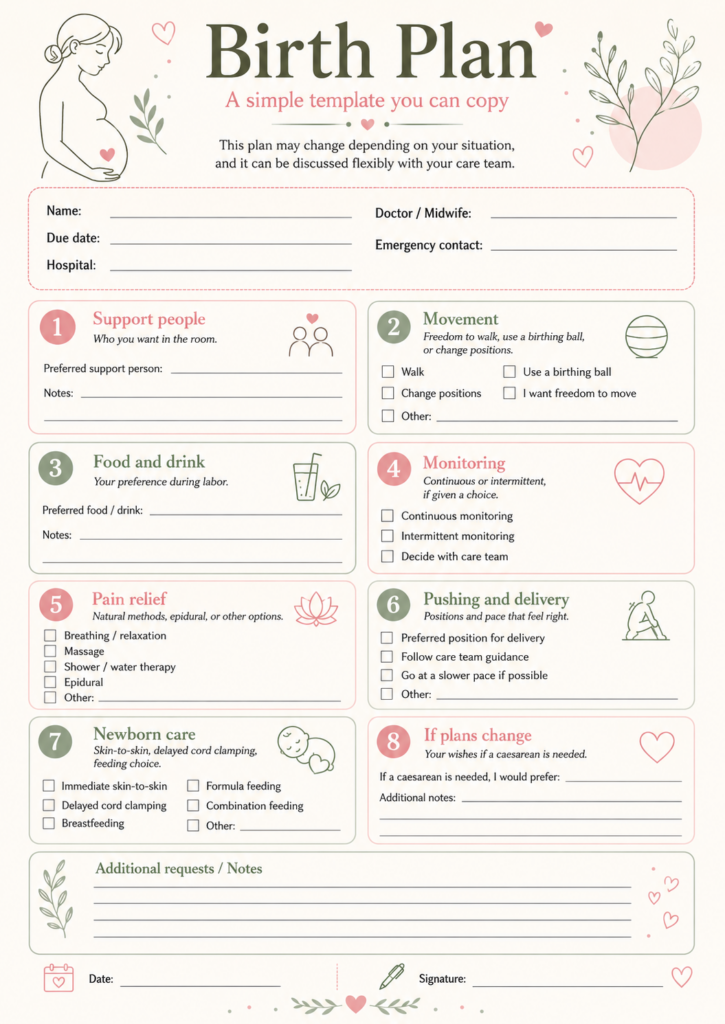
A simple template you can copy
- Support people: who you want in the room.
- Movement: freedom to walk, use a birthing ball, or change positions.
- Food and drink: your preference during labor.
- Monitoring: continuous or intermittent, if given a choice.
- Pain relief: natural methods, epidural, or other options.
- Pushing and delivery: positions and pace that feel right.
- Newborn care: skin-to-skin, delayed cord clamping, feeding choice.
- If plans change: your wishes if a caesarean is needed.
Why a birth plan can make a difference
Writing things down reduces guesswork in the moment. It also invites early conversations that can ease anxiety.
A randomized controlled trial in Tabriz, Iran enrolled 106 pregnant women at 32–36 weeks to test how a birth plan affects maternal and neonatal outcomes. Researchers measured the childbirth experience and the length of active labor as main outcomes, alongside fear of labor and postpartum mood.
Larger work continues in this area. A separate trial in Tehran enrolled 300 pregnant women and was the first to study birth plans built into childbirth preparation classes.
Planning beyond labor: your baby’s health
A birth plan handles the day of delivery. Many families also think ahead about their baby’s long-term health — especially when a relative has a genetic condition, or when a previous pregnancy raised questions.
Genes carry instructions. When a single gene has a change, or variant, the protein it builds may not work as expected, and that can lead to a rare condition. Some of these conditions are hard to spot at birth because early signs look ordinary — feeding trouble, low muscle tone, or delayed milestones.
Where genetic testing fits
Genetic testing reads a baby’s DNA to look for these variants. It cannot predict everything, and it does not replace your doctor’s judgment. But when symptoms are unexplained or a condition runs in the family, an early answer can shorten the search and guide care sooner.
If you are building a birth plan and also weighing your family history, a genetic counselor or clinician can help you decide whether testing makes sense for you.
When to talk to a professional
Bring your birth plan to a prenatal visit and review it with your provider. Ask what your hospital or birth center can support, and update the plan as your pregnancy progresses.
If a rare condition is a concern, that is the moment to ask about genetic testing — not to alarm you, but to give you information and options. Every family deserves clear answers about their child’s health. A birth plan covers the day of delivery, but it can’t tell you what’s happening at the genetic level — and that’s a separate question worth answering early.
3B-NEO is a newborn genomic screening test, ordered during pregnancy and run on a blood sample taken right after birth. Using whole exome sequencing, it screens for a broad range of rare genetic conditions — including ones that don’t show any signs at birth. If unexplained symptoms or a family history leave you with questions a birth plan can’t answer, this is one way to get a clear answer sooner rather than later.
Full series
View all

Seong Eun
Marketing Manager
I’m turning genomic insights into impact.