




What Is Sequencing? Why It Matters in Genetic Testing
📍Key Takeaways
- Sequencing reads the order of DNA’s four bases (A, T, G, C) to find the disease-causing variant hidden among roughly 3 billion base pairs.
- Sanger sequencing (first generation) confirms single genes, while NGS surveys the genome at scale — split into WGS and WES.
What sequencing actually means
At its core, sequencing is the process of determining the exact order of the four chemical bases — adenine (A), thymine (T), guanine (G), and cytosine (C) — that spell out a strand of DNA. That order, the DNA sequence, is the instruction set of a living organism. The human genome runs to roughly 3 billion base pairs, and a single change in that long string can be the difference between health and disease. Sequencing is how we read it.
How sequencing works
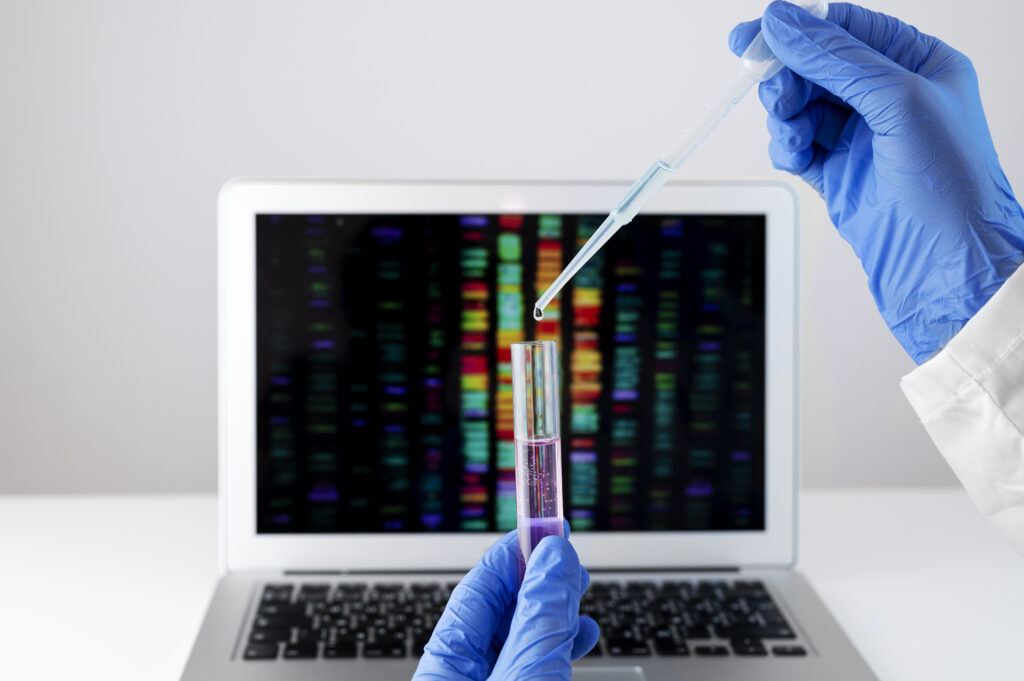
Modern sequencing rarely reads the genome end to end in one pass. Instead, DNA is broken into millions of short fragments, each fragment is read, and software stitches the overlapping reads back together against a reference genome. Where a patient’s sequence departs from that reference, a variant is flagged. It helps to separate two steps here: sequencing generates the raw data, and variant analysis interprets it. A sequencer does not diagnose — it produces the text that clinical interpretation then turns into meaning.
The main types of sequencing
Sequencing technologies fall into two broad generations. Sanger sequencing, developed in the 1970s, is highly accurate but low-throughput, which makes it well suited to confirming a single gene or a specific variant. Next-generation sequencing (NGS) reads millions of fragments in parallel, making it fast and economical enough to survey the genome at scale.
Within NGS, the key distinction is scope. Whole genome sequencing (WGS) reads essentially the entire genome. Whole exome sequencing (WES) targets only the exome — the protein-coding regions — which is roughly 1% of the genome yet harbors about 85% of known disease-causing variants in Mendelian disorders (in coding and canonical splice-site regions). That efficiency is why WES is often the pragmatic first-line choice, while WGS offers the broadest view.
Why depth and coverage decide quality
Two sequencing runs are not created equal. The concepts that separate a trustworthy result from a shaky one are depth and coverage. Depth is how many times a given position in the genome is read; coverage is how much of the genome is read at all. Adequate depth is what lets an analyst distinguish a true variant from a sequencing error, so in a clinical setting sufficient depth and even coverage are preconditions for a confident call — not optional extras.
Sequencing in clinical diagnosis
Most rare diseases trace back to variants in a single gene, and symptoms alone often cannot pinpoint which one. That is where sequencing-based testing has become indispensable: it lets clinicians examine many genes at once instead of ordering them one by one. WES achieves a molecular diagnosis in roughly 30–50% of patients with suspected rare or Mendelian disease, with higher yields in early-onset, pediatric, and consanguineous cases. When WES is non-diagnostic, WGS can extend the search to disease-causing variants in non-coding regions. Sequencing, in other words, is less a lab technique than the foundation of precision medicine.
Frequently asked questions
Is sequencing the same as genetic testing?
Not quite. Sequencing is the technology that reads the DNA; genetic testing is the full process of interpreting that read in a clinical context. Sequencing is one step within a genetic test.
WGS or WES — which is better?
Neither is universally superior. The right choice depends on the diagnostic question, the budget, and the type of variant you need to detect.
Hear directly from a fellow clinician how genetic testing can offer diagnostic clues. Click the button below to read our interview with a pediatrician who has 24 years of clinical experience.
References
- National Human Genome Research Institute. DNA Sequencing Fact Sheet. https://www.genome.gov/about-genomics/fact-sheets/DNA-Sequencing-Fact-Sheet
- Centers for Disease Control and Prevention. What is Genomic Sequencing? https://www.cdc.gov/advanced-molecular-detection/about/what-is-genomic-sequencing.html
- Yang Y, et al. Clinical Whole-Exome Sequencing for the Diagnosis of Mendelian Disorders. 2013. https://doi.org/10.1056/NEJMoa1306555
- Bamshad MJ, et al. Exome sequencing as a tool for Mendelian disease gene discovery. Nat Rev Genet. 2011. https://doi.org/10.1038/nrg3031

Soo-jung Baek
Marketing Manager
I strive to empower the rare disease community by sharing meaningful insights backed by our company’s expertise.