



Polycystic Kidney Disease: When Is Genetic Testing Useful?
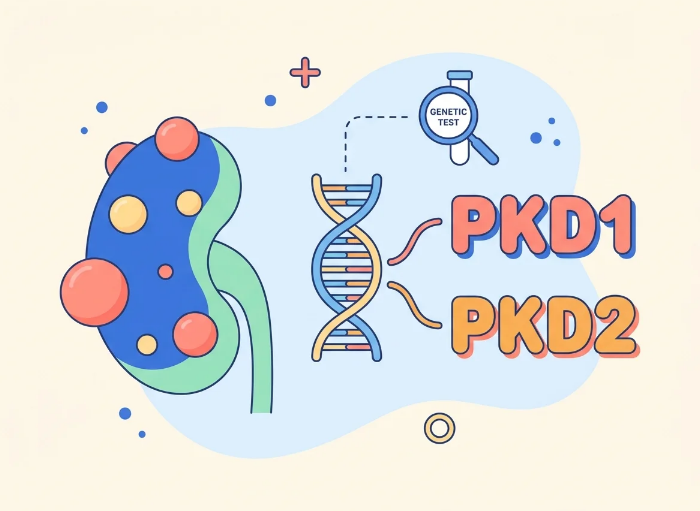
Polycystic kidney disease (PKD) is a group of inherited conditions in which fluid-filled cysts gradually replace functioning kidney tissue. The dominant form, ADPKD, is the one clinicians see most often. It typically presents in adulthood with enlarging kidneys, hypertension, and declining kidney function.
The disease is monogenic: a single pathogenic variant, usually in PKD1 or PKD2, is enough to cause it. Understanding which gene is involved—and what kind of variant—helps predict trajectory and guide family counseling.
Frequently asked questions
How common is polycystic kidney disease?
ADPKD affects roughly 1 in 1000 people, making it the most common inherited kidney disorder. Registry-based estimates in Europe place point prevalence near 3.3 per 10,000, with genomic studies suggesting higher true rates.
Is polycystic kidney disease inherited?
Yes. ADPKD follows autosomal dominant inheritance, so each child of an affected parent has a 50% chance of inheriting the variant. A rarer recessive form exists and typically presents in infancy or childhood.
The genetics behind the cysts
ADPKD is a textbook monogenic disorder. A pathogenic variant in PKD1 on chromosome 16 accounts for roughly 85% of cases, and PKD2 on chromosome 4 for most of the rest, as summarized in a review of ADPKD genetics (OMIM 173900).
These genes encode polycystin-1 and polycystin-2, proteins that sit in the membrane of kidney tubule cells and sense fluid flow. When their function drops below a critical threshold, tubule cells proliferate abnormally and secrete fluid, seeding the cysts that define the disease.
There is no single “PKD mutation.” More than 1250 PKD1 and 200 PKD2 variants have been catalogued, and no single mutation accounts for more than 2% of cases. This diversity is why sequencing, rather than a targeted single-variant test, is usually needed.
Why the gene matters for prognosis
Variant location and type influence disease course. In cohorts enriched for high-risk, progressive disease, about 75% carried PKD1 variants and 15% carried PKD2 variants, with the remainder undetected. In general, PKD1-associated disease tends to progress faster and reach kidney failure earlier than PKD2-associated disease.
How common is ADPKD?
Prevalence estimates depend on how cases are counted. Clinically ascertained studies report 2.4–9.0 per 10,000, while a large genomic-sequencing study produced a minimal estimate of 1 per 1000. The gap reflects milder cases that never reach clinical attention.
A registry-based analysis across the EU found a minimum point prevalence of 3.29 per 10,000, rising to a projected 3.96 per 10,000 with universal screening. Whatever the exact figure, ADPKD is the leading inherited cause of kidney failure and contributes to about 5% of all end-stage renal disease.
What genetic testing adds to diagnosis
Many patients are diagnosed by imaging and family history alone. Ultrasound or MRI showing multiple bilateral cysts in someone with an affected parent is often enough. Genetic testing earns its place in specific situations: ambiguous imaging, no known family history, early or unusually severe presentation, and evaluation of potential living kidney donors from affected families.
Genetic testing also helps pinpoint which gene is responsible. In one large exome study, 19 of 235 patients (8%) diagnosed with ADPKD carried variants in genes other than PKD1 or PKD2. Which gene is involved can change how a patient is monitored and counseled.
Not all “pathogenic” variants behave the same
This is the subtlety clinicians most need to appreciate. The same exome study found that 98% of people with large deletions or truncating PKD1/PKD2 variants had ADPKD, but only 31% of those carrying missense PKD1 variants previously labeled “likely pathogenic” actually had the disease.
In plain terms: a variant that disrupts the gene completely is a reliable signal, while many subtler single-letter changes are not. Interpreting these results requires expertise, and misreading a benign variant as disease-causing can lead to unnecessary anxiety or inappropriate exclusion of a kidney donor.
Detection rates in practice
Modern sequencing combined with methods that catch large deletions identifies a causative variant in most, but not all, patients. An Italian cohort of 440 unrelated patients reached an overall detection rate of 80%, with 85.5% of pathogenic variants in PKD1 and 14.5% in PKD2. A Chinese cohort reported a similar pattern, with disease-causing variants found in about 90% of patients.
A negative result therefore does not exclude ADPKD. Some patients carry variants in hard-to-sequence regions, and a small fraction have disease driven by genes not yet on standard panels. Combining chart review with sequencing captures the most: in one analysis, 76.6% of confirmed ADPKD cases had an identifiable genetic cause.
* This article is educational and does not replace individualized medical advice. Diagnostic and management decisions should be made with a qualified clinician.
Want to learn more about
3billion's genetic testing?
We'll reply within 1 business day.
References
- Pandita S, et al. Autosomal Dominant Polycystic Kidney Disease: Presence of Hypomorphic Alleles in PKD1 Gene. 2018. https://doi.org/10.4103/ijn.IJN_236_17
- Lanktree MB, et al. Insights into Autosomal Dominant Polycystic Kidney Disease from Genetic Studies. 2021. https://doi.org/10.2215/CJN.02320220
- Willey CJ, et al. Prevalence of autosomal dominant polycystic kidney disease in the European Union. 2017. https://doi.org/10.1093/ndt/gfw240
- Chang AR, et al. Exome Sequencing of a Clinical Population for Autosomal Dominant Polycystic Kidney Disease. 2022. https://doi.org/10.1001/jama.2022.22847
- Carrera P, et al. Deciphering Variability of PKD1 and PKD2 in an Italian Cohort of 643 Patients with Autosomal Dominant Polycystic Kidney Disease (ADPKD). 2016. https://doi.org/10.1038/srep30850
- Liu B, et al. Identification of novel PKD1 and PKD2 mutations in a Chinese population with autosomal dominant polycystic kidney disease. 2015. https://doi.org/10.1038/srep17468

Soo-jung Baek
Marketing Manager
I strive to empower the rare disease community by sharing meaningful insights backed by our company’s expertise.