


Duo / Trio Analysis, Now as Fast as Proband-only Analysis

Duo / Trio analysis is not a new concept in genomic analysis. Family-based analysis has long been utilized as a core method to enhance diagnostic accuracy. Nevertheless, many analysis pipelines have operated under the unspoken assumption that “Duo / Trio analysis is inherently slower.”
This latest GEBRA™ update began by viewing this premise not as a simple performance issue, but as a fundamental problem of analysis architecture.
The Bottleneck: It wasn’t ‘Complexity,’ it was ‘Design’
The reasons why traditional Duo / Trio analysis felt slow are clear:
- Increased data throughput due to a higher number of samples.
- Complex comparative operations and inheritance-based filtering between samples.
Because of this, most systems designed Duo / Trio analysis as an “extension step” performed after the Proband-only analysis. Consequently, it became accepted as a natural cost that Duo would take twice as long and Trio three times as long as a Proband analysis.
GEBRA™ Redefined: From an ‘Extension’ to a ‘Parallel Unit’
GEBRA™ has fundamentally redesigned this approach. We restructured Duo / Trio analysis to be an equivalent analysis unit processed in parallel from the start, rather than an incremental add-on.
[Key Enhancements]
- Reconfigured Computational Flow: Optimized the internal operation logic of the Duo / Trio pipelines.
- Parallel-First Architecture: Overhauled the structure to enable immediate parallel processing without wait times.
- Redundancy Elimination: Completely removed unnecessary, repetitive calculations between family samples.
[Performance Results]
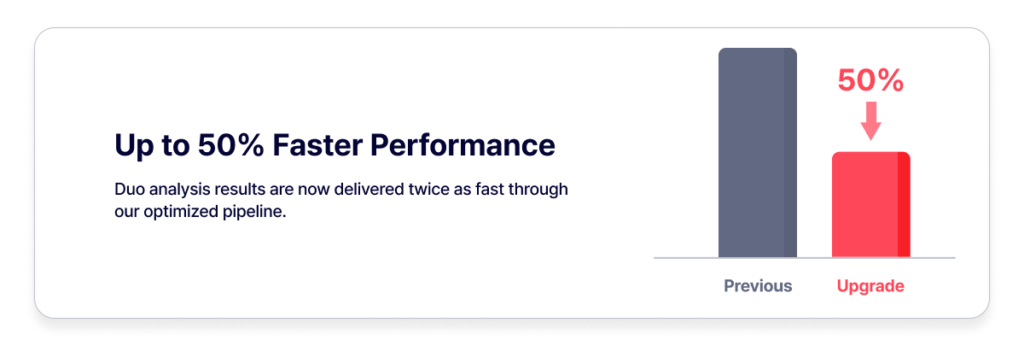
- Duo Analysis: Turnaround time reduced by approximately 50%.
- Trio Analysis: Turnaround time reduced by approximately 67%.
- The Outcome: Duo and Trio analysis now complete at speeds comparable to a single Proband analysis.
Beyond Speed: A Paradigm Shift in Workflow
The core of this improvement is not just that it is “faster.” It means that family-based analysis is no longer an “exceptional task” or a “path requiring extra resources.”
Duo / Trio analysis is now handled natively within the standard GEBRA™ workflow. In other words, it has transitioned from a “slow alternative” to a “default processing standard.” This structural change drastically improves the efficiency of genomic services across the board.
Real-World Impact on Genomic Services
- Rapid WGS / Urgent WES: Extends the speed of sequencing all the way to the interpretation phase, completing the true definition of a “Rapid” service.
- NICU / PICU Genomic Diagnosis: Removes the interpretation bottleneck in environments where Trio analysis is the standard, providing faster answers for critically ill infants.
- Reanalysis of Negative Cases: Eliminates the burden of long wait times when adding parental samples, allowing reanalysis to follow as a natural next step.
- Large-scale National Projects: Ensures Duo / Trio analysis does not become a bottleneck in massive datasets, maximizing operational stability and scalability.
GEBRA™ is more than just an analysis platform; it is the interpretation and workflow layer that makes existing genomic services faster, more stable, and more scalable.
The moment Duo / Trio analysis is handled in parallel, the efficiency of your genomic service changes fundamentally. Experience the difference in GEBRA™ today.

3billion Inc.
3billion is dedicated to creating a world where patients with rare diseases are not neglected in diagnosis and treatment.