




What Is Genetic Phasing and Why Is It Important for Rare Disease Diagnosis?

Sohyun Lee
Clinical Genomics Scientist & Clinical Customer Support
I'm guiding test selection, supporting variant and result interpretation, handling case inquiries, and translating field insights into service improvements.
When reviewing a genetic testing report, it is common to find one or more genetic variants identified. However, simply detecting variants is often not enough. When two or more variants are found within the same gene, understanding how those variants are arranged on the chromosomes becomes critically important.
This is where genetic phasing comes in.
Genetic phasing is the process of determining whether genetic variants are located on the same chromosome copy (in cis) or on different chromosome copies (in trans), and in many cases, identifying which parent contributed each variant.
This information plays a crucial role in the diagnosis of many inherited disorders, particularly autosomal recessive diseases.
Frequently Asked Questions
What is genetic phasing?
Genetic phasing is the process of determining which chromosome copy carries a particular genetic variant. More specifically, it identifies whether multiple variants are located on the same allele or on different alleles.
Why is phasing important?
The clinical interpretation of two variants found in the same gene can change dramatically depending on whether they are arranged in cis or in trans. For many autosomal recessive disorders, disease causation typically requires two pathogenic variants to be present in trans.
What do cis and trans mean in genetics?
- In cis: Two variants are located on the same chromosome copy.
- In trans: Two variants are located on opposite chromosome copies.
How is phasing determined?
Several approaches can be used, including:
- Trio analysis involving the patient and both biological parents
- Read-based phasing using short-read NGS data
- Long-read sequencing technologies
- Statistical phasing algorithms
Understanding Chromosomes and Alleles
Human DNA is organized into 23 pairs of chromosomes.
For each chromosome pair, one chromosome is inherited from the mother and the other from the father. As a result, most genes are present in two copies, known as alleles.
Although these two copies are usually very similar, they often contain small sequence differences known as genetic variants.
Most variants are harmless and contribute to normal human diversity. However, some variants can disrupt gene function and lead to disease.
When two variants are identified within the same gene, a key question arises:
Are these variants located on the same allele, or on opposite alleles?
Genetic phasing helps answer this question.
What Is Genetic Phasing?
Phasing is the process of assigning genetic variants to their respective parental chromosome copies.
For example, imagine that two pathogenic variants are identified in the same gene.
Phasing allows us to distinguish between two possible configurations.
Cis Configuration
Both variants are located on the same chromosome copy.
In this situation, the two variants are said to be in cis.
Trans Configuration
The variants are located on opposite chromosome copies.
In this situation, the variants are said to be in trans.
Although both scenarios involve two variants in the same gene, their biological and clinical implications can be very different.
Why Are Cis and Trans Important?
The importance of distinguishing between cis and trans configurations becomes particularly evident in autosomal recessive disorders.
In most recessive diseases, both copies of a gene must be affected for the disease to develop.
If two pathogenic variants are located in cis, one normal copy of the gene remains intact on the opposite chromosome. In such cases, the individual may simply be a carrier and may not develop the disease.
In contrast, if the two variants are located in trans, each chromosome copy carries one pathogenic variant. As a result, both copies of the gene are affected, which can lead to disease manifestation.
Therefore, even when the same two variants are identified, the clinical interpretation and diagnostic conclusion can differ significantly depending on whether they are in cis or in trans.
How Is Phasing Determined?
1. Trio Analysis
One of the most widely used approaches is trio analysis, which involves sequencing the patient together with both biological parents.
For example, if two variants are identified in a patient and subsequent testing shows that:
- Variant A is inherited from the father
- Variant B is inherited from the mother
the variants can be determined to be in trans, since they originated from different parental chromosome copies.
Because trio analysis directly reveals the inheritance pattern of each variant, it is considered one of the most reliable methods for establishing phase.
2. Short-Read NGS-Based Phasing (Read-Based Phasing)
Many people assume that parental testing is always required to determine whether variants are in cis or in trans. However, in some cases, phasing can be established even without parental samples.
Modern clinical genetic testing typically relies on short-read next-generation sequencing (NGS), which generates sequencing reads of approximately 150 base pairs in length.
When two variants are located sufficiently close to one another, a single sequencing read—or a pair of paired-end reads—may span both variant positions simultaneously.
In these situations, laboratories can directly examine the variant combinations present within individual sequencing reads to infer the phase of the variants.
For example, if the two variants are consistently observed together within the same sequencing reads, they are likely located on the same DNA molecule, supporting a cis configuration.
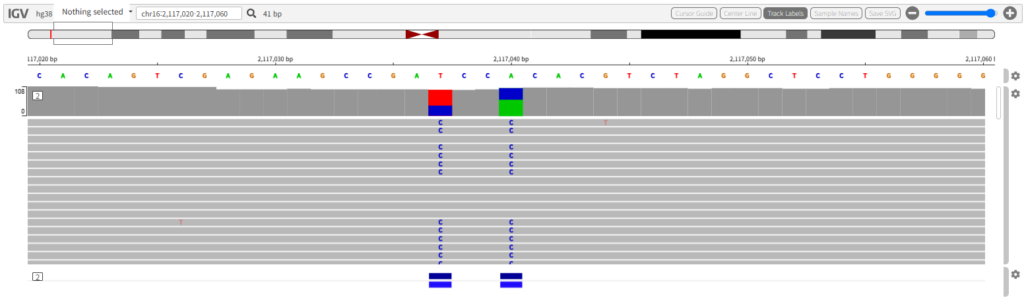
Conversely, if reads containing Variant A consistently carry the reference sequence at the position of Variant B, and reads containing Variant B consistently carry the reference sequence at the position of Variant A, the variants are likely located on opposite chromosome copies, supporting a trans configuration.
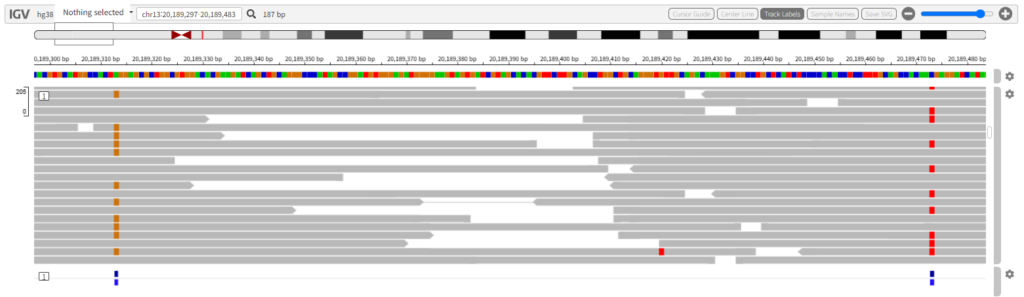
This approach is known as read-based phasing.
A major advantage of this method is that it can provide phasing information without requiring parental samples. However, it is only applicable when the variants are sufficiently close together. If the distance between variants is too large, standard short-read sequencing data may not provide enough information to determine their phase directly.
3. Long-Read Sequencing
Recent advances in sequencing technology have enabled the use of long-read sequencing, which can generate reads spanning thousands to tens of thousands of base pairs in a single run.
When two variants are captured within the same long read, it is possible to directly determine whether they are located on the same DNA molecule.
This approach is particularly valuable for analyzing structural variants, repetitive genomic regions, and other complex genomic architectures that can be challenging to resolve using conventional short-read sequencing.
4. Statistical Phasing
When parental DNA samples are unavailable and experimental phasing is not feasible, statistical phasing can be used.
This approach compares an individual’s genetic variants against large population reference datasets to infer the most likely arrangement of variants across chromosome copies.
Although statistical phasing can be highly informative, it is based on probabilistic prediction rather than direct experimental evidence. Therefore, in clinically significant situations, more direct phasing approaches—such as trio analysis or read-based phasing—are generally preferred whenever possible.
The Diagnostic Value of Phasing
The goal of genetic testing is not simply to identify genetic variants.
More importantly, it is to determine whether those variants can explain a patient’s clinical presentation and underlying disease.
Phasing provides critical context by revealing how variants are arranged within the genome, rather than considering each variant in isolation. This information can improve the accuracy of rare disease diagnosis, help resolve uncertain findings, and provide more precise information for genetic counseling.
In some cases, a single piece of phasing information can be the key factor that confirms a molecular diagnosis.
For this reason, phasing is regarded in clinical genetics not merely as a technical analysis step, but as a fundamental component of accurate genetic diagnosis and interpretation.
Want to learn more about 3billion’s genetic testing? Leave us your questions about test types, turnaround time, or the process.