




Achondroplasia in Children: From the FGFR3 Mutation to Voxzogo, the First Targeted Therapy

Sookjin Lee
Chief Business Officer (CBO) | Ph.D.
A business expert leading innovation in precision medicine and genomics for 20 years. Accelerating the commercialization of innovative technologies with academic expertise and market insight.
Key summary
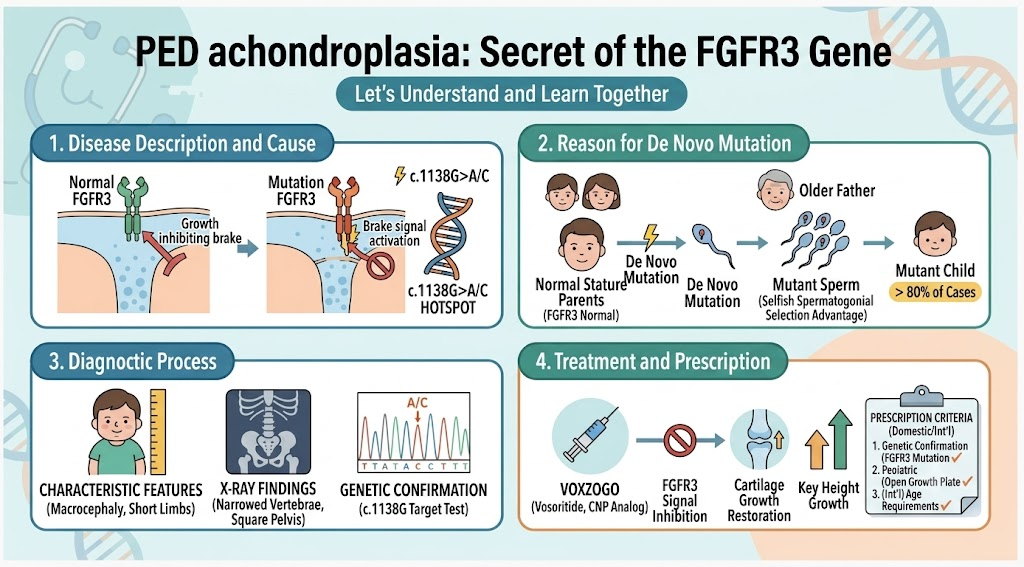
- What it is: Achondroplasia is the most common form of disproportionate short stature, caused by a mutation in the FGFR3 gene.
- Genetics: About 80% of cases are de novo —the mutation arises anew rather than being inherited—and incidence rises with paternal age.
- Diagnosis: Suspected on prenatal ultrasound or from characteristic features and X-ray findings after birth, and confirmed by targeted genetic testing of a single FGFR3 position.
- Treatment: Voxzogo (vosoritide), the first targeted therapy, is now available for children with open growth plates.
1. What is achondroplasia?
Achondroplasia is a rare skeletal disorder and the most common cause of disproportionate short stature. It occurs in roughly 1 in 15,000 to 40,000 births. Despite its name, cartilage is not absent; rather, the conversion of cartilage into bone (ossification) is disrupted, which limits the growth of the long bones.
Characteristic features
- Disproportionate short stature: The limbs are notably short relative to the trunk.
- Distinctive appearance: A relatively large head, prominent forehead, low nasal bridge, and trident-shaped hands.
2. Why does achondroplasia occur? — a growth brake that won’t release
The disorder stems from a mutation in a single gene: FGFR3 (fibroblast growth factor receptor 3).
Normally, the FGFR3 protein acts as a brake in the growth plate, preventing cartilage from converting to bone too quickly. When FGFR3 is mutated, this brake signal stays switched on even without an external trigger (a gain-of-function mutation). The result is severely suppressed cartilage growth, so the long bones of the limbs never grow enough.
3. Why are so many cases de novo ?
Achondroplasia is inherited in an autosomal dominant manner, yet about 80% of new patients carry a de novo mutation that neither parent passed on. The reasons trace back to features unique to the FGFR3 mutation.
① A mutation concentrated at one position (a hotspot)
Most de novo achondroplasia arises at a single position in FGFR3 : c.1138. The most common change, c.1138G>A, accounts for roughly 97–98% of cases. The cytosine at this position sits within a CpG sequence and is methylated, and methylated cytosine deaminates spontaneously, readily producing a G>A change. In other words, the disease mutation sits on a spot in the genome that is inherently prone to mutation—a hotspot. A second change at the same position, c.1138G>C (about 2%), also occurs; the base differs, but it produces the identical protein change (p.Gly380Arg).
② Mutant cells survive and expand (selfish spermatogonial selection)
The FGFR3 mutation keeps growth signaling permanently switched on. Spermatogonial stem cells carrying it gain a proliferative advantage over normal cells and gradually expand their share within the testis—a phenomenon known as selfish spermatogonial selection.
The c.1138G>A mutation has been shown to undergo sub-clonal expansion in aged testis tissue, alongside a significant age-related increase in mutant sperm. So the mutation does not simply accumulate at random over time; the mutant cells actively proliferate and increase their proportion.
③ The paternal age effect—and one important caveat
The stem cells that produce sperm divide throughout life, so mutations have more time to accumulate as a man ages. Direct measurement of sperm DNA has confirmed that the frequency of c.1138-mutant sperm rises with paternal age (Tiemann-Boege et al., PNAS 2002).
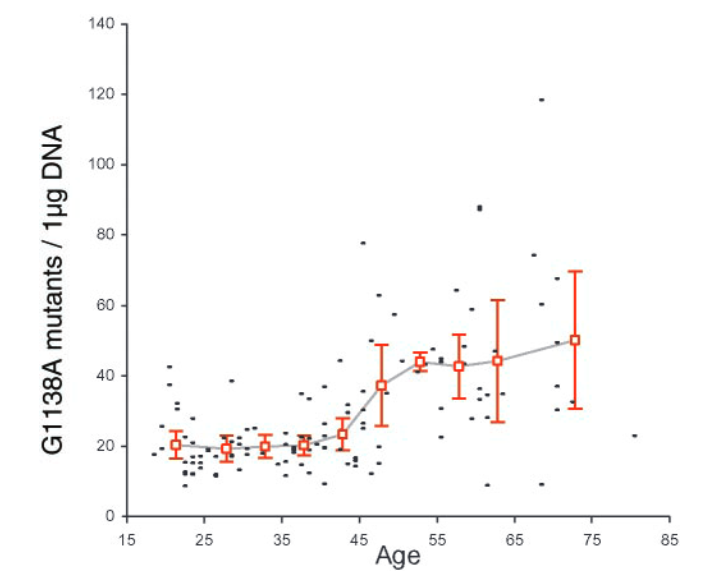
Reference: https://www.pnas.org/doi/epdf/10.1073/pnas.232568699
The same study, however, adds an important caveat. The increase measured in sperm (about twofold) was smaller than the increase in the rate at which older fathers have children with achondroplasia. Looking at the actual age distribution of fathers of affected children, cases below age 30 were fewer than the sperm-mutation frequency would predict, while cases from age 35 onward were more than predicted. In short, risk climbs more steeply at older ages than the sperm data alone would suggest.
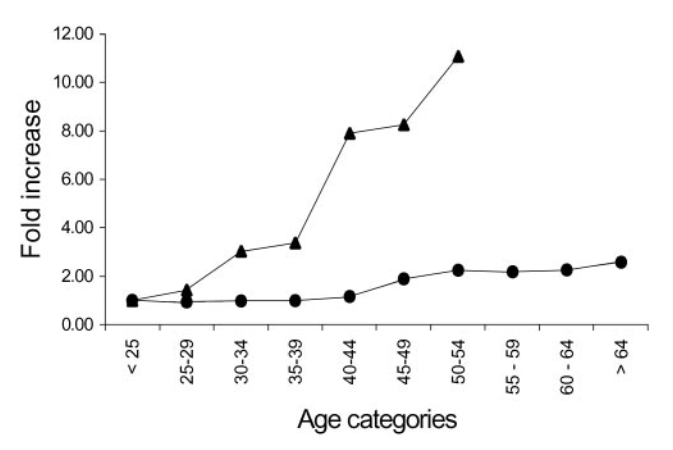
This gap can be explained by the clonal expansion. Because mutant cells proliferate on their own within the testis and amplify the effect over time, risk rises more steeply than a model of simple mutation accumulation would predict (Goriely & Wilkie, Am J Hum Genet 2012).
4. How and when is achondroplasia diagnosed?
In most cases, the characteristic appearance and X-ray findings are enough to make the diagnosis.
① When it is identified
- Prenatally: From the third trimester (around 26 weeks), ultrasound may show limbs that are unusually short relative to the trunk and head, prompting initial suspicion.
- At birth: A large head, prominent forehead, and short limbs allow immediate recognition.
② Confirmatory testing (genetics)
More than 99% of patients carry one of just two changes at FGFR3 c.1138 (c.1138G>A or c.1138G>C). Because both produce the same protein change (p.Gly380Arg), a single targeted genetic test (Sanger sequencing) of that position confirms the diagnosis in typical presentations.
Where the phenotype is atypical, or where hotspot testing returns negative, a broader approach is warranted: the recurrent variant in hypochondroplasia sits at a different FGFR3 position, and a c.1138 assay cannot detect it.
–> See how hypochondroplasia differs from achondroplasia
5. Is penetrance complete?
Yes. Achondroplasia-associated FGFR3 variants show complete penetrance. A single c.1138G>A or G>C variant is enough for the clinical features of achondroplasia to appear, regardless of environmental factors or other genetic background.
6. Is there a treatment? — Voxzogo, the first targeted therapy
Management once relied on limb-lengthening surgery or treating complications. Recently, the first targeted therapy based on the underlying genetic mechanism became available.
- Drug: Voxzogo (vosoritide)
- Manufacturer: BioMarin Pharmaceutical
- Mechanism: Rather than switching off the overactive FGFR3 brake directly, it delivers an analog of C-type natriuretic peptide (CNP). This CNP signal suppresses the FGFR3 brake downstream, restoring growth-plate growth.
- Modality: A recombinant peptide injection (once-daily subcutaneous dosing)
7. Who is eligible for Voxzogo?
Voxzogo works only while the growth plates are open, so eligibility centers on open epiphyses and a confirmed diagnosis.
- Open growth plates (epiphyses): The child must still be growing. Once the epiphyses close, the drug no longer promotes linear growth.
- Confirmed diagnosis: Achondroplasia should be confirmed by clinical and radiographic features and, where needed, by genetic testing of FGFR3.
- Age: Approved age ranges differ by region. In the US, the FDA expanded the indication in October 2023 to children of all ages with open growth plates (previously 5 years and older). In the EU, the EMA approval covers children from 4 months of age with open epiphyses.
Because approval status, reimbursement, and prescribing criteria vary by country, clinicians should confirm the current local label and coverage before prescribing. Bone-age assessment (a wrist X-ray) is important before starting treatment, since closed growth plates mean no expected benefit.
8. Frequently asked questions (FAQ)
Q1. If both parents are unaffected, is the next child at risk? When both parents of a child with achondroplasia are of average height, the mutation is de novo, so the chance of another child being affected is very low—comparable to the general population.
Q2. Can Voxzogo bring a child to average adult height? Voxzogo aims to restore growth velocity toward a normal range, and starting earlier helps. Whether treatment brings final height to the population average, however, requires longer-term data.
Q3. Why does bone age matter for eligibility? Voxzogo can promote bone growth only while the growth plates are open. If they have already closed, treatment cannot be expected to increase height—so a bone-age assessment (wrist X-ray) is essential before prescribing.
References
- Tiemann-Boege I, et al. The observed human sperm mutation frequency cannot explain the achondroplasia paternal age effect. PNAS 2002;99(23):14952–14957.
- Goriely A, Wilkie AOM. Paternal age effect mutations and selfish spermatogonial selection: causes and consequences for human disease. Am J Hum Genet 2012;90(2):175–200.
- Striedner Y, Arbeithuber B, Moura S, Nowak E, Reinhardt R, Muresan L, Salazar R, Ebner T, Tiemann-Boege I. Exploring the Micro-Mosaic Landscape of FGFR3 Mutations in the Ageing Male Germline and Their Potential Implications in Meiotic Differentiation. Genes. 2024;15(2):191.
- BioMarin Pharmaceutical. VOXZOGO (vosoritide) U.S. prescribing information / FDA expanded indication, October 2023.
- European Medicines Agency. VOXZOGO (vosoritide) product information (indication for children ≥4 months with open epiphyses).