


 Back to List
Four 3billion Papers Accepted to ICML 2026 Workshops
- Four papers accepted to workshops at ICML 2026, one of the world’s leading AI conferences
- AIVARI Agent selected as a GenBio Spotlight paper, highlighting advances in genetic variant interpretation and drug target discovery
- Research demonstrates 3billion’s AI capabilities across genetic diagnosis and drug target discovery
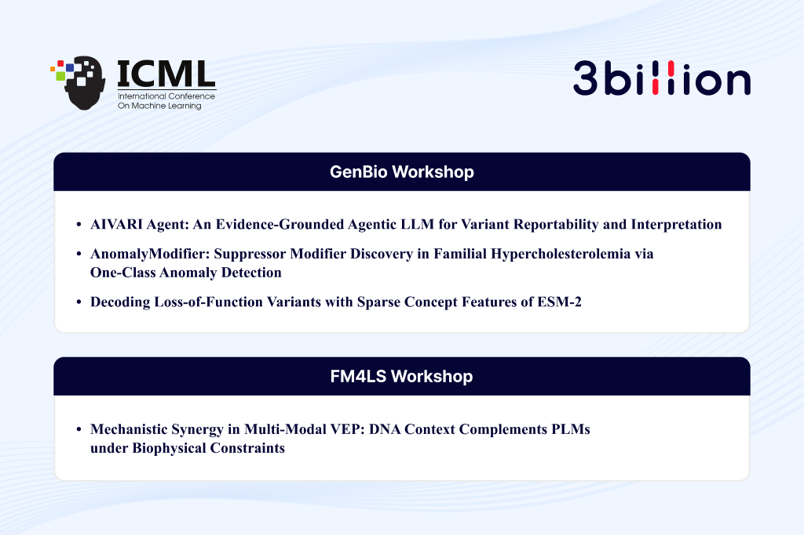
SEOUL, South Korea, June 30, 2026 — 3billion announced that four of its papers have been accepted for presentation at workshops of the International Conference on Machine Learning (ICML 2026). The conference will take place at COEX in Seoul from July 6 to 11.
Alongside NeurIPS and ICLR, ICML is widely regarded as one of the world’s three leading AI and machine learning conferences. Researchers and industry experts from around the world gather at the conference to share the latest advances and emerging trends in machine learning. Through its four workshop papers, 3billion will present research on genetic variant interpretation for rare disease diagnosis and drug target discovery using patient genomic data.
Three of the papers were accepted to GenBio, a workshop focused on the application of generative and agentic AI to biological research. GenBio brings together researchers from leading AI companies, universities, and research institutions to discuss advances in AI for the life sciences.
The three accepted papers are ▲AIVARI Agent: An Evidence-Grounded Agentic LLM for Variant Reportability and Interpretation ▲AnomalyModifier: Suppressor Modifier Discovery in Familial Hypercholesterolemia via One-Class Anomaly Detection ▲Decoding Loss-of-Function Variants with Sparse Concept Features of ESM-2.
Developed by 3billion, AIVARI Agent is an AI agent designed to determine which genetic variants warrant inclusion in clinical reports. It assesses the disease relevance of candidate variants by integrating evidence on pathogenicity, inheritance patterns, scientific literature, and other sources and generating interpretive hypotheses. By assisting experts with the evidence-intensive process of variant interpretation, AIVARI Agent improves the accuracy, reliability, and consistency of genetic diagnosis. The paper was selected for a Spotlight presentation at GenBio.
AnomalyModifier is an AI model that identifies suppressor variants in genomic data from patients with familial hypercholesterolemia. While AIVARI Agent is designed to improve the accuracy and reliability of diagnosis, AnomalyModifier extends the use of genomic data collected through diagnosis to drug target discovery.
Suppressor variants can reduce the onset of symptoms or the impact of a disease even when a disease-causing variant is present. Genes associated with these variants may therefore serve as potential drug targets. By framing rare disease drug target discovery, where labeled data are scarce, as an anomaly detection problem, the research team demonstrated how patient genomic data can serve as a valuable resource for identifying potential therapeutic targets.
The third GenBio paper applies ESM-2, a protein language model, to the interpretation of loss-of-function variants. The researchers proposed an interpretable framework that decomposes the model’s complex internal representations into biologically meaningful concepts, enabling loss-of-function variants to be predicted in an explainable manner.
A fourth paper was accepted to FM4LS, the workshop on Multi-modal Foundation Models and Large Language Models for Life Sciences. The workshop focuses on multimodal foundation models and large language models for life sciences and brings together researchers from leading universities, research institutions, and AI companies, including Google DeepMind and Microsoft Research.
The accepted paper proposes a multimodal AI framework that combines protein and DNA language models to predict the pathogenicity of genetic variants. By adding DNA context to protein sequence information, the framework captures information that protein sequences alone may miss, improving the accuracy and reliability of clinical variant interpretation.
“The acceptance of our papers at ICML workshops reflects global recognition of 3billion’s AI-powered genomic interpretation technologies,” said Changwon Keum, CEO of 3billion. “We will continue advancing AI across genetic diagnosis and patient data-driven target discovery to broaden access to diagnosis and treatment for people with rare diseases.”
Get exclusive rare disease updates
from 3billion.

3billion Inc.
3billion is dedicated to creating a world where patients with rare diseases are not neglected in diagnosis and treatment.