


Rare Disease Diagnostics Starter Kit: WES, WGS & VUS Guide
If you’ve spent any time in rare disease diagnostics, you know the drill: the phenotype points one way, the first test comes back negative, and now you’re stuck asking questions instead of answers.
Was the gene even covered well enough? Is that variant sitting in VUS purgatory because nobody’s revisited it? Or is the answer already there, buried in data that the literature just hasn’t caught up to yet?
That’s the real challenge in this field. It’s rarely about which test to order first. It’s about knowing what to do when the first answer isn’t good enough.
We put together a collection of the resources we’ve found most useful over the past year and turned it into The Starter Kit for Rare Disease Diagnostics. It’s for geneticists, pediatricians, neurologists, and anyone else working through a case that won’t resolve cleanly.
What’s Inside the Starter Kit?
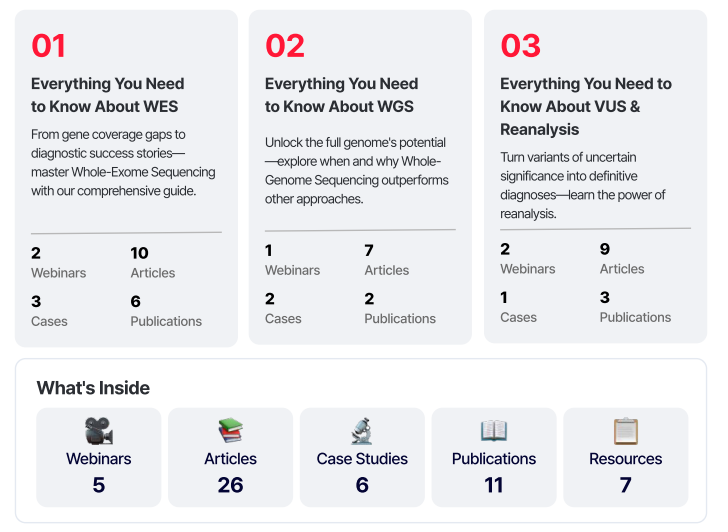
The Starter Kit for Rare Disease Diagnostics serves as a complete toolkit for clinicians navigating complex genetic cases. The issue is organized into three central focus areas:
1. Everything You Need to Know About WES— Where are the coverage gaps hiding, and how do you optimize target capture so you’re not missing something obvious?
2. Everything You Need to Know About WGS — What actually tells you it’s time to move from exome to genome?
3. Everything You Need to Know About VUS & Reanalysis — What’s a real, actionable path forward when you’re staring at a variant of uncertain significance or a case that’s gone cold?
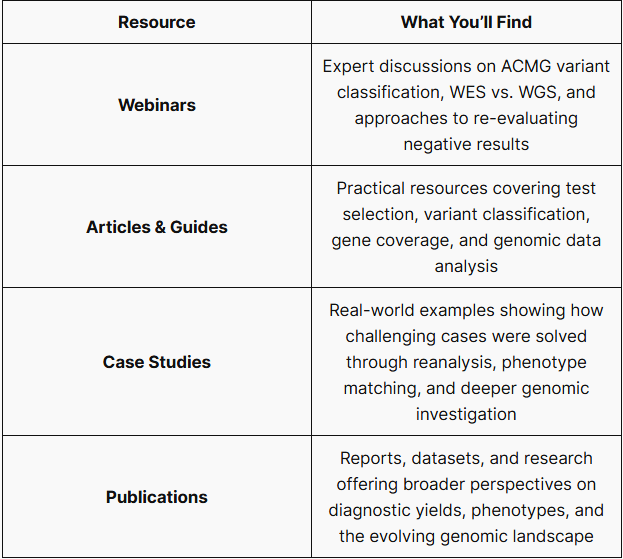
Here’s a quick look at what you’ll find inside.
Your Rare Disease Diagnostic Reading List
How to actually use this?
You don’t need to read everything at once.
Think of this collection as a diagnostic reference shelf—something to return to when you’re wondering:
- Was this gene actually well covered by the exome?
- Should I consider WGS for this patient?
- How should I approach this VUS?
- Could additional phenotype information change the interpretation?
- Is it time to reanalyze an old negative case?
Rare disease diagnostics is constantly evolving, and the best approach today may not be the best approach a year from now.
So bookmark the resources that are most relevant to your practice, come back when you need them, and keep exploring.
Ready to get started?
Request a Starter Kit by submitting the contact form.
Select "Others" as the inquiry category and note "starter kit". We'll email you the materials.

Jiale (Ashley) Zhu
Marketing Manager
Passionate about making complex genetic concepts accessible to healthcare professionals and raising awareness of the challenges and advances in diagnosing rare diseases.