



Genetic Mechanisms of GDD with Normal MRI: WES Strategies to End the Diagnostic Odyssey

Sookjin Lee
Chief Business Officer (CBO) | Ph.D.
A business expert leading innovation in precision medicine and genomics for 20 years. Accelerating the commercialization of innovative technologies with academic expertise and market insight.
🎯 Key Highlights
- The Paradox of Normal Neuroimaging: Developmental delay (GDD/ID) with an unremarkable MRI is often not a structural failure but a functional one, rooted in synaptic plasticity defects or molecular signaling dysregulation.
- Prioritizing Genomic Diagnostics: The absence of structural anomalies significantly increases the statistical probability of a monogenic etiology, providing a robust clinical rationale for Whole Exome Sequencing (WES) as a first-tier test.
- Mitigating Irreversible Neurological Damage: Definitive genetic diagnosis is the only gateway to life-altering interventions, such as establishing a metabolic bypass in SLC2A1 deficiency or preventing iatrogenic harm by excluding contraindicated medications in sodium channelopathies.
1. The Paradox of a ‘Normal’ MRI: Molecular Pathogenesis Beyond Structure
In the clinical evaluation of GDD/ID, an ‘unremarkable’ MRI report should paradoxically heighten the suspicion of underlying molecular-level genetic defects.
- Synaptopathy: While the macro-anatomy of the brain appears intact, functional connectivity is disrupted by pathogenic variants in pre- and post-synaptic proteins (e.g., SYNGAP1, SHANK3), leading to a collapse of neural network integrity.
- Core Mechanisms of Neurodevelopment: Proper brain maturation depends on protein synthesis via the mTOR pathway (regulated by TSC1/TSC2) and epigenetic modulation (via MECP2, KMT2A). Aberrations in these pathways impair neuronal migration and synaptic connectivity, resulting in profound functional deficits despite a structurally normal MRI.
- High-Yield Phenotypes: Clinical presentations combining Intellectual Disability with Autism Spectrum Disorder (ASD), primary microcephaly, or neonatal hypotonia exhibit a high correlation with monogenic causes, necessitating immediate genomic investigation.
2. Why WES is the ‘First-tier’ Choice for MRI-Normal Patients
Traditional diagnostic protocols—moving from MRI to metabolic screens, then to Chromosomal Microarray (CMA)—often prove inefficient for non-syndromic GDD. In these cases, Single Nucleotide Variants (SNVs) are far more prevalent than large copy-number variations.
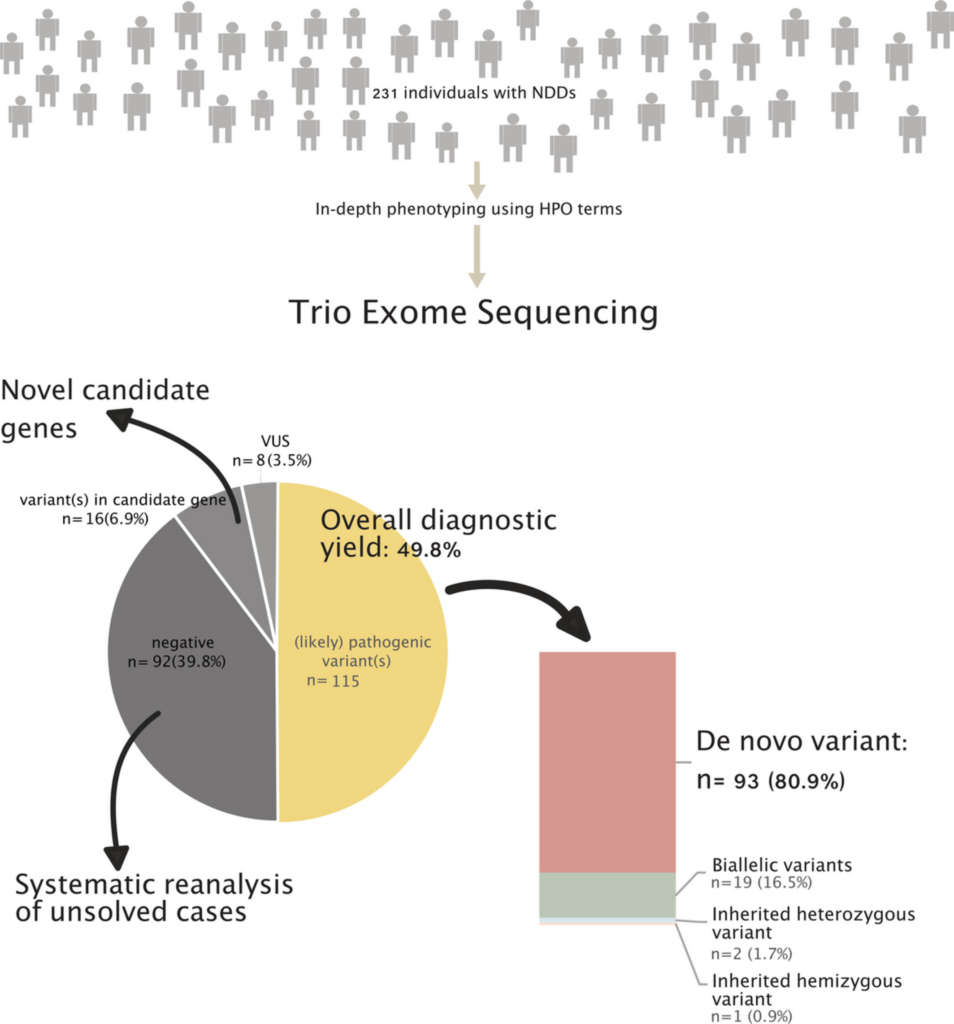
- Capturing De Novo Variants: Over 60% of severe neurodevelopmental disorders are attributed to de novo mutations, which are identified with the highest diagnostic yield through WES.
- Halting the Diagnostic Odyssey: Implementing WES early terminates the cycle of repetitive sedated MRIs, lumbar punctures, and invasive biopsies, significantly reducing both patient trauma and cumulative healthcare costs.
3. The Diagnostic Bridge: From Genotype to Precision Medicine
A genetic diagnosis is not merely a label; it is the inception of Precision Medicine based on specific biochemical mechanisms.
- Metabolic Rescue (SLC2A1 ): In GLUT1 deficiency, the brain is starved of glucose. Introducing a Ketogenic Diet provides ketone bodies as an alternative fuel source via the MCT1 transporter (Metabolic Bypass), halting progressive cognitive decline.
- Pharmacogenomics (SCN1A/2A/8A): In SCN1A Loss-of-Function (Dravet Syndrome), using Sodium Channel Blockers (e.g., Carbamazepine) is a critical error that paralyzes inhibitory interneurons, potentially triggering refractory status epilepticus. Conversely, for SCN2A Gain-of-Function variants, these same drugs serve as the primary targeted therapy.
- Systemic Vigilance: Identifying variants in ELN (Williams Syndrome) or TCF4 (Pitt-Hopkins Syndrome) allows clinicians to preemptively manage risks like Supravalvular Aortic Stenosis (SVAS) or episodic respiratory failure, preventing sudden death.
4. Ending the Diagnostic Odyssey: A Scientific Basis for Family Planning
The uncertainty of an ‘unexplained’ diagnosis imposes a heavy psychological burden on parents. Trio-WES (patient and parents) clarifies the origin of the variant and identifies potential germline mosaicism. This provides an accurate calculation of recurrence risk, empowering families with the only scientific evidence required for informed family planning.
[References]
- Manickam K, et al. (2021). “Exome and genome sequencing for pediatric patients with congenital anomalies or intellectual disability: an evidence-based clinical guideline of the ACMG.” Genetics in Medicine. (Establishes WES as a first-tier test with a 30-40% yield).
- DDD Study (2017). “Prevalence and architecture of de novo mutations in developmental disorders.” Nature. (Proves >60% of severe NDDs are caused by de novo variants).
- Zoghbi HY, Bear MF. (2012). “Synaptic Dysfunction in Neurodevelopmental Disorders.” Cold Spring Harbor Perspectives in Biology. (Foundational research on synaptopathy and the mTOR pathway).
- Parekh PK, et al. (2022). “Epigenetic mechanisms in neurodevelopmental disorders.” Nature Reviews Genetics. (Impact of epigenetic regulators like MECP2 on neural networks).
- Klepper J, et al. (2020). “Glut1 Deficiency Syndrome (Glut1DS): State of the art in 2020.” European Journal of Paediatric Neurology. (Molecular basis of the ketogenic diet and MCT1 bypass).
- Wolff M, et al. (2019). “Phenotypic spectrum and genetics of SCN2A-related disorders.” Epilepsia. (Comparison of drug responses in SCN1A LoF vs SCN2A GoF).
- Sweatt JD. (2013). “Pitt-Hopkins Syndrome: intellectual disability due to loss of TCF4 function.” Learning & Memory. (TCF4 and respiratory dysregulation).
👉 “If you are currently managing a patient with persistent developmental delay despite an unremarkable MRI, request a consultation with us today. We provide optimized genomic analysis plans precisely tailored to your patient’s clinical phenotype. Trust 3billion’s team of clinical experts to provide the definitive insights needed to end the diagnostic odyssey.”