



Negative Genetic Test Result: What to Say to Your Patient

Sookjin Lee
Chief Business Officer (CBO) | Ph.D.
A business expert leading innovation in precision medicine and genomics for 20 years. Accelerating the commercialization of innovative technologies with academic expertise and market insight.
When a rare disease genetic test finds no cause, patients and families almost always ask the same thing first.
“So it’s not genetic?”
There is no short answer. Saying “we can’t rule it out” often lands as “so you don’t know,” and patients walk away feeling the test was a waste.
This article collects wording you can use in that moment. The sentences in the grey boxes are written in plain language, ready to read aloud.
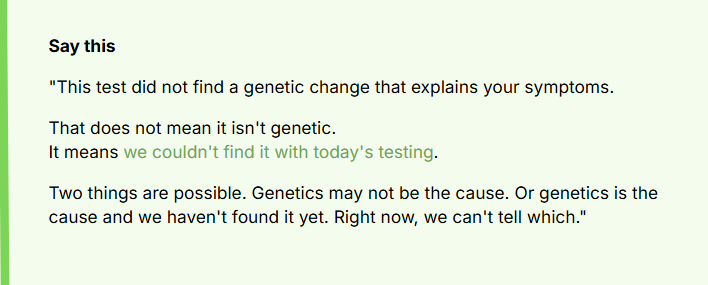
1. Negative means “not found yet,” not “not genetic”
A negative result holds two possibilities at once:
- Genetics is not the cause
- Genetics is the cause, but current technology and knowledge could not find it
To confirm “not genetic,” you would need to check all 3 billion bases and every medical insight not yet discovered. That is why reports say “not detected” rather than “not genetic.”
2. Why we may not find it yet — two limits
Split it into how we read and how well we understand what we read. This is accurate, and it sets up the next step naturally.
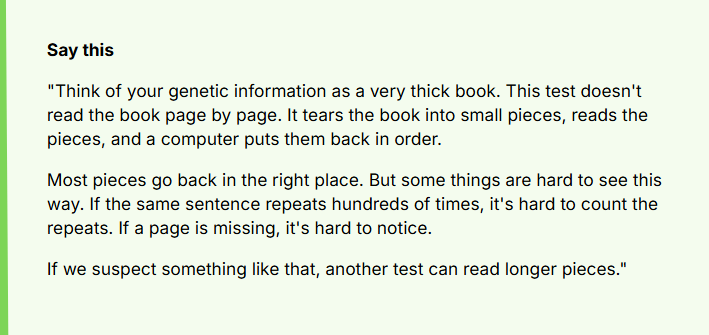
① How we read — cut into pieces, then reassembled
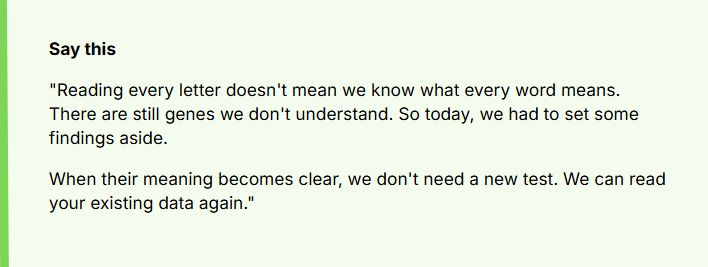
② How well we understand it — the dictionary
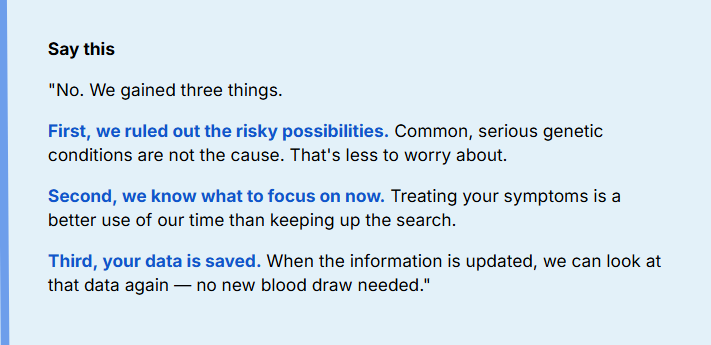
3. “So was the test pointless?”
The most common question, and the one worth answering carefully. Three parts make it easier to accept.
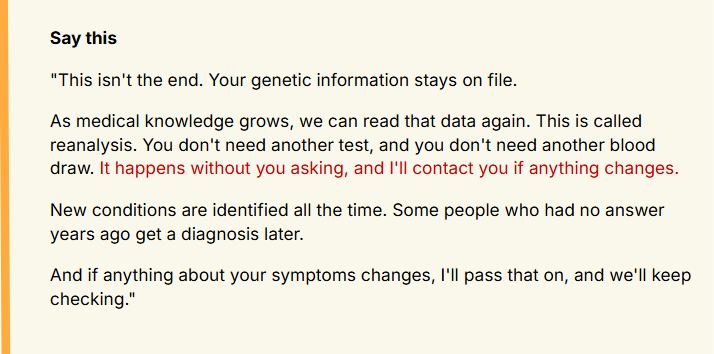
4. What happens next — reanalysis, not retesting
Patients hear “we’ll check again later” as “I’ll need another test.” Two points ease that: reanalysis is not a new test, and it happens without them asking.
Three sentences to leave them with
Close the visit with these three. Patients can repeat them to family at home.
1) They didn’t find a genetic condition to worry about right now.
2) That doesn’t mean it isn’t genetic.
3) For now I treat the symptoms, and they keep checking the data.
A negative result isn’t the end of the diagnostic journey. It’s one step in narrowing the possibilities. Once patients hear it that way, most of the anxiety drops away.
If you have questions about interpreting a negative result or about reanalysis, feel free to reach out.