




A Simple Guide to the ACMG Secondary Findings List | SF Series Part 2

Sohyun Lee
Clinical Genomics Scientist & Clinical Customer Support
I'm guiding test selection, supporting variant and result interpretation, handling case inquiries, and translating field insights into service improvements.
👉 Read the previous article in this series (You had exome sequencing—and it revealed a completely unrelated condition?)
Exome sequencing can uncover a large number of genetic variants.
That does not mean, however, that every piece of genetic information unrelated to a patient’s current symptoms is reported back to them.
The American College of Medical Genetics and Genomics (ACMG), a leading professional society in clinical genetics, recommends the additional analysis of a defined set of genes associated with medically actionable conditions—those for which prevention or treatment can improve health outcomes.
This is known as the ACMG Secondary Findings list.
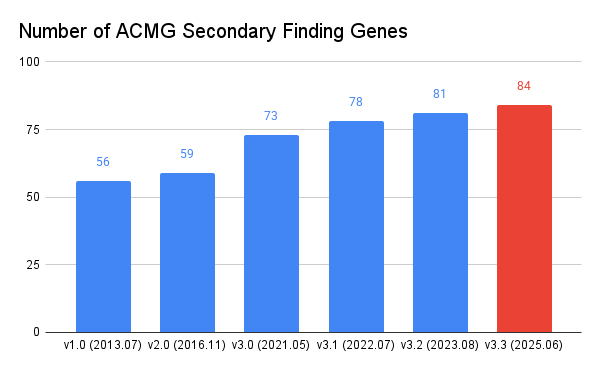
As of August 2026, the current official version is ACMG SF v3.3, which includes a total of 84 genes. The list was published in 2025 and is revised on an ongoing basis as new medical evidence accumulates.
Which conditions make the list?
The ACMG list is not selected on the basis of how rare a condition is.
The most important criteria are the following.
- Can it cause a serious health problem?
- Can individuals at risk be identified before symptoms develop?
- Are there established options for early screening, prevention, or treatment?
- Once the result is known, can meaningful clinical action be taken that actually benefits the patient?
In other words, more than the rarity of a condition, the key criterion is “whether knowing in advance can improve health outcomes.”
1. Hereditary Cancers
Representative conditions include the following.
- Hereditary breast and ovarian cancer
- Lynch syndrome
- Familial adenomatous polyposis
- Li-Fraumeni syndrome
- Multiple endocrine neoplasia
Associated genes include BRCA1, BRCA2, MLH1, MSH2, APC, TP53, and RET.
When an increased genetic risk is identified, cancer screening can begin at an earlier age than in the general population, screening intervals can be adjusted, and in some cases preventive treatment can be considered.
2. Inherited Cardiac Conditions
Representative conditions are as follows.
- Hypertrophic cardiomyopathy
- Dilated cardiomyopathy
- Inherited arrhythmia syndromes
- Long QT syndrome
- Catecholaminergic polymorphic ventricular tachycardia
Associated genes include MYBPC3, MYH7, LMNA, KCNQ1, KCNH2, and RYR2.
These conditions may cause no symptoms in their early stages, but in some people the first manifestation may be a serious arrhythmia or sudden cardiac death.
Knowing the risk in advance makes it possible to begin regular follow-up with tests such as electrocardiography (ECG) and echocardiography.
3. Hereditary Aortic Disease
Representative conditions include Marfan syndrome and heritable thoracic aortic aneurysm and dissection.
Examples of associated genes are as follows.
- FBN1
- TGFBR1
- TGFBR2
- SMAD3
- ACTA2
When a genetic risk is confirmed, blood pressure can be managed proactively, the aorta can be monitored with regular imaging, and preventive surgery can be considered when needed—before a rupture or dissection occurs.
4. Familial Hypercholesterolemia
Familial hypercholesterolemia is a genetic condition in which LDL cholesterol levels are elevated from birth, increasing the risk of premature cardiovascular disease.
The main associated genes are LDLR, APOB, and PCSK9.
When a genetic risk is confirmed, cholesterol testing and genetic testing for family members can be carried out, and intensive lipid-lowering therapy can be started when needed.
5. Malignant Hyperthermia Susceptibility
People with malignant hyperthermia susceptibility can develop serious reactions—such as high fever, muscle rigidity, and metabolic abnormalities—when exposed to certain anesthetic agents.
The main associated genes are RYR1 and CACNA1S.
Knowing this genetic risk in advance allows the anesthetic approach and the medications used to be adjusted, helping prevent serious complications.
Not every variant is reported
Identifying a variant in a gene on the ACMG list does not mean it will always be reported.
Even within the same gene, whether a variant is reported can depend on factors such as the following.
- Variant type and molecular consequence
- Disease mechanism
- Mode of inheritance
- Medical evidence accumulated to date
- Condition-specific reporting criteria
In general, Secondary Findings reporting focuses on Pathogenic or Likely Pathogenic variants.
Variants of uncertain significance (VUS), on the other hand, are generally not included in Secondary Findings reporting.
It’s not about the number of genes
The ACMG Secondary Findings list is not meant to find every possible genetic condition.
It is also different from general population screening panels applied to all healthy individuals.
It is best understood as a list of genes reviewed additionally—during exome or genome sequencing performed for another reason—to avoid missing important, important health risks for which early intervention may improve outcomes.
In one sentence
The ACMG Secondary Findings list is a curated set of genes and conditions—those where knowing in advance can change health outcomes—that are recommended for additional review.
So, if a pathogenic variant is identified in the Secondary Findings, does that mean the condition is confirmed?
In the next article, we’ll take a closer look at what a reportable secondary finding actually means, and what tests and follow-up management to consider after receiving the result.
Click the button below to check the Secondary Findings clinical action guidance recommended by the ACMG ACT Sheets, GeneReviews®, and NCCN Guidelines. You can easily search by gene or by condition.
References
Full series
View all
- Your Exome Test Found a Disease You Weren’t Looking For? | SF Series Part 1
- A Simple Guide to the ACMG Secondary Findings List | SF Series Part 2
- Does a Positive Secondary Finding Mean Disease Will Develop? | SF Series Part 3