




VUS Is Not One Thing
Introducing VUS Subclassification & Point-Based Pathogenicity Scoring in GEBRA
In clinical genomics, a Variant of Uncertain Significance (VUS) is often presented as a single outcome.
“It’s a VUS.”
But in practice, VUS is not a single state.
- Some variants lean toward pathogenicity.
- Others lean toward benignity.
- Some sit precisely in between.
Yet historically, they have been displayed identically within systems — as one undifferentiated category.
This update is designed to introduce structure within that uncertainty.
1. VUS Subclassification (SNV Only)
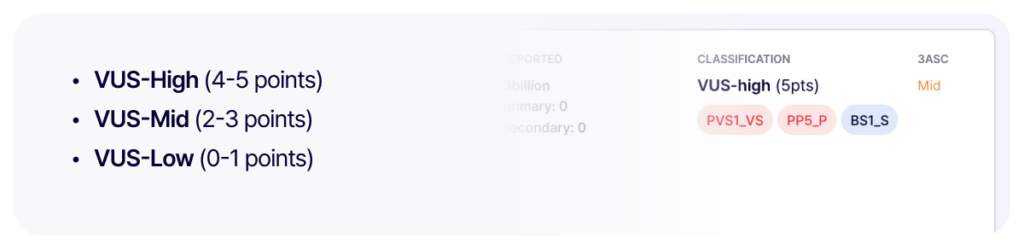
We are introducing a more granular look at the ‘Uncertain’ range (0–5 points) defined by ACMG guidelines. By stratifying VUS based on the weight of available evidence, we provide deeper precision without overstepping official classifications.
- VUS-high (4–5 points)
- VUS-mid (2–3 points)
- VUS-low (0–1 point)
This is not a new classification system. It is a positioning tool within the existing ACMG framework that makes the “weight” of a variant immediately visible.
2. Transition to Point-Based Scoring UI (SNV Only)
To maximize reproducibility and explainability, GEBRA has transitioned its primary UI display from Bayesian scores to the ACMG Point-Based Scoring System.
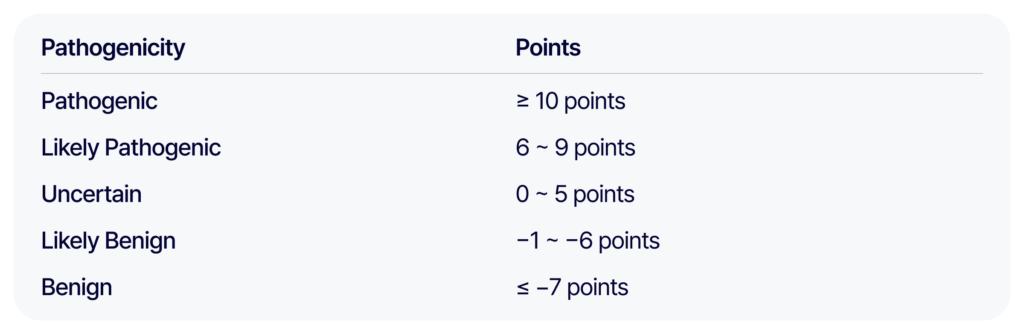
While Bayesian logic remains a core part of our internal engine, the UI now reflects the point-based system to ensure that every interpretation is transparent and easy to justify.
3. Platform-Wide Integration
This structural change is reflected across every touchpoint of the GEBRA workflow:
- Variant Cards: Enhanced visualization of tiers in both Prioritized and All Variants.
- Pathogenicity Filters: New options to filter by high/mid/low VUS.
- Reporting: Clear notation of sub-categories (e.g., “VUS-high”) in final reports.
The update is also enabled for GEBRA SaaS environments, with pathogenicity calculation logic aligned to the point-based framework.
💡 Why This Matters in Clinical Practice
① Visualizing the Gradient
By exposing the “slope” within the uncertain range, reviewers can make decisions based on clear contextual boundaries rather than a flat label.
② Strategic Follow-ups
Not all VUS findings require the same resources. Subclassification helps prioritize variants for functional studies or segregation testing.
③ Rich Context for Reanalysis
When a case is revisited, knowing exactly where a variant stood within the VUS range provides a vital head start for re-interpretation.
“More Space to Think.”
This update does not replace expert judgment, nor does it arbitrarily alter the ACMG framework. Instead, it organizes the interpretive space. By treating VUS as a contextual range rather than a single state, GEBRA focuses on tidying the environment where interpretation happens. We believe that better structure leads to better insights.

3billion Inc.
3billion is dedicated to creating a world where patients with rare diseases are not neglected in diagnosis and treatment.