Reading a 3B-EXOME Report, Section by Section

Sohyun Lee
Clinical Genomics Scientist & Clinical Customer Support
I'm guiding test selection, supporting variant and result interpretation, handling case inquiries, and translating field insights into service improvements.
With the 3B-EXOME report, the RESULT SUMMARY on the first page tells you the conclusion at a glance; the remaining pages explain the evidence behind that conclusion and its limitations. This guide walks through the report section by section, so that once it’s in your hands you know where to start and what to check.
👉Check Sample Report of 3B-EXOME
The report at a glance
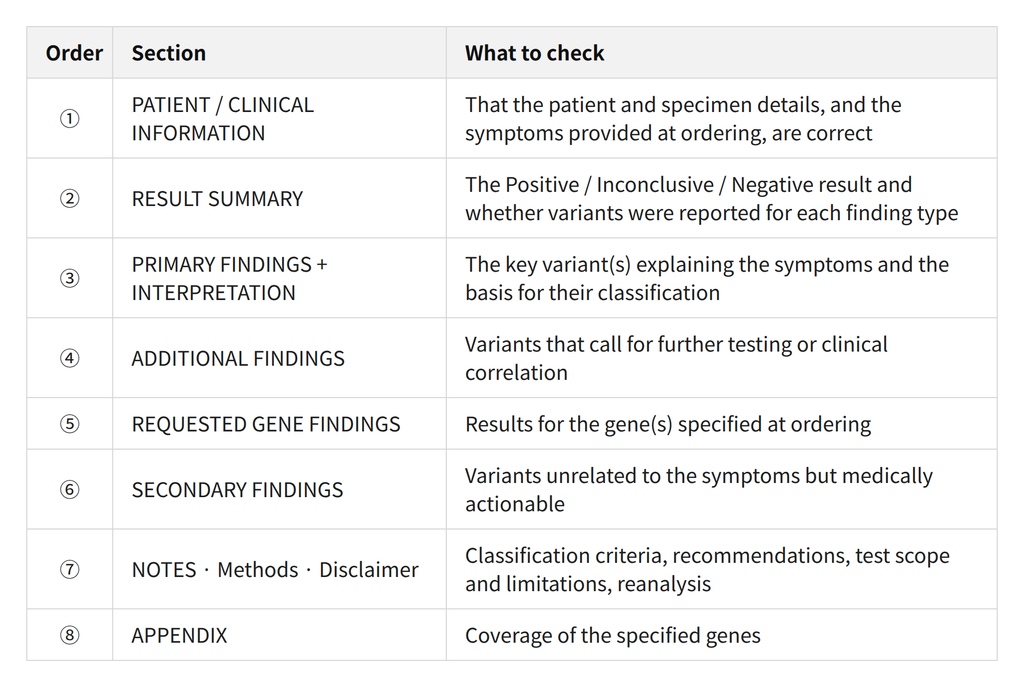
①② Patient information and RESULT SUMMARY
First, check the result (Positive / Inconclusive / Negative) and which finding types have reported variants.
Please check the CLINICAL INFORMATION as well. Interpretation is based on the symptoms and family history you provided at ordering. During analysis we review not only the test request but also any attachments and notes, so there is no need to worry that the case was interpreted with information missing. And if new symptoms come to light afterward, simply letting us know can change the interpretation.
The RESULT SUMMARY presents three types of finding separately.
- Primary findings: variants that explain the patient’s symptoms
- Additional findings: variants that require clinical correlation or further testing
- Secondary findings: variants found in the ACMG SF gene list, independent of the symptoms
The result for Primary findings follows the criteria below (also included in the report’s NOTES section).
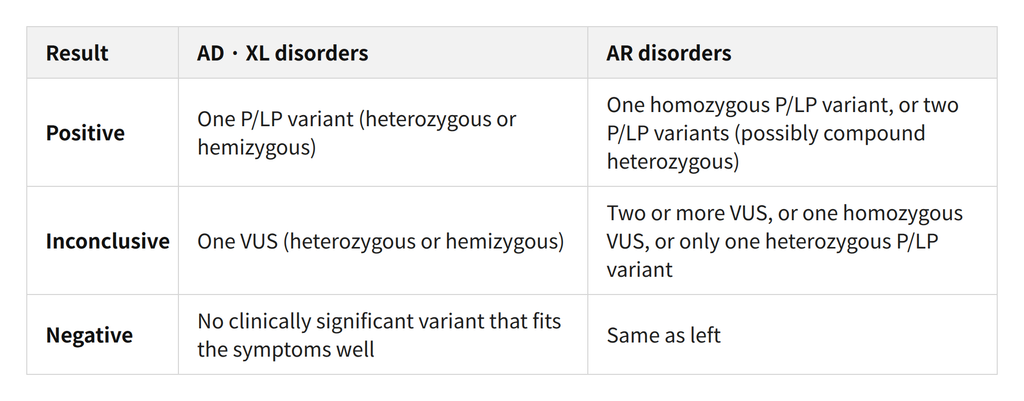
A P/LP variant found in a gene whose disease association is not yet well established is also classified as Inconclusive. Inconclusive does not mean “no diagnosis”—it means “more evidence is needed.”
③ PRIMARY FINDINGS: the key variant and the evidence behind it
Read the Primary findings in this order: the Summary, the variant information box, and then the INTERPRETATION table on the following page.
The Summary captures, very briefly in one or two sentences, the zygosity, variant classification, gene, associated disorder and inheritance pattern (with OMIM number), and the main features of the associated disorder; where relevant, it adds a recommendation for clinical correlation or parental testing.
The variant information box contains the following fields.
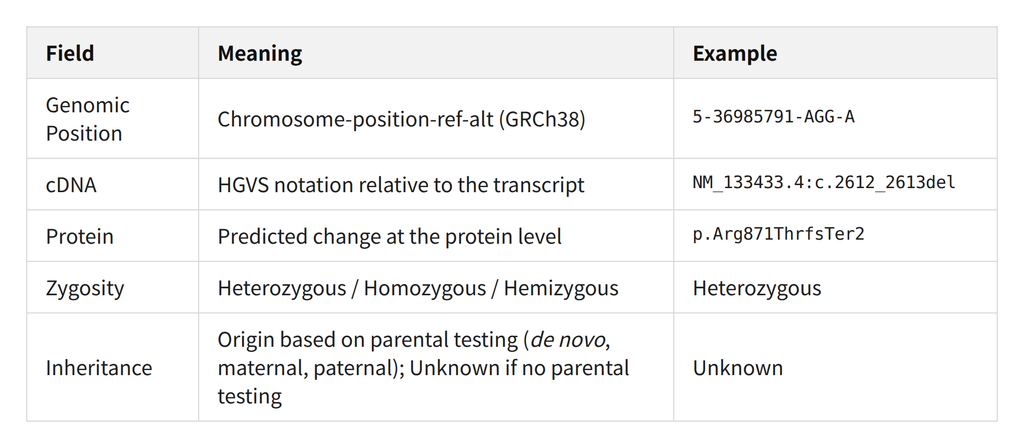
The PRIMARY FINDINGS INTERPRETATION table lays out the basis for classification by the ACMG/AMP evidence categories.
- Population Data: frequency in the general population (e.g., gnomAD)
- Predicted Consequence / Location: the predicted effect (frameshift, nonsense, etc.) and its location
- Segregation Data: segregation within the family
- Computation and Functional Data: in silico predictions and functional studies
- Previously Reported Variant Data: prior reports in the literature and databases
- Validation: whether the variant was confirmed by Sanger sequencing. For high-quality variants, this may be omitted based on internal validation criteria
- Variant Classification: the final classification (Pathogenic, Likely pathogenic, VUS, etc.)
A field marked “None” means there is not yet any evidence in that category. For example, if Segregation Data is None, parental testing can strengthen the basis for classification.
④⑤ ADDITIONAL FINDINGS and REQUESTED GENE FINDINGS
Additional findings are variants that cannot be reported as Primary on the current evidence alone, but whose significance may change with your clinical judgment or further testing.
Three types fall into this category.
- A VUS that could explain the symptoms but lacks sufficient evidence of pathogenicity
- A P/LP variant or VUS that could partly explain the symptoms, regardless of inheritance pattern
- A variant related to the family history you provided at ordering (included even if unrelated to the patient’s current symptoms)
For each variant, the table presents in silico scores (REVEL, 3Cnet, SpliceAI), gnomAD allele frequency, classification, and the associated disorder and inheritance pattern. Compare these against the patient’s clinical picture and consider next steps such as the following.
- Confirming segregation through parental or family testing
- Targeted clinical or biochemical testing for the associated disorder
- Sharing any newly identified symptoms with 3billion
REQUESTED GENE FINDINGS appears only when you specified particular genes at ordering. If it reads “No clinically significant variant,” check the APPENDIX on the last page to confirm that the gene was adequately covered (proportion at ≥20x).
⑥ SECONDARY FINDINGS: variants unrelated to the symptoms but worth knowing
Secondary findings are P/LP variants found—independent of the reason for testing—in genes where early detection and management can change health outcomes. The reportable genes follow the ACMG SF v3.3 list (PMID 40568962).
Each entry gives a description of the condition (e.g., increased risk of hereditary breast and ovarian cancer), the gene, the variant information, and the classification, along with a recommendation such as “Genetic counseling and clinical management are warranted.”
Points to keep in mind:
- A secondary finding can be meaningful for the patient and their blood relatives alike, so genetic counseling and guidance on family testing are warranted.
- Even when RESULT SUMMARY reads “No variant reported,” this does not rule out variants in genes outside the list or in regions beyond the test’s detection limits.
⑦ NOTES · Methods · Disclaimer: test scope, limitations, and reanalysis
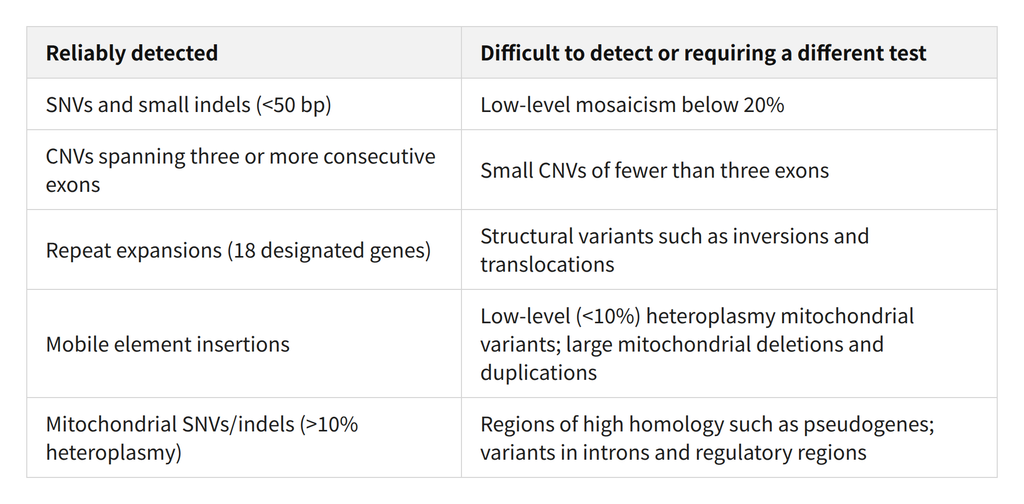
The later pages explain what this test can find and what it may miss. Please refer to them in particular when interpreting a Negative result.
Detection scope
Methods contains the sequencing quality metrics for the sample. The mean depth and the “proportion of target regions covered at ≥20x” give you a quick read on data quality; gene- and exon-level depth information, as well as FASTQ and VCF files, are available on request.
Parental and family testing recommendation: To confirm segregation of a variant, WES or Sanger testing of the parents or family is recommended. Structural variants can be confirmed by Sanger only when the exact breakpoint has been determined.
A Negative result does not rule out a genetic disorder. Variant interpretation reflects the knowledge available at the time of reporting, so classifications and diagnoses can change as new evidence emerges.
- When the patient has consented to reanalysis, 3billion runs automated reanalysis daily against the latest information and sends an updated report to the ordering physician if the result changes.
- Consent for reanalysis is renewed every 10 years.
- If you update us with new symptoms or test results, they are incorporated into the reanalysis.
- Under Korea’s Bioethics and Safety Act, specimens are retained for up to six months; after that, a variant reported through reanalysis cannot readily be confirmed by Sanger without a new specimen.
⑧ APPENDIX and getting in touch
The APPENDIX summarizes coverage for the genes you specified (% bp ≥20x). If a gene falls below the threshold or was not included in the analyzed regions (N/A), please consider separate testing for that gene.
In short
- Use RESULT SUMMARY to check the result and the finding types.
- Use PRIMARY FINDINGS and the INTERPRETATION table to review the variant and the basis for its classification.
- In ADDITIONAL / SECONDARY FINDINGS, pick up anything that calls for further testing or counseling.
- Use NOTES and the Disclaimer to understand what the test cannot see, and make use of reanalysis when needed.
If you have further questions about interpreting the report, please reach out using the “Contact us” button below. We’ll review your inquiry and get back to you promptly.
Want to learn more about
3billion's genetic testing?
We'll reply within 1 business day.