




Solving Undiagnosed Cases with Long-Read Sequencing (Part 1): Finding the Missing Variant in Autosomal Recessive Disease

Sookjin Lee
Chief Business Officer (CBO) | Ph.D.
A business expert leading innovation in precision medicine and genomics for 20 years. Accelerating the commercialization of innovative technologies with academic expertise and market insight.
Summary
A Seoul National University Hospital team applied targeted long-read sequencing — a capture-based panel of 56 autosomal recessive genes, not whole-genome — to 78 undiagnosed patients in whom short-read sequencing (SRS) had found only one pathogenic allele. The assay recovered the missing variant in 20 of 78 patients (25.6%): 10 through structural variant detection, 3 through functionally validated deep intronic splicing variants, and 7 through haplotype phasing that reclassified a VUS. This yield comes from a highly selected cohort and should not be applied directly to unselected rare disease populations. (Lee et al., EJHG 2026)

As targeted panels and whole-exome sequencing (WES) have become standard in clinical genetic diagnosis, diagnoses have accumulated — and so have the unsolved cases. The phenotype is clear, but the causative variant stays hidden. Or an autosomal recessive condition is suspected, yet only one pathogenic allele turns up.
Long-read sequencing (LRS) is emerging as one way to close this gap. Its reads span tens to hundreds of kilobases, letting it detect structural variants (SVs), deep intronic variants, and repeat expansions directly, and phase haplotypes across long stretches. These are precisely the regions where short-read sequencing (SRS) tends to fall short.
Targeted Long-Read, Not WGS
LRS is entering the clinic in several forms. The most comprehensive is long-read whole-genome sequencing (lrWGS) — but its storage, processing, and analysis demands, along with cost, are considerable. Targeted long-read sequencing, which captures only the genes of interest, has emerged as a practical alternative.
The study featured here takes the targeted route. Published in European Journal of Human Genetics, the Seoul National University Hospital team applied a targeted long-read panel covering 56 autosomal recessive genes to undiagnosed patients, quantifying how many missing variants it could actually recover. (Lee et al., 2026)
** The targeted panel used here was custom-designed by the Seoul National University team.
Study Design: Targeted Long-Read in 78 Undiagnosed Patients
The cohort was 78 undiagnosed patients in whom a disease-targeted NGS panel had confirmed only a single pathogenic allele. Inherited retinal and other eye disorders were the largest group (37 patients, 47.4%), followed by neuromuscular, renal, neurological, and metabolic conditions.
The panel captures the full exonic, intronic, and 5′/3′ UTR regions of 56 autosomal recessive genes by hybridization, then sequences them on the PacBio Sequel II. SVs were called with pbsv, SNVs/indels with DeepVariant, and haplotypes phased with WhatsHap. Deep intronic variants were prioritized by SpliceAI, then functionally tested for splicing effects by minigene assay or RT-PCR.
Three Routes to 25.6% of New Diagnoses
Targeted long-read sequencing identified an additional pathogenic or likely pathogenic variant in 20 of 78 patients (25.6%), along three routes.
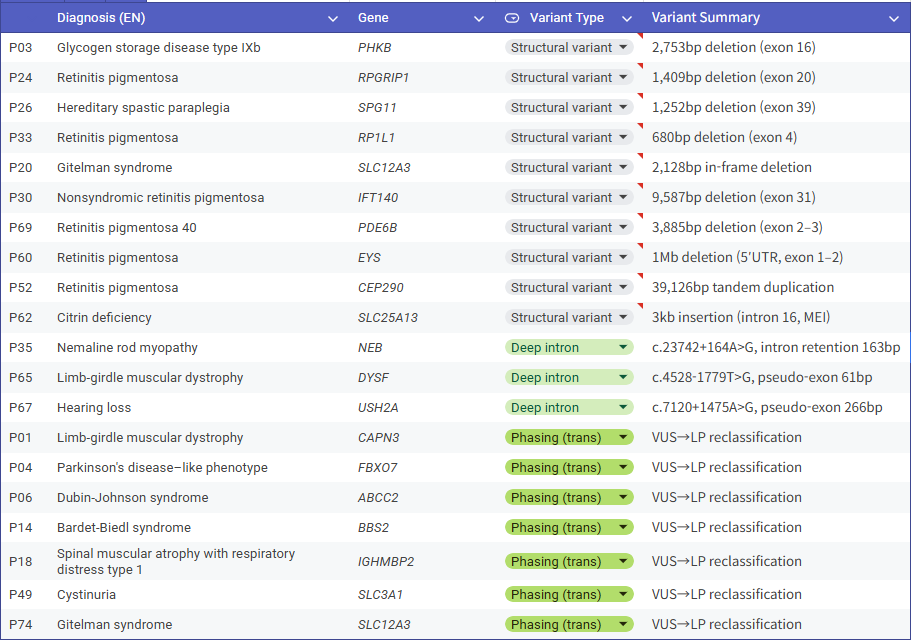
- Structural variant detection — 10 patients (12.8%). These ranged from 600 bp deletions to a 1 Mb deletion, plus a tandem duplication and a mobile element insertion. Six of the ten had inherited retinal disease (RPGRIP1, EYS, IFT140, RP1L1, CEP290, PDE6B ). Notably, a 1 Mb deletion spanning the EYS 5′UTR removed the promoter region — a noncoding SV. The authors suggest screening the EYS 5′UTR, particularly exons 1–2, in patients carrying a single heterozygous EYS pathogenic variant.
- Functionally confirmed deep intronic variants — 3 patients (3.85%). Of five deep intronic variants detected, three caused partial intron retention or pseudo-exon inclusion on minigene or RT-PCR, confirming aberrant splicing; these were reclassified as likely pathogenic on functional grounds. One point stands out: SpliceAI scores did not always match the functional result. Patient P67 showed a 266 bp pseudo-exon insertion despite a low predicted score (Δ0.28), while P09 — with a comparable score (Δ0.21) — spliced normally. Confirming the actual splicing outcome, rather than stopping at prediction, is a strength of this study.
- VUS reclassification through phasing — 7 patients (8.97%). Among 15 patients carrying both a pathogenic variant and a VUS, long-read sequencing determined the phase of the two variants from the proband’s DNA alone, without parental samples. Phase was resolved in 8 patients; in the 7 where the VUS proved to be in trans with the known pathogenic variant, the VUS was reclassified as likely pathogenic under the ACMG/AMP 2015 criteria (PM3). The one patient found to be in cis (P79) was not reclassified, and phase could not be resolved in 7 patients where the inter-variant distance exceeded the 8–10 kb library fragment size.
Clinical Implications: When to Consider It
The target group is clear: patients whose phenotype fits an autosomal recessive condition but in whom only one pathogenic allele has been found. In these cases the second allele may still be hiding as an SV, a deep intronic variant, or an unresolved phase.
The authors position the assay as a reflex second-tier test — used when WES fails to find the second pathogenic variant in a WES-first workflow, or as a complement after srWGS. Short-read technology has inherent limits in detecting SVs in repetitive or low-complexity regions, and cannot directly phase compound heterozygous variants across long intervals.
Reading the Numbers Carefully
Two caveats belong with this result.
First, the 25.6% yield comes from a highly selected cohort. The authors themselves state that it should not be applied directly to unselected rare disease populations.
Second, phasing succeeded in only 8 of 15 patients (53.3%). The failures were cases where the distance between the two variants (median 30 kb, up to 126 kb) exceeded the 8–10 kb library fragment size. The 56-gene panel is also a limited set, built around one institution’s cohort.
Closing
An autosomal recessive case left undiagnosed after SRS may not be “undiagnosable” — it may simply be one where the second variant hasn’t been found yet. This study shows, with concrete numbers, that three blind spots — SVs, deep intronic variants, and unresolved phase — can be narrowed with targeted long-read sequencing rather than srWGS. We’ll return in the next part with another approach and another group of disorders.
FAQ
Q. Is the long-read sequencing in this study whole-genome (lrWGS)?
No. It is targeted long-read sequencing — capturing only the exonic, intronic, and 5′/3′ UTR regions of 56 autosomal recessive genes by hybridization, then reading them on the PacBio Sequel II. The authors present it as a scalable alternative that avoids the data and cost burden of lrWGS.
Q. Who were the patients?
78 undiagnosed patients with a suspected autosomal recessive phenotype in whom a disease-targeted NGS panel had confirmed only one pathogenic allele. Inherited retinal and other eye disorders made up the largest share, at 47.4%.
Q. How was the 25.6% figure reached?
An additional pathogenic or likely pathogenic variant was found in 20 of 78 patients: 10 through structural variants (12.8%), 3 through deep intronic variants with functionally confirmed splicing defects (3.85%), and 7 through phasing that confirmed a variant in trans and reclassified the VUS (8.97%).
Q. Can this 25.6% be expected in the general patient population?
Not directly. This cohort was retrospectively selected for cases with a single pathogenic allele detected by SRS — a highly enriched population. The authors explicitly caution against applying the figure to unselected rare disease cohorts.
Q. Were deep intronic variants classified on SpliceAI prediction alone?
No. SpliceAI was used to prioritize candidates, after which minigene assays or RT-PCR confirmed the actual splicing effect. One case (P67) showed a pseudo-exon insertion despite a low predicted score, underscoring the need for functional validation.
Q. Was phasing possible without parental samples?
Yes. Long-read sequencing determined the phase of the two variants from the proband’s DNA alone. However, phase could not be resolved when the inter-variant distance exceeded the 8–10 kb library fragment size — and in practice it succeeded in only 8 of 15 patients.
Q. When might this be considered clinically?
The authors propose it as a reflex second-tier test when WES fails to identify the second pathogenic variant, or as a complement after srWGS. It may be particularly useful in autosomal recessive disease driven by structural or deep intronic variants.
Full series
View all
- Solving Undiagnosed Cases with Long-Read Sequencing (Part 1): Finding the Missing Variant in Autosomal Recessive Disease