



Klinefelter Syndrome: Why 62% of Cases Go Undiagnosed
Klinefelter syndrome is a genetic condition in which someone with a male body has one or more extra X chromosomes, most often in the pattern known as 47,XXY. It is the most common sex chromosome disorder in men and a common—though frequently missed—cause of male infertility and low testosterone.
The clinical challenge is not rarity but detection. Because features are subtle and evolve across the lifespan, the majority of affected men are never identified—a diagnostic gap with real consequences for reproductive, metabolic, and cardiovascular health.
Frequently asked questions
How common is Klinefelter syndrome?
Klinefelter syndrome occurs in approximately 1 in 600 to 1 in 650 male births, making it the most common sex chromosome disorder in males.
Why are so many cases missed?
Only about a third of cases are ever diagnosed. Signs are subtle before puberty, variable in adulthood, and often attributed to other causes, so most diagnoses occur late—frequently during an infertility workup.
What test confirms Klinefelter syndrome?
A standard karyotype confirms the 47,XXY chromosome complement. Chromosomal microarray also detects the extra X. A hormonal pattern of low testosterone with elevated LH and FSH supports the diagnosis and should prompt genetic testing.
Can men with Klinefelter syndrome have children?
Most men with the condition are infertile due to testicular failure, but sperm retrieval via testicular extraction combined with assisted reproduction allows some to father biological children. A fertility specialist should guide options.
Mechanism: an extra X and its downstream effects
The 47,XXY karyotype usually arises when an X chromosome fails to separate properly during egg or sperm formation, or shortly after fertilization. The extra X disrupts sperm production and lowers testosterone activity, which gives rise to the features of the syndrome.
The condition was first described in 1942 by Dr. Harry Klinefelter, who reported post-pubertal males with infertility, gynecomastia, and elevated gonadotropins; the extra X chromosome was identified as the cause in 1959.
Prevalence and the diagnostic gap
The prevalence of 47,XXY is approximately 1 in 650 males based on large newborn screening studies, though the rate of diagnosis in the general population is far lower. Other cohorts cite figures near 1 in 600 male births.
Underdiagnosis is the defining epidemiologic feature. One review estimated an expected prevalence of 152 per 100,000 newborn males, yet found that only about 38% of cases are ever diagnosed.
Phenotype across the lifespan
Infancy and childhood
Presentation is often silent. Subtle findings include hypotonia, delayed speech, and language-based learning difficulties. The behavioral phenotype includes developmental delays, executive dysfunction and ADHD, and social-emotional difficulties, though variability between individuals is substantial.
Adolescence and adulthood
Puberty may begin normally but stall, with incomplete virilization, small firm testes, gynecomastia, tall stature with long limbs, and reduced muscle mass. Azoospermia is typical, and infertility is a frequent presenting reason for evaluation.
Metabolic and cardiovascular risk
The condition carries meaningful long-term morbidity. Up to 50% of men with Klinefelter syndrome have metabolic syndrome, driving excess diabetes and cardiovascular disease. In Danish and British cohorts, mortality was increased by roughly 50% and hospital admission risk by 70%, corresponding to a median loss of about two years of life.
Establishing the diagnosis
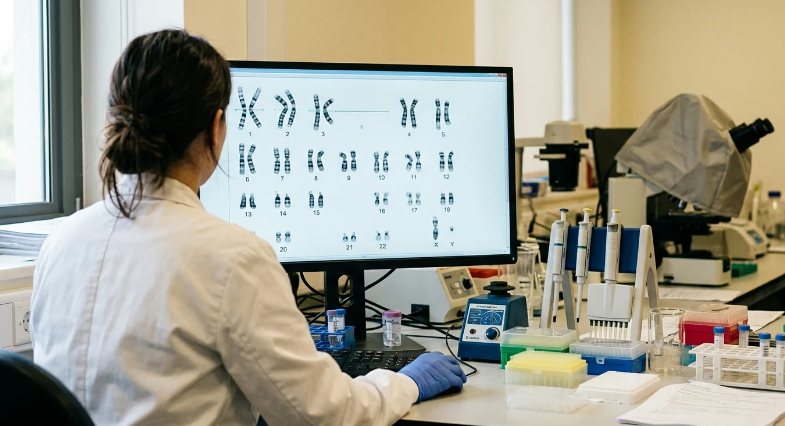
A peripheral blood karyotype remains the confirmatory test, revealing the 47,XXY complement; chromosomal microarray reliably detects the extra X and quantifies mosaicism.
Whole exome sequencing (WES) and whole genome sequencing (WGS) are not the tests used to confirm Klinefelter syndrome. But when a karyotype has already established 47,XXY and findings outside the usual range of the syndrome are also present — severe developmental delay, or multiple congenital anomalies — further testing may be worth considering to check whether a second underlying cause is involved. This is particularly true when symptoms span several organ systems.
* This article is educational and does not replace individualized medical advice. Diagnostic and management decisions should be made with a qualified clinician.
Want to learn more about
3billion's genetic testing?
We'll reply within 1 business day.
References
- Tartaglia N, et al. The spectrum of the behavioral phenotype in boys and adolescents 47,XXY (Klinefelter syndrome). Pediatric Endocrinology Reviews. 2010. https://pmc.ncbi.nlm.nih.gov/articles/PMC3740580/
- Bojesen A, Gravholt CH. Morbidity and mortality in Klinefelter syndrome (47,XXY). Acta Paediatrica. 2011. https://doi.org/10.1111/j.1651-2227.2011.02274.x
- Davis SM, et al. High prevalence of cardiometabolic risk features in adolescents with 47,XXY/Klinefelter syndrome. American Journal of Medical Genetics Part C. 2020. https://doi.org/10.1002/ajmg.c.31784
- Ridder LO, et al. Morbidity, mortality, and socioeconomics in Klinefelter syndrome and 47,XYY syndrome: a comparative review. Endocrine Connections. 2023. https://doi.org/10.1530/EC-23-0024

Soo-jung Baek
Marketing Manager
I strive to empower the rare disease community by sharing meaningful insights backed by our company’s expertise.