



Sudden Death in Healthy Adults: Why a “Normal” Genetic Test Doesn’t Mean You’re Safe from Brugada Syndrome

Sookjin Lee
Chief Business Officer (CBO) | Ph.D.
A business expert leading innovation in precision medicine and genomics for 20 years. Accelerating the commercialization of innovative technologies with academic expertise and market insight.
TL;DR
- Brugada Syndrome is a hereditary arrhythmia that causes sudden death in structurally normal hearts.
- A “negative” result on the primary culprit gene, SCN5A, is common. However, patients with a high Polygenic Risk Score (PRS) face a risk of sudden death equal to those with rare pathogenic mutations.
- Asian males have a lower detection rate of SCN5A mutations (6–8%) but carry a higher prevalence of ZSCAN20 variants, which stimulate testosterone and indirectly disrupt cardiac rhythm.
- Standard ECGs and sodium channel blocker provocation challenges are vital to bypass the diagnostic limitations of single-gene testing.
- If diagnosed as high-risk, immediate fever management is critical, and certain psychiatric drugs must be strictly avoided.
- 1 in 6 patients suffer from anxiety or depression post-diagnosis. A multidisciplinary approach combining cardiology and mental health is essential.
Imagine a seemingly healthy adult, in the prime of their life, suddenly dying in their sleep or collapsing without warning. When an autopsy reveals a structurally perfect heart, the cause is often classified under Sudden Arrhythmic Death Syndrome (SADS). The silent driver behind many of these tragedies is Brugada Syndrome (BrS).

BrS primarily strikes otherwise healthy men aged 30 to 50. It remains completely asymptomatic until it triggers a lethal ventricular fibrillation(VF).
In this article, backed by the latest genomic and neuropsychiatric studies, we will explore why a “negative” genetic test is not a clean bill of health, how polygenic risk scores (PRS) are reshaping risk stratification, and what immediate, practical steps can prevent sudden cardiac death.
1. The Fall of the Single-Gene Myth: The Rise of Polygenic Risk Scores (PRS)
Historically, Brugada Syndrome was treated as a classic monogenic, Mendelian (autosomal dominant) disorder caused by rare, loss-of-function mutations in the SCN5A gene. However, 80% of clinically confirmed BrS patients test negative for SCN5A mutations [1].
To explain this “missing herizability,” clinical genetics has shifted to the “Polygenic Disease Threshold Model”. Instead of one catastrophic mutation, BrS often manifests when a person’s cumulative burden of common genetic variants and environmental triggers crosses a critical biological threshold.
Recent landmark clinical trials (such as Kukavica et al., 2024) proved that SCN5A-negative patients in the highest PRS percentiles exhibit rates of life-threatening ventricular arrhythmias identical to patients carrying rare SCN5A pathogenic mutations [1].
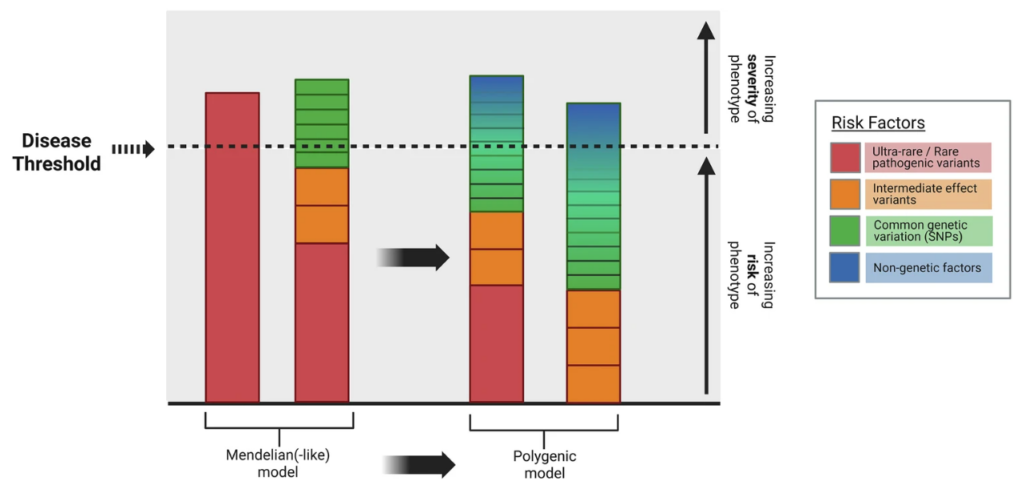
💡Disease Threshold Model
Our heart possesses an electrical safety margin known as the “conduction reserve”—a critical physiological threshold.
- SCN5A-Positive Patients: A single “massive boulder” (a rare, highly pathogenic mutation) instantly breaches this threshold entirely on its own, without requiring other genetic variables.
- SCN5A-Negative, High-PRS Patients: While they lack this single massive boulder, a high accumulation of “common sand grains” (dozens of minor risk SNPs) combined with “environmental triggers” (such as fevers or certain medications) gradually piles up to cross this exact same threshold.
The core takeaway is simple: once the threshold is crossed, the cardiac brake fails. Whether the underlying cause was a single massive boulder or a collection of common sand grains, the resulting electrical instability and the severity of the sudden death risk are identical.
This is the biological reality of “unequal equity, equal severity.”
💡The Synergistic Boost: VUS + PRS
Evaluating an SCN5A VUS is a major clinical challenge. Emerging models suggest that combining VUS status with PRS may help clinicians better estimate a patient’s potential susceptibility:
- [High-Risk] SCN5A VUS (+) & High PRS (+): A high polygenic risk background may act as a genetic modifier, potentially reducing the conduction reserve. This cumulative burden could hypothetically elevate the clinical presentation of a VUS to a level comparable to a pathogenic variant.
- [Moderate-Risk] SCN5A VUS (-) & High PRS (+): While polygenic risk is high, the absence of an underlying primary channel defect suggests a more robust conduction reserve. Crossing the disease threshold typically requires a much higher accumulation of risk alleles or significant environmental triggers (e.g., severe fever).
- [Lower-Risk] SCN5A VUS (+) & Low PRS (-): A highly favorable polygenic background may buffer the potential impact of an SCN5A VUS, keeping the clinical penetrance low.
Note: Because SCN5A VUS classifications are subject to reclassification as clinical evidence accumulates, these risk tiers represent simplified conceptual models to illustrate the potential modifying effects of PRS, rather than definitive prognostic categories.
2. Which Genetic Combinations Drive the Highest Risk?
Large-scale GWAS have identified specific common and rare variants that collectively push patients toward the sudden death threshold [1, 2]:
- The Triple-SNP Synergy:
Carrying risk alleles across the SCN5A (rs11708996), SCN10A (rs10428132), and HEY2/NCOA7 (rs9388451) loci is highly predictive. Individuals carrying four or more risk alleles across these three loci face a 20-fold increase in Brugada susceptibility. - MAPRE2 (rs476348): This variant downregulates the MAPRE2 gene, disrupting cellular microtubule networks. This blocks the physical trafficking of sodium channels to the cell membrane, slowing cardiac conduction velocity.
- CAMK2D (rs6816233): This variant alters calcium/calmodulin-dependent protein kinase II expression, activating pro-inflammatory and pro-cell death pathways that lead to subclinical myocardial fibrosis and inflammation.
- Asian-Specific Rare Variations: WES) of East Asian cohorts shows that SCN5A-negative patients share distinct enrichment of rare variants in other ion channel genes such as KCNJ8, SCN1B, ZFPM2, MAPRE2, and KCNE5.
To deliver genuine preventative value, next-generation genetic screening must evolve from basic SCN5A sequencing into comprehensive, ancestry-specific panels integrating PRS and non-coding regulatory regions (like the RE5 enhancer).
3. Beyond Genetics: Real-World Diagnostic Tools
Because standard genetic testing only yields a ~20% diagnosis rate, clinical surveillance tools are indispensable [1]:
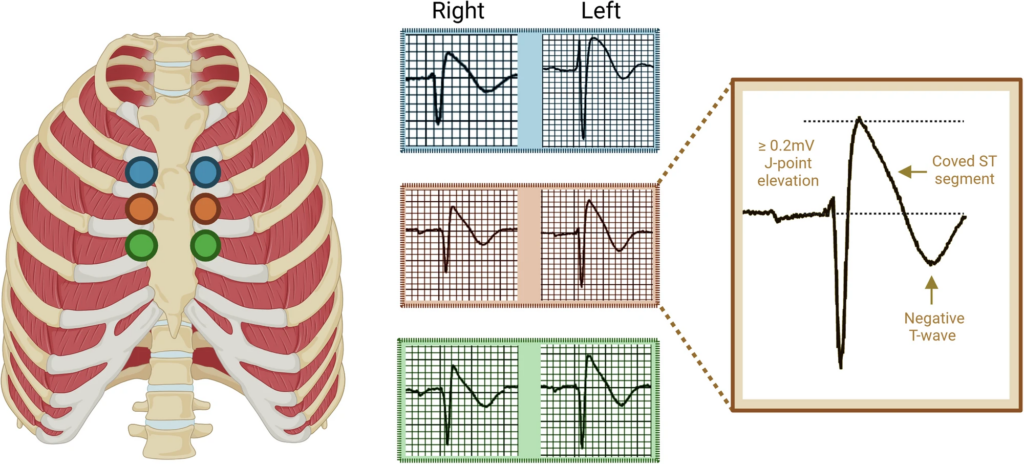
- The Type 1 Brugada ECG Pattern: The classic diagnostic marker consists of a J-point elevation ≥0.2 mV, followed by a coved ST-segment elevation, and a negative T-wave in the right precordial leads (V1, V2).
- High-Lead & Holter Monitoring: Standard 10-second ECGs often miss the transient Brugada pattern. Shifting the V1 and V2 electrodes up to the 2nd and 3rd intercostal spaces (high-lead ECG) and running 24-hour Holter monitoring dramatically increases detection.
- Pharmacological Provocation Challenge: In patients with normal baseline ECGs but high clinical suspicion, a sodium channel blocker (e.g., ajmaline, flecainide) is administered under strict cardiology supervision to temporarily unmask the hidden Type 1 pattern.
- Symptom Tracking: Recurrent, unexplained syncope (fainting) or agonal breathing during rest or sleep are major red flags signaling nocturnal ventricular fibrillation
4. Critical Action Plan: How to Manage Brugada Risk
To manage potential risks, high-risk patients are advised to implement key lifestyle and medical precautions [3]:
- Prompt Fever Control: High body temperature can disrupt cardiac sodium channels, potentially unmasking Brugada ECG patterns. Patients should use antipyretics (e.g., acetaminophen) immediately at the first sign of a fever.
- Avoid Contraindicated Drugs: Medications that block sodium channels—such as lithium, quetiapine, clozapine, amitriptyline, and desipramine—must be avoided.
- Limit Alcohol: Binge drinking is a documented trigger for dangerous ventricular fibrillation events in Brugada patients.
- Integrated Psychocardiological Care: Receiving a diagnosis can be highly stressful, with 15.7% to 16% of patients experiencing clinical anxiety or depression. Because chronic stress can negatively modulate cardiac rhythm, integrated care combining cardiology with psychological support (such as CBT) is highly recommended.
Disclaimer: This article is written for educational purposes and based on peer-reviewed genomic research. If you exhibit symptoms such as unexplained syncope or palpitations, please consult a board-certified cardiologist immediately.
FAQ
Q1. If my SCN5A genetic test is normal and there is no family history of sudden death, am I completely safe?
A. No, not necessarily. Standard genetic testing only captures SCN5A coding mutations, which account for just 20% of cases [1]. The remaining 80% are driven by polygenic risk (high PRS) and variants in non-coding regions, which are typically omitted from standard panels. If you have experienced unexplained fainting (syncope) or irregular heartbeats, you should consult a cardiologist for clinical testing (ECG/Holter/provocation).
Q2. Why are men at a significantly higher risk of sudden death from Brugada Syndrome?
A. It is driven by a unique non-cardiac genetic mechanism. While BrS is a cardiac disease, multi-ancestry GWAS discovered that the ZSCAN20 gene variant (rs16835523)—which is highly enriched in Asian populations—is expressed in the testes, not the heart [1]. This variant upregulates testosterone production, which directly modulates and alters the cardiac action potential, making males highly vulnerable to arrhythmia. This “genetic bypass” explains why East Asian men exhibit the highest clinical burden of BrS.
Q3. Which medications must a Brugada Syndrome patient strictly avoid?
A. Any drug that significantly blocks sodium ion channels. Key contraindicated medications include lithium (used for bipolar disorder), antipsychotics like quetiapine and clozapine, and tricyclic antidepressants such as amitriptyline and desipramine [3]. These drugs can unmask silent Brugada patterns and trigger cardiac arrest.
Reference
- [1] Griffiths, R. L. M. et al. “Brugada Syndrome: an exemplar for the genomic basis of sudden death.” European Journal of Human Genetics (2025).
- [2] Juang, J. et al. “Identification of genetic variants by using a whole exome sequencing approach in Taiwanese patients with Brugada Syndrome.” European Heart Journal (2024).
- [3] Santoro, F. et al. “Psychological profile of patients with Brugada syndrome and the impact of its diagnosis and management.” Nature / Springer Review (2024).