


When Should We Consider WES/WGS in Pediatric Patients? — Based on the 2021 ACMG Guidelines

Sohyun Lee
Clinical Genomics Scientist & Clinical Customer Support
I'm guiding test selection, supporting variant and result interpretation, handling case inquiries, and translating field insights into service improvements.
In clinic, we frequently encounter patients like these:
- Children with unexplained developmental delay
- Intellectual disability
- Multiple congenital anomalies
As we go through the diagnostic workup—CMA, single gene tests, targeted panels—there are still many cases where we fail to reach a definitive diagnosis. This is often referred to as the “diagnostic journey.”
The Direction Was Already Set in 2021
There is an important reference point for this issue.
In 2021, the American College of Medical Genetics and Genomics published an evidence-based guideline.
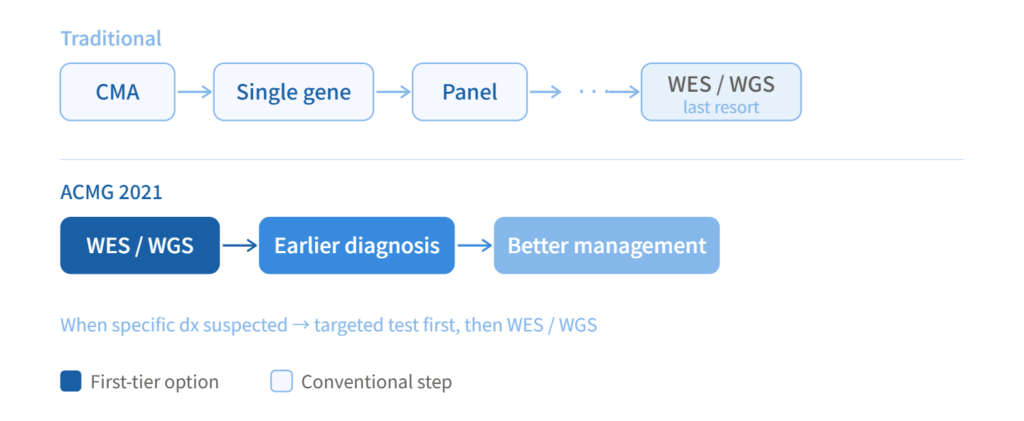
The conclusion is quite clear: ES/GS is strongly recommended as a first-tier or second-tier test for pediatric patients with congenital anomalies, developmental delay, or intellectual disability.
In other words, these tests should no longer be viewed only as a “last resort.”
What Difference Does It Make in Practice?
This is, in my view, the most important point.
According to the guideline:
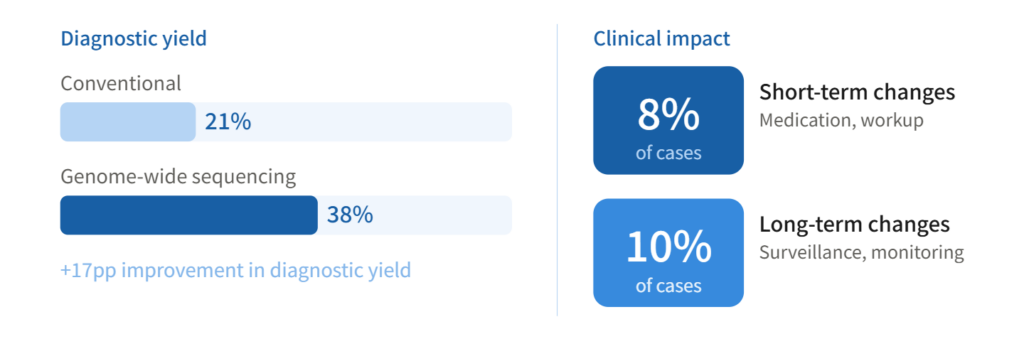
- About 8% of cases showed changes in short-term clinical management
- About 10% showed changes in long-term management
These numbers may not seem large at first glance, but in real clinical practice, they can be quite meaningful.
For example:
- Adjusting medications
- Avoiding unnecessary tests
- Initiating surveillance for potential complications
Diagnostic Yield: A Meaningful Difference
The data cited in the guideline show:
- Genome-wide sequencing: ~38%
- Conventional testing: ~21%
While these numbers may vary depending on the patient population, overall, this approach clearly increases the likelihood of reaching a diagnosis.
Rethinking the Testing Strategy
Traditionally, the workflow often looks like this:
CMA → single gene → panel → … → WES at the end
However, the guideline suggests a different perspective: Using ES earlier in the diagnostic process may lead to more diagnoses at a lower overall cost.
The key point here is not that the test itself is cheaper, but that it may be more efficient when considering the entire diagnostic pathway.
It Is Not the Answer for Every Patient
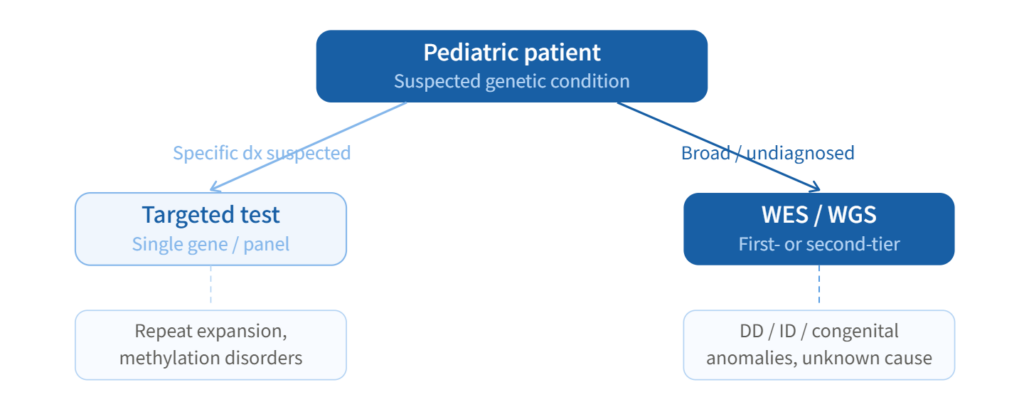
This is an important caveat. As the guideline clearly states:
- When a specific condition is strongly suspected
- Or when the genetic mechanism is not well detected by ES (e.g., repeat expansion, methylation disorders)
Targeted testing should still be prioritized.
Ultimately, the key question is not which test is “better,” but which strategy is most appropriate for the individual patient.
A Personal Take
Applying this guideline in practice, one thing becomes clear.
WES/WGS is no longer simply a test that we “eventually get to.”
It is now something we may need to consider earlier in the process.
It is not the first test for every patient, but it is no longer appropriate to think of it only as a last step.
Closing Thoughts
In pediatric patients with suspected genetic disorders, the order in which we approach testing can significantly impact:
- Time to diagnosis
- The experience of patients and families
- Clinical management decisions
The 2021 ACMG guideline provides a clear direction on this issue.
And its message remains highly relevant in current clinical practice.
Not sure which test fits your patient? Just ask — we’re happy to help.
References
1. Manickam K, McClain MR, Demmer LA, Biswas S, Kearney HM, Malinowski J, Massingham LJ, Miller D, Yu TW, Hisama FM; ACMG Board of Directors. Exome and genome sequencing for pediatric patients with congenital anomalies or intellectual disability: an evidence-based clinical guideline of the American College of Medical Genetics and Genomics (ACMG). Genet Med. 2021 Nov;23(11):2029-2037. doi: 10.1038/s41436-021-01242-6. Epub 2021 Jul 1. PMID: 34211152.