



Most-Read Genetic Testing Blogs of 2025: Cost, Access, and Inheritance Explained
Key Takeaways
• Cost and insurance coverage remain major barriers to accessing genetic testing worldwide.
• Clinicians and families seek clear, realistic explanations when navigating testing decisions.
• Evidence-based communication builds trust, especially around sensitive topics like autism inheritance.
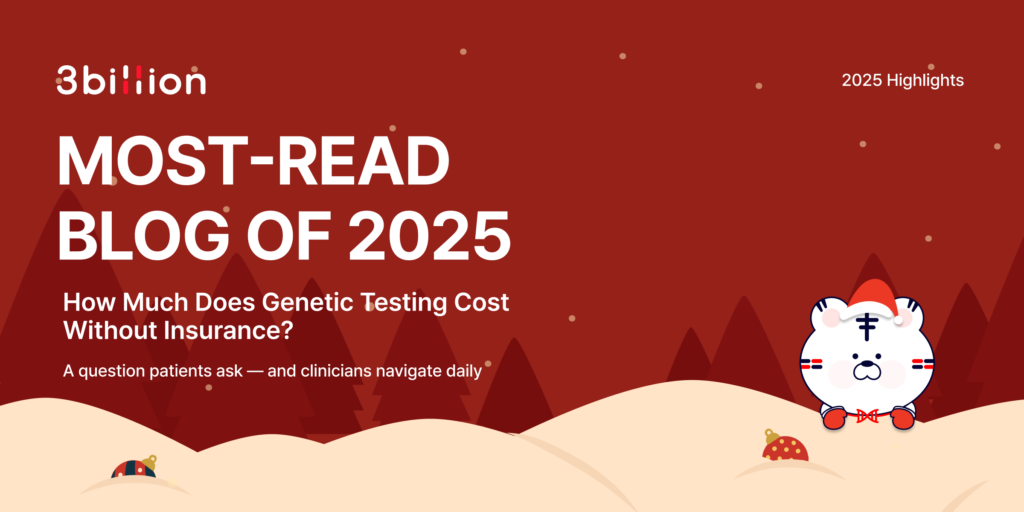
No.1 Most-Read Blog of 2025 : How Much Does Genetic Testing Cost Without Insurance?
Cost remains one of the most common — and most difficult — questions around genetic testing. As testing becomes more widely recommended in clinical care, insurance coverage continues to vary by region, indication, and policy, leaving many patients to face out-of-pocket decisions.
This blog resonated with clinicians worldwide because it clearly outlines what genetic testing costs look like when insurance isn’t available. It walks through typical price ranges across different testing options — from direct-to-consumer tests to clinical diagnostics like single-gene testing, chromosomal microarray, and whole exome sequencing — while highlighting the real-world tradeoffs clinicians navigate when discussing access with patients.
Its practical, no-assumptions approach made it the most-read blog on 3billion in 2025.
👉 Read the full blog: How Much Does Genetic Testing Cost Without Insurance?

No.2 Most-Read Blog of 2025 : Is Autism Hereditary? Understanding Genetics Without Blame
When a child is diagnosed with autism, one of the first questions families ask is deeply personal:
“Did my child inherit this from me?”
This blog became one of the most-read posts of 2025 because it addresses that question with clarity, science, and empathy. Rather than oversimplifying autism as purely inherited — or placing blame on parents — it explains autism as a complex, multifactorial condition, shaped by a combination of genetic and environmental factors.
The article walks through what current research tells us:
- Autism has a strong genetic component, but no single gene causes it]
- Multiple genes may contribute to risk
- Some cases are linked to de novo (new) genetic mutations, not inherited from either parent
- Many families have no prior history of autism, even when genetics play a role
It also explores the concept of idiopathic autism, which accounts for the majority of cases — helping clinicians and families understand why autism can occur even when no clear genetic or environmental cause is identified.
By grounding a sensitive topic in evidence — while acknowledging uncertainty — this post became a trusted resource for clinicians, patients, and families alike.
👉 Read the full blog: Is Autism Hereditary? (From Mother or Father?)
Full series
View all

3billion Inc.
3billion is dedicated to creating a world where patients with rare diseases are not neglected in diagnosis and treatment.