AIVARI: A Variant Interpretation AI Assistant That Shows Its Evidence
AI First Review. Your Expert Judgment.
Finding the important candidate variants in a WES or WGS analysis is only the start of clinical genome interpretation.
The analyst has to judge not only whether a candidate variant is pathogenic, but whether that variant can actually explain the patient’s disease, taking the clinical phenotype, the inheritance pattern and the disease mechanism together. That review means checking evidence across several databases and connecting different pieces of information into one reading.
AIVARI (AI Variant Reportability and Interpretation Agent) is an AI-based variant interpretation assistant built to support the clinician’s first review in that process. Working from GEBRA’s variant analysis and prioritization output, it evaluates candidate genes and disease hypotheses, and returns not only the call but the evidence and clinical explanation behind it.
FAQs
Q1. How is AIVARI different from 3ASC, a standard variant prioritization tool?
A. For candidates that have already been shortlisted, AIVARI combines variant pathogenicity, patient phenotype, inheritance pattern and the related evidence to assess clinical reportability, and gives the reasoning behind that assessment.
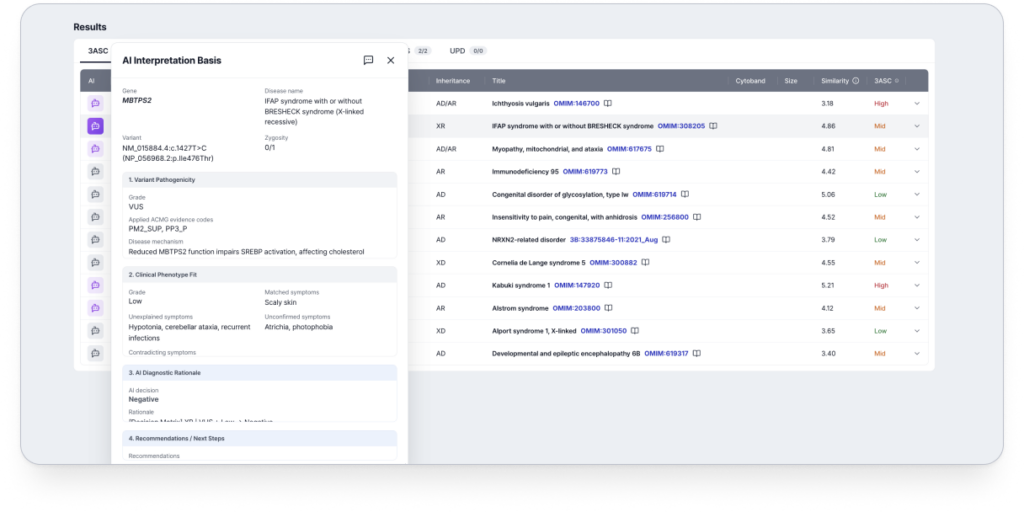
Q2. What can I see in AI Interpretation Basis?
A. Evidence and explanation organized into four areas: Variant Pathogenicity, Clinical Phenotype Fit, AI Diagnostic Rationale, and Recommendations / Next Steps.
Q3. Does a Report call from AIVARI mean a confirmed diagnosis?
A. No. Report is an AI judgment suggesting that the finding be considered for clinical reporting. The final diagnosis and the decision to report are made by the clinical expert.
Q4. Is AIVARI’s 95.6% a diagnostic accuracy figure?
A. No. It is case-level Group Sensitivity measured on a 235-case matched comparison set. It measures whether the system correctly identified at least one of the actually reportable candidates.
1. Why Interpretation Is Still Needed After Variant Prioritization
Variant interpretation software ranks candidates using ACMG/AMP classification, variant frequency, functional impact, the patient’s HPO phenotype and other information. But a high-ranking candidate does not necessarily explain that patient’s disease.
For example, even when a variant classified as Likely Pathogenic is ranked high or mid in prioritization, how well the patient’s clinical phenotype and inheritance pattern match that disease still has to be reviewed separately. And even when the typical symptoms of the disease have not yet been confirmed, sufficient molecular evidence may call for further clinical evaluation.
This is the difference between Variant Prioritization and Clinical Interpretation.
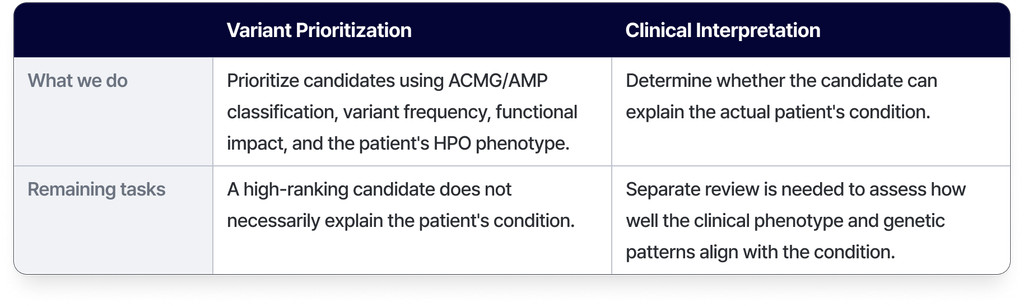
Working from the existing analysis output, AIVARI adds an assessment of whether a candidate can explain the patient’s disease, and provides the initial call and its basis for the clinical expert to review.
2. AI Interpretation Basis: Seeing the Evidence Behind the Call
One of AIVARI’s main features is AI Interpretation Basis. Instead of returning a score or a verdict alone, it shows in structured form what information the AI based its interpretation on.
The actual AIVARI screen shows four areas.
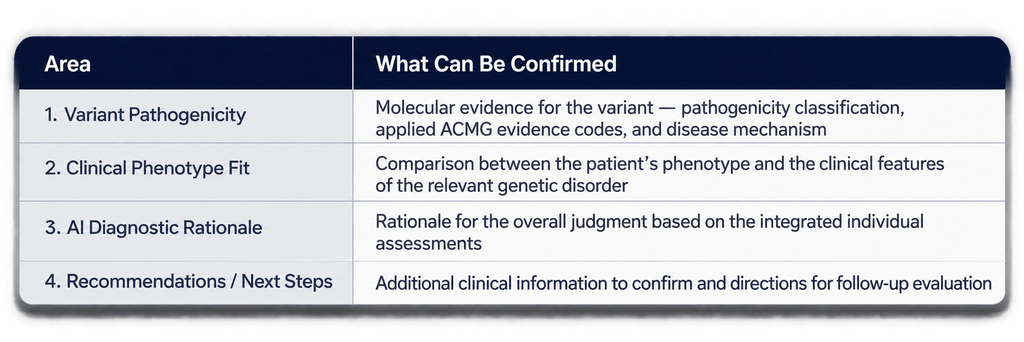
a. Variant Pathogenicity — the molecular evidence for the variant
AIVARI reviews the pathogenicity classification of the candidate variant and the related evidence.
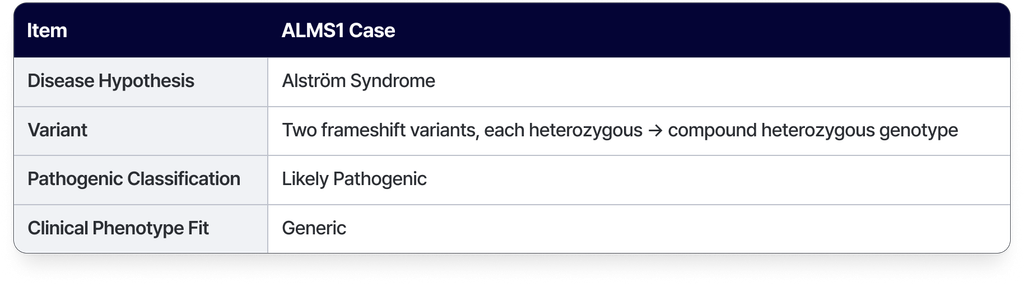
In the actual ALMS1 case, two frameshift variants associated with Alström syndrome can be seen. Each is presented as heterozygous, and together they form a compound heterozygous genotype.
AI Interpretation Basis presents each variant’s pathogenicity classification, the ACMG evidence codes applied, the disease mechanism and the explanation for it. The analyst therefore does not stop at the Likely Pathogenic label, but can review the molecular evidence used to reach it.
b. Clinical Phenotype Fit — comparing the patient’s symptoms with the disease
Variant pathogenicity alone cannot fully explain that patient’s disease. AIVARI compares the patient’s phenotype with the clinical features of the genetic disease and assesses the fit.
In the actual ALMS1 case, AIVARI rated clinical phenotype fit as Generic. The screen separates the following.
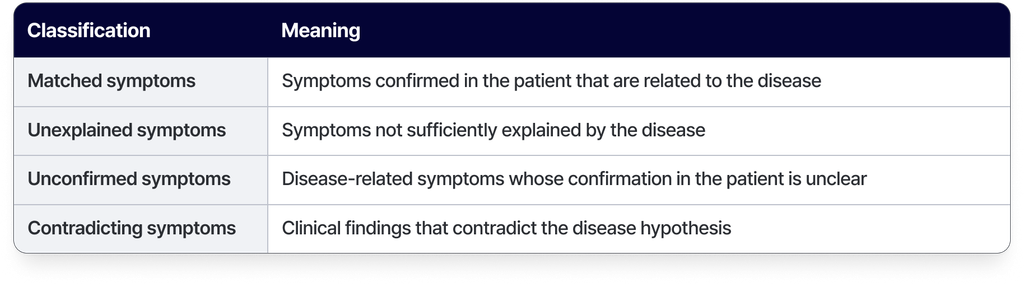
In this case, proteinuria is presented as a matched symptom. The characteristic findings of Alström syndrome, including progressive cone-rod dystrophy, sensorineural hearing loss and childhood obesity, are classified as unconfirmed.
Along with that difference, AIVARI also states that the patient’s current phenotype does not sufficiently match the typical clinical picture of the disease.
“What matters is not a phenotype similarity score on its own, but being able to see which symptoms match and which evidence is still missing. “
c. AI Diagnostic Rationale — combining the evidence into an interpretation
AIVARI combines the individual assessments of variant and phenotype and presents the reasoning.
In the ALMS1 case it takes into account that two Likely Pathogenic frameshift variants are in a compound heterozygous state. At the same time it explains the uncertainty: the patient’s clinical picture is non-specific, and the hallmark features of Alström syndrome have not been sufficiently confirmed.
Taking that together, the AI’s suggestion is Report. That means AIVARI suggests reviewing the finding as a candidate for clinical reporting, not that the disease has been confirmed.
The purpose of AI Diagnostic Rationale is not to settle the conclusion in place of the expert, but to make it possible to understand how the different pieces of evidence fed into the final call.
d. Recommendations / Next Steps — directions for further review
In clinical variant interpretation, the information at hand may not answer every question. AIVARI therefore suggests additional clinical information that could be checked alongside the initial interpretation.
In the ALMS1 case it recommends clinical follow-up plus ophthalmologic and audiologic evaluation to check whether the characteristic symptoms of Alström syndrome appear.
Suggestions like these give the clinical expert something to work from when considering whether further evaluation is needed. AI-generated recommendations still have to be verified separately against the patient’s actual clinical status and the responsible expert’s judgment.
The four areas in one case
3. The AI First Reviewer AIVARI Is Aiming For
AIVARI’s goal is not to replace the expert’s judgment. It is to let the expert start from the initial interpretation and evidence the AI has provided, instead of repeating the first review from scratch.
A workflow using GEBRA and AIVARI can be set up as follows.
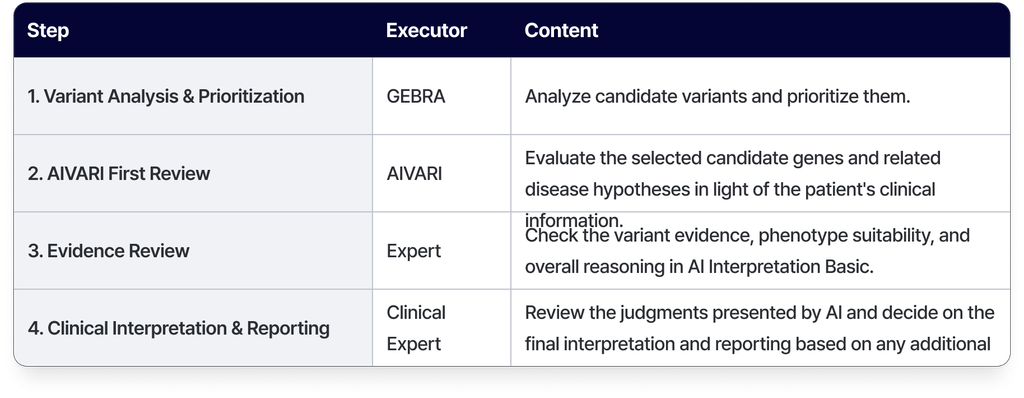
This is an approach that connects the AI’s first review to the expert’s clinical judgment. Whether it reduces actual working time or improves interpretation efficiency requires further validation in clinical settings.
4. AIVARI’s Performance Measured on Real Clinical Cases
3billion researchers evaluated how effectively the AIVARI Agent identifies clinically important candidates.
The study, presented at the ICML 2026 Workshop on Generative and Agentic AI for Biology, analyzed 300 clinical cases and 6,460 candidate hypotheses in total. Within that set, 235 cases and 1,022 hypotheses that could be compared directly against the existing pipeline under identical conditions were evaluated separately.
What do the performance metrics mean?
Rather than only asking whether the AI’s call was correct, the study evaluated how well it found the candidates that were treated as important in the actual clinical reports.
The main metrics are as follows.
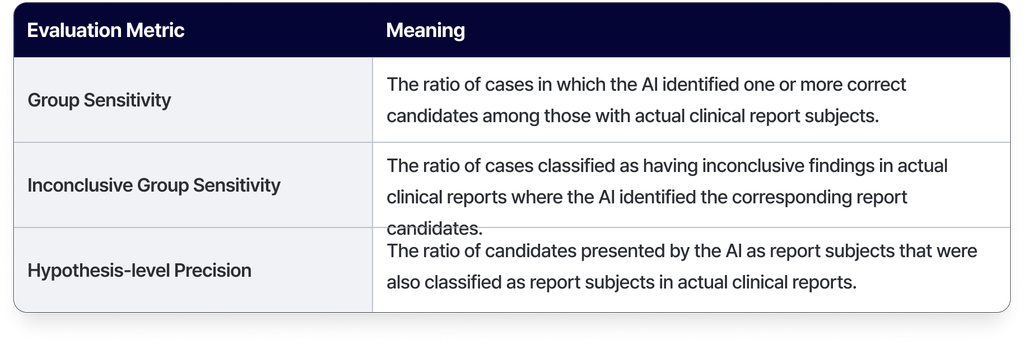
Here, reportable means a finding that the clinical expert classified as Positive or Inconclusive in the final report in this study.
For example, a Group Sensitivity of 95% means that out of 100 cases with an actual reportable finding, the AI identified at least one correct candidate in roughly 95. A Precision of 40% means that out of 100 candidate hypotheses the AI proposed as reportable, roughly 40 were also classified as reportable in the actual clinical report. The two metrics measure different things.
AIVARI’s study results
On the 235-case matched comparison set, the results were as follows.
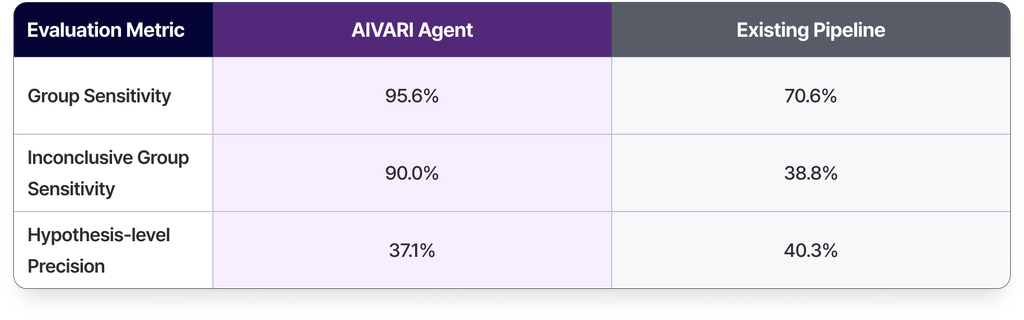
* The existing pipeline is HP(Gemini), which uses the same base language model.
What do these results mean?
The most notable part is the difference on inconclusive cases.
The existing pipeline identified the correct reported candidate in 38.8% of these cases, while the AIVARI Agent identified it in 90.0%.
That suggests AIVARI may be useful for surfacing candidates with incomplete clinical evidence, or candidates that are hard to judge, as targets for further review.
Because AIVARI is weighted toward not missing important candidates, it can also propose more candidates that are not actually clinically reportable. Hypothesis-level precision was in fact lower than the existing pipeline’s (37.1% vs. 40.3%).
AIVARI’s strength is therefore not in judging every candidate correctly, but in reducing the chance of missing an important candidate while providing an initial call and its basis for the expert to review.
Points to consider when reading these results
The Group Sensitivity used in this study does not mean diagnostic accuracy or an automated diagnosis success rate.
The study also used clinical cases from a single institution and was limited to SNVs and small indels. How much AIVARI can reduce interpretation time in a real clinical setting, and whether it shows the same performance on other types of genetic variants, requires further validation.
5. What Comes Next for Variant Interpretation AI
As genome interpretation software advances, the technology for finding and ranking candidates keeps getting more refined. One of the questions that matters now is how to read those results in the patient’s clinical context and connect them to evidence the expert can review.
AIVARI explores the AI First Reviewer idea in that step. It checks the pathogenicity evidence for the variant, evaluates the patient’s phenotype and inheritance pattern, and presents its reasoning along with directions for further review.
“From variant prioritization to evidence-grounded clinical interpretation. AI supports the first review; the expert evaluates the evidence and makes the final call. ”
Putting the step that finds candidates and the step that reads those candidates against the patient into one flow: that is what GEBRA and AIVARI are attempting together.
Try AIVARI on Your Own Cases
In the AIVARI beta evaluation, you can use cases you have already interpreted and compare the AI’s calls and evidence against your existing clinical interpretation. It lets you examine whether important findings are identified, how consistent the judgments are, the clinical usefulness, and how well it could fit into your actual review workflow.
Can you see why the AI made that call?
Put AIVARI’s evidence side by side with your own interpretation.
References
Kang M, Kim S, Kwon KW, Moon D. AIVARI Agent: An Evidence-Grounded Agentic LLM for Variant Reportability and Interpretation. ICML 2026 Workshop on Generative and Agentic AI for Biology.

3billion Inc.
3billion is dedicated to creating a world where patients with rare diseases are not neglected in diagnosis and treatment.