


GEBRA™ Use Guide: Symptom Color Tag
- Genetic test | 25. 12. 05
The Symptom Color Tag in GEBRA™ provides a visual layer of interpretation that complements the numerical symptom similarity score displayed on each variant card. This feature allows users to understand how closely the patient’s clinical features align with the phenotypes associated with each candidate disease.
Overview of the Symptom Color Tag
Before any variant is selected, all HPO terms in the symptoms panel appear in gray.
When a variant is selected, GEBRA™ assigns each HPO term to one of three color categories:
🔴 Red — Exact Match
Displayed when the patient’s HPO term directly matches a phenotype associated with the selected disease.
🟡 Yellow — Partial or Broad Relevance
Displayed when the term falls within the broader clinical spectrum of the disease but is not an exact match.
⚫ Gray — No Known Association
Displayed when the term has no reported phenotypic correlation with the disease.
Example: Applying Color Tags to a Real Case

Let’s assume that a patient presented with the following features:
- muscle weakness
- micrognathia
- macrocephaly
- foot deformities
- skeletal abnormalities
- hypertelorism
- liver failure
- elevated liver enzymes
- jaundice
- vomiting
- coagulopathy
- hyperbilirubinemia
- increased serum lactate
- seizures
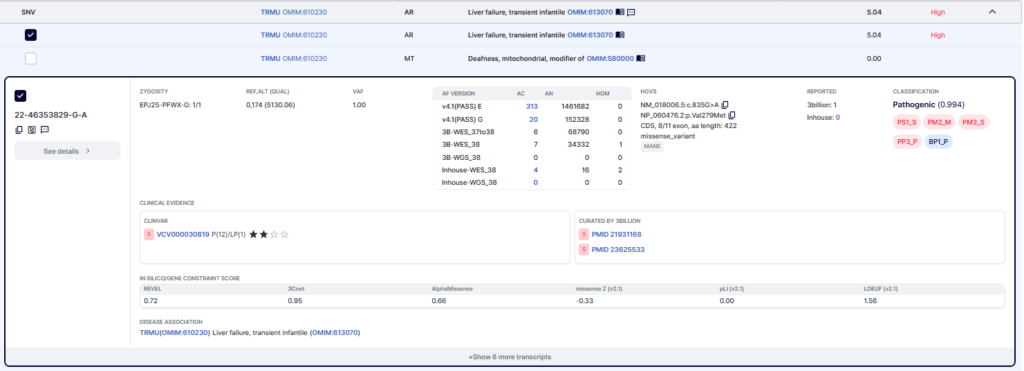
Through 3ASC prioritization, a High-3ASC-class variant in TRMU was identified, consistent with TRMU-related liver failure, transient infantile.
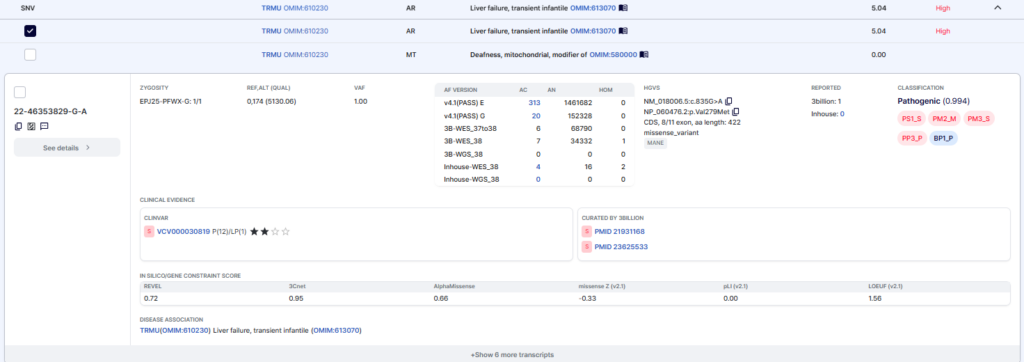
When the TRMU variant is selected, the color tags help visualize how the patient’s symptoms correspond to the known phenotype of this disease.

Red: Disease-Defining Features
The following HPO terms match the core phenotypes associated with the disease and are shown in red:
- liver failure
- elevated liver enzymes
- jaundice
- vomiting
- coagulopathy
- hyperbilirubinemia
- increased serum lactate
Yellow: Broader Phenotypic Relevance
These features are displayed in yellow, indicating broader relevance to the disease:
- muscle weakness
- seizures
Gray: Unrelated Features
The following features have no known association and remain gray:
- micrognathia
- macrocephaly
- foot deformities
- skeletal abnormalities
- hypertelorism
Why the Symptom Color Tag Helps
The color-coded representation enhances variant interpretation by:
- providing an immediate visual summary of phenotype–disease correspondence
- distinguishing disease-specific features from nonspecific or unrelated symptoms
- enabling efficient comparison across multiple candidate variants
Take a look at all GEBRA™ Related Articles:
- GEBRA™ Use Guide: 3ASC – Finding the One Causal Variant Among Thousands
- GEBRA™ Use Guide: Symptom-driven Update — When Phenotypes Evolve, Your Shortlist Should Too
- GEBRA™ Use Guide: Filters – See What Matters, Faster
- GEBRA™ Use Guide: Knowledge Base – Interpretations That Persist, Diagnoses That Compound
- GEBRA™ Use Guide: Gene Coverage – Diagnostic Confidence Starts with Coverage
- GEBRA™ Use Guide: 3bCNV – From Copy Number Variant Detection to Clinical Interpretation
Do you find this post helpful?
Click the button below to copy and share the link.

3billion Inc.
3billion is dedicated to creating a world where patients with rare diseases are not neglected in diagnosis and treatment.